

AI and Client Retention: The Numbers That Change Everything for Coaches in 2026
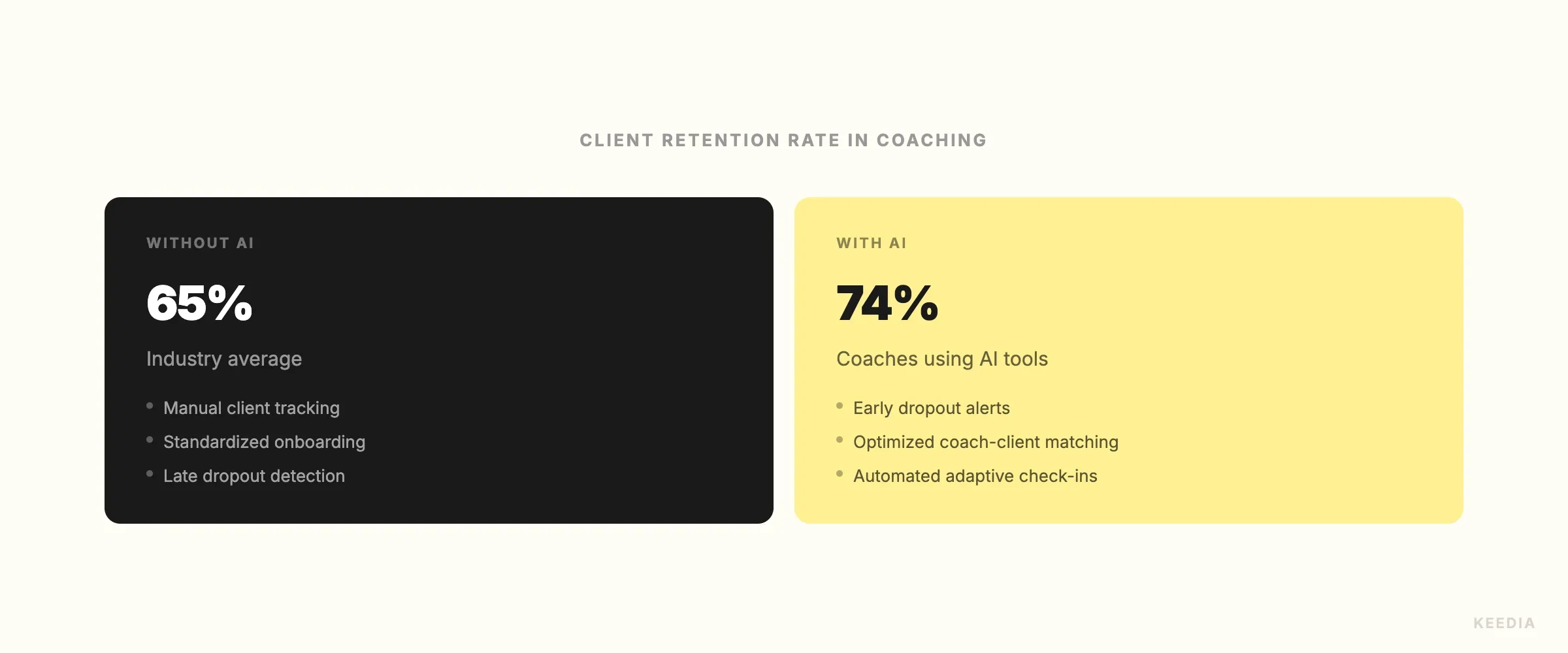
The industry average client retention rate in coaching sits at 65%. For businesses actively using AI tools in their client management, that number jumps to 74%. A 9-point gap doesn't sound dramatic until you run the math on a full client roster over 12 months. Then it changes how you think about everything.
This article isn't a tool roundup. It starts with the retention data and works backward to the mechanisms driving it, because understanding why the gap exists is what lets you close it.
What a 9-Point Retention Gap Actually Costs You
If you carry 40 active clients at $300 per month, the difference between 65% and 74% annual retention is roughly 3.6 clients retained per year. At $300 each, that's over $12,900 in revenue that high-AI-adopting coaches are keeping that lower-adopting coaches are losing. Multiply that across 3 years, factor in referrals from retained clients, and the compounding effect is significant.
Retention isn't just a satisfaction metric. It's a revenue multiplier that most coaches undertrack. For a deeper look at what's actually driving client exits, the analysis in client retention at 90 days: what triggers churn is worth your time before reading further, because the mechanisms overlap closely with what AI tools are now built to address.
The coaching platform market is growing at 11% CAGR between 2026 and 2036, scaling from $4.22 billion to a projected $12 billion. AI is the primary differentiator in that race. The platforms building market share are doing it by turning retention from a relationship skill into a measurable, manageable system.
Why the Gap Exists: Three Mechanisms That Actually Matter
The 9-point retention advantage doesn't come from one feature. It comes from three compounding effects that AI tools have made systematic: better initial matching, more consistent follow-up, and early dropout prediction.
Matching That Prevents Early Dropout
The single biggest driver of early client exits isn't program quality. It's compatibility. When a coach and client are misaligned on communication style, goal framing, or feedback preferences, clients don't usually say so directly. They just stop showing up.
AI matching algorithms built into platforms like CoachAccountable, Nudge, and Practice address this at intake. By analyzing client responses to onboarding questionnaires, communication patterns, and stated preferences, these tools generate compatibility scores that help coaches assign clients to the right coach within a team, or adjust their own communication approach before the first session.
Personality and communication style matching is cited by platform developers and coaches alike as the single largest driver of early-stage retention improvement. When the first session feels like a fit, clients commit to the second. That compounding effect carries through month three, which is where most dropout traditionally concentrates.
Follow-Up That Doesn't Slip Through the Cracks
Seventy-five percent of coaches now rely on client management software for scheduling, payments, and admin. What many don't realize is that the same platforms generating their invoices are also running the AI features making their more tech-forward competitors stickier.
Automated, personalized follow-up. Check-in prompts triggered by behavior patterns. Progress recaps generated from logged data before a scheduled call. These aren't hypothetical features. They're live in tools like Paperbell, TrueCoach, and Delenta, and they solve a problem every coach knows: follow-through consistency is hard to maintain manually across a full client load.
When clients receive consistent, contextually relevant touchpoints between sessions, perceived coach attentiveness goes up without the coach spending more time. That perception directly correlates with renewal decisions.
Early Dropout Prediction
This is where AI earns its most counterintuitive value. Coaches are skilled at reading clients in session. They're less reliable at catching pre-dropout signals across a full roster between sessions, especially when those signals are behavioral rather than verbal.
Platforms with predictive retention features analyze patterns like login frequency, workout completion rates, session rescheduling behavior, and response lag on check-ins. When multiple signals cluster, the platform flags the client as elevated churn risk. The coach gets an alert and can intervene before the client mentally exits.
This shifts retention from reactive to proactive. Instead of responding to a cancellation email, you're having a well-timed check-in conversation that the client experiences as genuine care.
The Tools Coaches Are Actually Using
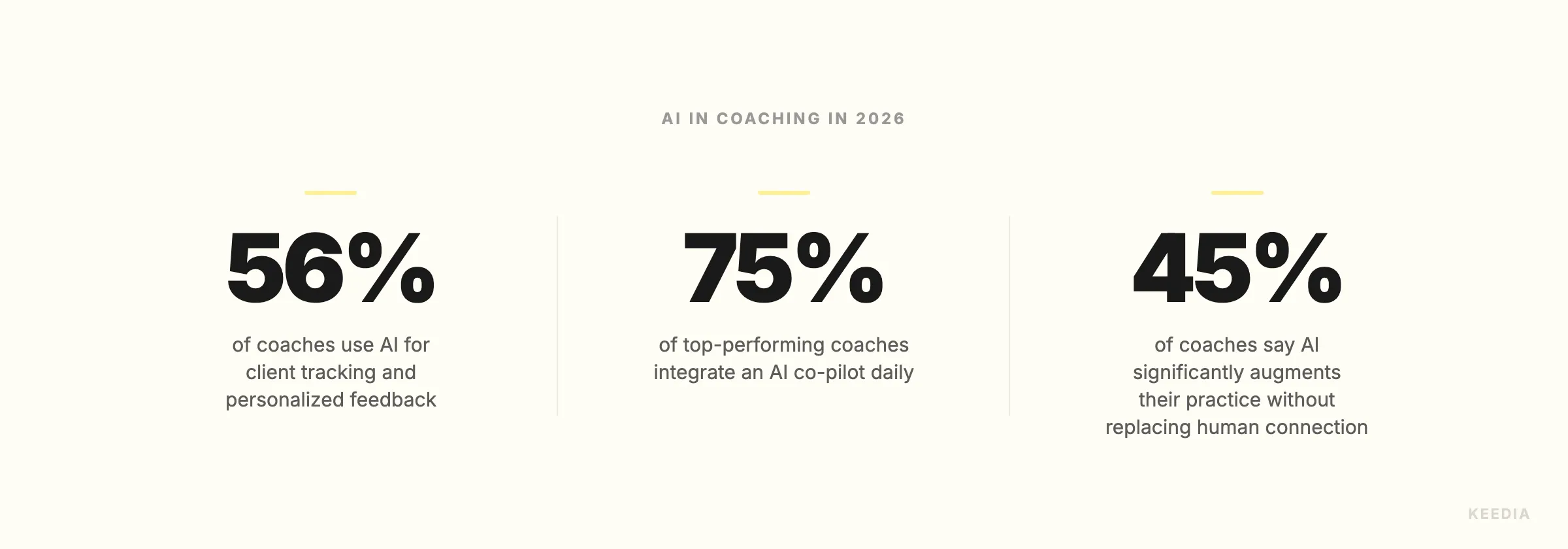
Fifty-six percent of coaches now use AI tools to track client progress and provide tailored feedback. Among high-performing coaching businesses, that number rises to 75% regularly using AI co-pilots as part of their workflow. These aren't coaches who've replaced human judgment with automation. They've built systems that protect their human attention for where it matters most.
Here's what that looks like in practice across the tools with meaningful market presence in 2026:
- TrueCoach: Primarily used in fitness and personal training contexts. AI features include automated progress reporting, habit tracking with behavioral nudges, and workout adherence alerts. The platform generates client-facing summaries that coaches can personalize before sending, saving significant drafting time while maintaining voice.
- CoachAccountable: Strong on accountability workflows. Uses behavioral data from client activity logs to surface engagement risk signals. Coaches receive dashboard views of client momentum scores, making roster-level attention management practical rather than overwhelming.
- Practice: Broader use case across life, business, and wellness coaching. AI-assisted intake matching, session note generation, and follow-up scheduling. The onboarding flow has been specifically designed around compatibility assessment.
- Paperbell: Admin-heavy with embedded scheduling intelligence. Not deep on predictive AI, but handles the operational layer that frees coach bandwidth for relationship work. Often used alongside more AI-forward tools.
- Nudge: Originally built for fitness but expanding. Behavioral tracking with machine learning-driven engagement scoring. Client-facing app with automated coaching prompts between live sessions.
For a broader comparison of what's available, AI tools for coaches: what's actually worth using in 2026 covers the feature-by-feature breakdown. This article is focused on why those features translate into the retention numbers, not just what they do.
The Depersonalization Fear Doesn't Hold Up
The most common objection to AI integration in coaching is that it makes the relationship feel transactional. Coaches worry that automated messages read as automated, that clients can tell the difference, and that perceived inauthenticity will cost more in trust than the efficiency gains are worth.
The retention data doesn't support that fear. Forty-five percent of coaches report that AI "significantly augments" their practice without replacing human connection. More telling, the coaches using AI tools most heavily are not showing lower client satisfaction scores. They're showing higher retention rates, which is the most direct behavioral measure of client satisfaction available.
The mechanism makes sense when you think it through. AI handles the operational layer: reminders, progress summaries, scheduling, intake processing. That frees the coach to be more present in actual sessions because they're not mentally tracking who they need to follow up with, who's behind on their homework, or who might be slipping. The human bandwidth gets redirected to human moments. Clients experience more of the coach's real attention, not less.
This dynamic parallels what the broader fitness industry is navigating. As covered in the State of Personal Training in 2026: Numbers, Trends and What's Changing for Coaches, the trainers and coaches seeing the strongest business outcomes are those who've learned to layer technology under their human offer rather than seeing it as competitive with it.
Revenue Implications for Your Business Model
The retention math gets more interesting when you factor in pricing. Coaches with systematized, AI-supported client journeys are reporting stronger ability to hold and raise rates, because the consistency of the experience justifies premium positioning.
There's a related dynamic in how clients perceive value when follow-up is reliable and progress is visibly tracked. A client who receives a weekly AI-generated progress summary, contextualized with their own historical data and personalized with coach commentary, experiences a richer service than one receiving generic check-in emails. That perceived richness supports higher price tolerance.
The relationship between structured delivery and rate integrity is worth understanding on its own terms. Pricing psychology: why raising rates gets better results explores the counterintuitive evidence that pricing confidence and program structure are more predictive of client commitment than rate levels themselves.
If you're running a solo practice, the retention improvement from AI adoption doesn't require enterprise-level tooling. A $50 to $150 per month investment in a platform with built-in AI features, applied to a client roster of 20 to 40 clients, can realistically return the equivalent of two to four additional client months per year through reduced churn. The ROI math is not complicated.
What This Means If You're Not Using AI Tools Yet
The 9-point retention gap between AI-adopting and non-adopting coaching businesses is not primarily a technology gap. It's a systems gap. The coaches closing it aren't necessarily more tech-savvy. They've built more consistent client experiences, and the consistency is being maintained at scale by tools that don't forget, don't get tired, and don't miss the behavioral signals that precede dropout.
You don't need to automate everything. You need to identify the three or four points in your client journey where inconsistency most often creates distance, and address those specifically. Onboarding compatibility. Mid-program check-in frequency. Progress visibility. Re-engagement timing when activity drops.
Those are exactly the points where current AI tools are delivering measurable outcomes. The retention data is telling you where the leverage is. What you do with it is still your call.