
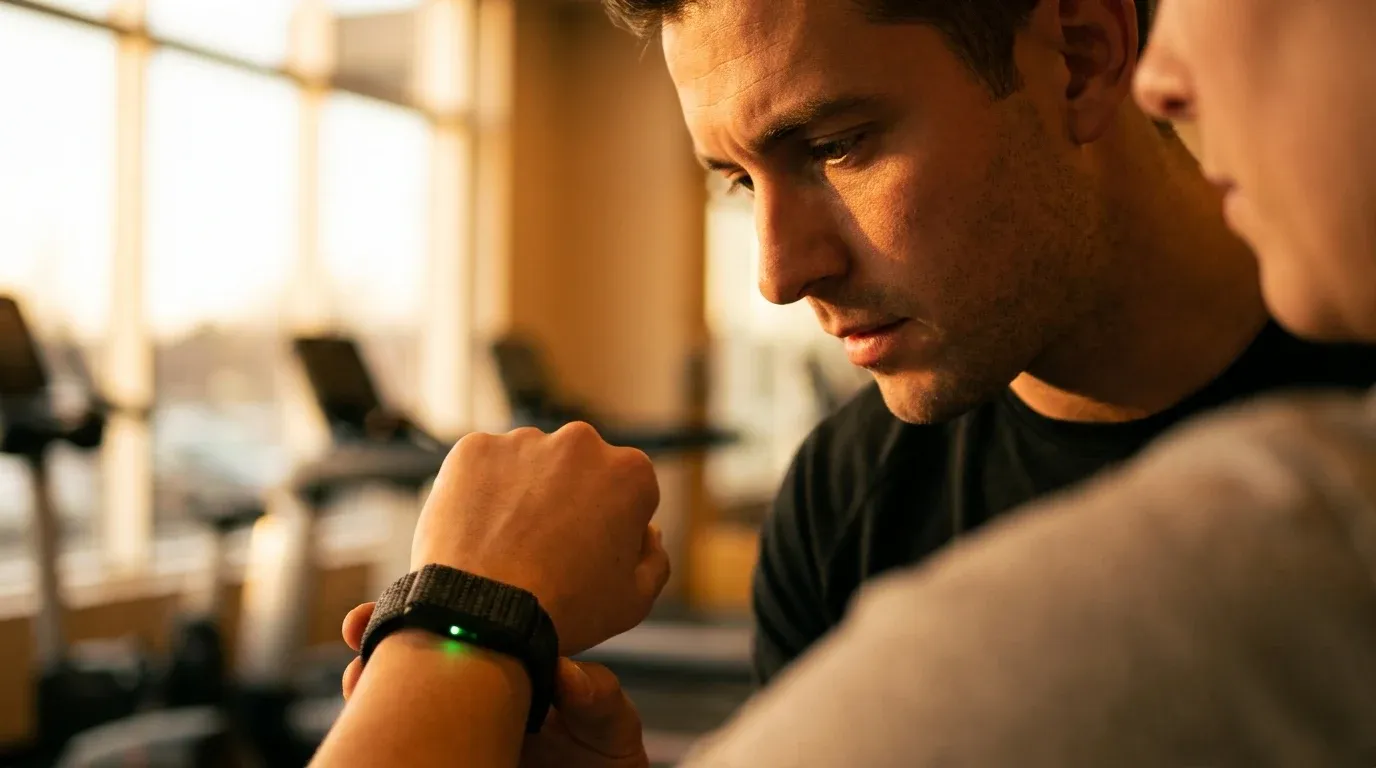
Whoop tells you your body is under-recovered. Oura says your readiness score is 61. Apple Watch flags an elevated resting heart rate. The data streams in constantly, and for millions of users, it arrives with a recommendation attached. Train. Rest. Breathe. Sleep more.
This is AI coaching. And depending on who you ask, it's either the future of personal fitness or a sophisticated-looking shortcut that misses most of what actually changes people's lives.
The honest answer sits somewhere between those positions. But getting there requires understanding exactly what these tools can and cannot do, and why that gap represents one of the biggest opportunities in professional coaching right now.
What AI Wearables Actually Do Well
Let's give credit where it's due. Devices like Whoop, Oura, and Garmin have made continuous physiological monitoring accessible at a consumer level. Heart rate variability, sleep architecture, blood oxygen saturation, skin temperature variance. This is data that, a decade ago, would have required a sports science lab.
The feedback loop is genuinely useful. When a client can see their HRV crash after three consecutive nights of poor sleep, the connection between recovery and performance becomes concrete rather than theoretical. Behavior change research consistently shows that people respond better to immediate, visible feedback than to abstract advice. Wearables deliver that feedback at scale.
AI-powered recommendations built on top of this data have also improved considerably. Strain management algorithms, readiness-based training load suggestions, and recovery pacing tools are no longer just rough approximations. For general population users managing moderate activity levels, they provide real, actionable guidance.
So yes. AI coaching via wearables works. To a point.
Where the Algorithm Hits a Wall
Here's what an algorithm cannot do. It cannot ask you why your sleep scores have been declining for two weeks. It cannot recognize that your elevated cortisol readings correlate with a job transition you mentioned last month. It cannot notice that you've been canceling sessions and adjust its approach accordingly.
Behavioral psychology research is unambiguous on this: sustained behavior change requires more than data. It requires accountability structures, motivational alignment, identity-level coaching, and the ability to navigate setbacks in real time. A wearable cannot build a therapeutic alliance. It cannot distinguish between a client who needs to be pushed and one who needs permission to rest.
There's also the interpretation problem. A readiness score of 58 means something very different for an elite CrossFit athlete peaking for a competition than it does for a 45-year-old executive managing chronic stress. The same number. Completely different implications. Context is not a feature you can train into a general-purpose algorithm, and AI coaching systems that ignore this distinction can actively lead users toward poor decisions.
This is the black box problem. The output looks authoritative. The user trusts it. But the logic behind it is opaque, built on population-level models that may have nothing to do with that individual's specific physiology, history, or goal structure.
The Client Is Arriving Better Informed. Are You Ready?
One underappreciated consequence of the wearable boom is what it's doing to client literacy. People walking into coaching relationships today often have months or years of biometric data on their phones. They know their average HRV. They've read about training load. They're asking questions coaches weren't fielding five years ago.
This is broadly a good thing. A client who understands the relationship between sleep and performance is a more engaged, more coachable client. But it also raises the bar for coaches. If you can't speak fluently to what a client's wearable is telling them, you're going to struggle to position yourself as the expert in the room.
Data literacy is now a professional competency. Understanding how to read HRV trends, interpret sleep stage data, and contextualize strain scores within a periodized training plan is no longer optional for coaches who want to work with motivated, health-literate clients. As outlined in When 64% of Trainers Use AI, What Actually Makes You Indispensable?, the coaches who thrive in this environment are the ones who integrate technology fluency with the human skills that technology can't replicate.
Ignoring this shift doesn't protect you. It just hands an advantage to whoever is willing to adapt.
How Human Coaches Are Winning With Wearable Data
The most effective coaching model emerging from this landscape isn't human versus AI. It's human plus AI, with clear roles assigned to each.
Coaches who integrate wearable data into their sessions are using it as a conversation starter rather than a verdict. A low readiness score at the start of a session opens a discussion about what's driving it. A week of declining HRV trends becomes a structured check-in on stress load, nutrition, and sleep hygiene. The data doesn't replace the coach's judgment. It gives the coach better raw material to work with.
Practically, this looks like requesting clients share their wearable data before sessions, building session structure partly around current recovery metrics, and using trend lines over multiple weeks to identify patterns that a single data point would miss. For coaches working in longevity, performance, or executive wellness spaces, this approach is increasingly table stakes. Longevity Coaching: How to Build a Premium Offer That Sells on Different Terms explores how this kind of integrated, data-informed approach allows coaches to justify premium pricing structures that generic AI tools simply can't compete with.
The financial signal is already there. Coaches who position themselves as wearable-fluent and data-integrated are charging $200 to $400 per session in urban US markets, well above the national average. The value proposition is clear: the client gets AI-grade data analysis plus the human judgment and accountability structure that the algorithm can't provide.
The Risks Coaches Need to Know
There are real risks in leaning too heavily on wearable data, and coaches need to be aware of them.
First, wearable accuracy has limits. Consumer-grade optical heart rate sensors, for example, are less reliable during high-intensity interval work than during steady-state cardio. HRV measurements taken at inconsistent times or under varying conditions can produce misleading baselines. Coaches should communicate these limitations clearly to clients rather than treating device output as ground truth.
Second, there's a psychological risk sometimes called "metric obsession." Some clients, particularly those prone to anxiety, can become overly fixated on daily readiness scores in ways that increase rather than reduce stress. Coaches working with clients who show these tendencies should be deliberate about how much emphasis they place on daily fluctuations versus longer-term trends. Recovery science supports a weekly or biweekly review of trend data rather than daily score chasing. Recovery in 2026: The Strategies That Actually Work offers a useful framework for thinking about sustainable recovery protocols that work alongside, not against, wearable monitoring.
Third, clients may conflate wearable recommendations with medical advice. This is a boundary coaches need to maintain actively. Wearables can flag patterns. They cannot diagnose. If a client's data consistently suggests something outside the normal training response, the appropriate step is a referral to a medical professional, not a deeper algorithm interrogation.
Your Value Proposition Just Got Clearer
The broader narrative around AI and coaching often defaults to anxiety. But the evidence points somewhere more useful. AI coaching tools are expanding the market for health optimization services, not replacing professional coaches. They're creating clients who are more engaged, more data-literate, and more willing to invest in expertise, provided that expertise is demonstrably better than what an app delivers.
That's the real opportunity. Not to compete with Whoop's AI on its own terms, but to show clients exactly what $35 a month in subscription fees cannot give them. The behavioral accountability. The real-time contextual judgment. The relationship that makes the hard weeks navigable. The long-term program design that treats their physiology as an individual case study rather than a population average.
Coaches who are struggling to articulate this value proposition clearly, or who are losing potential clients to the perception that AI tools are "good enough," should examine how they're presenting their offer. 4 in 5 Trainers Struggle to Find Clients: The Fix addresses exactly this challenge, with practical positioning strategies for coaches navigating a technology-saturated market.
The black box critique of AI coaching is valid. But the response to it isn't skepticism toward technology. It's investing in the skills and frameworks that make human coaching irreplaceable: behavioral psychology, individualized programming, data-informed but judgment-led decision making, and the kind of trust that no algorithm has yet figured out how to replicate.
Wearables will keep getting smarter. The coaches who pair their own expertise with that data will stay ahead. The ones who ignore it will find the gap closing faster than they expected. Your move is not complicated. Show up fluent in the data your clients are already carrying in their pocket, and then deliver what the device can't. That's not a defensive play. It's a genuine competitive edge.