
A study that arrives at exactly the right moment
The question many coaches are asking in 2026: is AI going to replace their profession? ChatGPT can generate a training program in 30 seconds. Apps offer 'personalized' plans for a few dollars a month. Why would a client pay $60, $80, or $150 an hour to a coach when they can get a complete program in a few clicks?
A study published in PMC in 2026 brings real data to this debate. Researchers asked generative AI systems to create resistance training programs for muscle hypertrophy and maximal strength, then submitted those programs to rigorous professional assessment. The findings are nuanced — and very instructive for coaches.
The verdict: mediocre to adequate, with systematic gaps
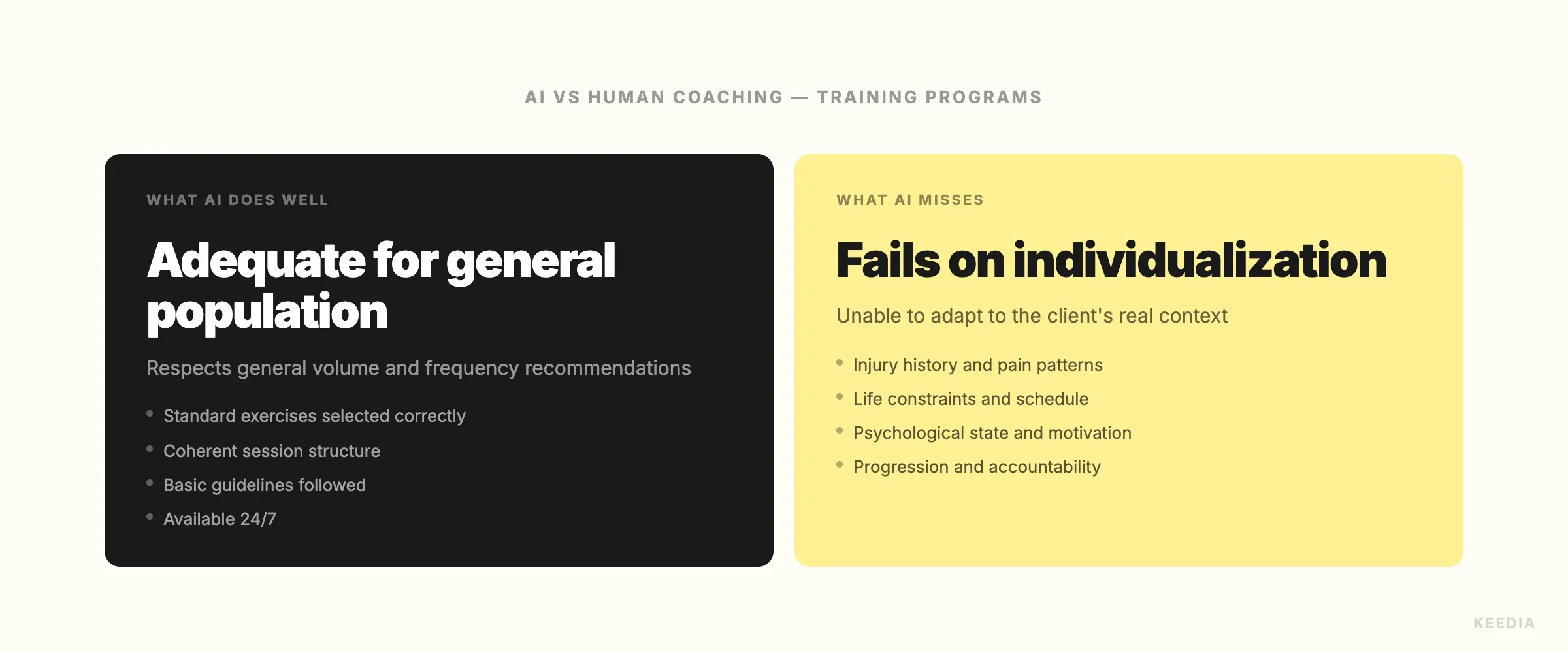
AI-generated programs scored mediocre to adequate in professional assessment. It's not a total failure — AI systems correctly incorporated many general recommendations on volume, frequency, and exercise selection. For a hypothetical 'average' individual with no particular history, the programs were often acceptable.
But the gaps were systematic and revealing:
- AI programs didn't account for injury history — an absolutely critical factor in real coaching programming.
- Progressive overload was often generic or poorly calibrated to the client's actual starting level.
- Programs completely ignored real-life constraints: busy schedules, limited equipment access, chronic fatigue.
- Psychological adaptation — motivation, the coaching relationship, commitment — was by definition absent.
What this means for coaches: a clarification, not a threat
The real risk AI poses to coaching isn't what most coaches imagine. It's not "AI will do my job better than me." It's "some clients will try AI, get a mediocre but adequate program, abandon it after a few weeks without accountability, and never come back to a coach."
That's a different risk — requiring a different response. The response isn't to be better at programming than ChatGPT. It's to be irreplaceable on everything AI can't do: the relationship, adaptive progression, accountability, and understanding real human context.
The 2026 coaching industry report data confirms that the coaches performing best in 2026 don't position themselves as 'program makers.' They position themselves as transformation partners. That's a distinction no algorithm can replicate.
How to use AI as a tool, not a competitor
The best approach in 2026 isn't AI or human. It's AI AND human. In practice:
AI can generate a first program draft in seconds. Coaches can use that draft as a starting point, modify it for the client's real context, and use the time saved on relationship and follow-up.
AI tools can analyze wearable data — HR, recovery, sleep — and suggest load adjustments. The coach interprets those suggestions in the human context and makes the final call.
Chatbots can answer basic client questions between sessions. The coach handles complex questions, moments of discouragement, and program adjustments that require judgment.
In short: AI saves time on mechanical tasks. The coach reinvests that time in what actually creates value — the relationship and the adaptation. That's the model that will dominate the next few years.
The value the study can't measure
One final thing the study doesn't say — but may be the most important: clients don't stay with a coach because the program is perfect. They stay because they feel understood, because someone sees their progress, because someone is expecting them at their next session.
AI can generate a 10-week program in 30 seconds. It can't check in on Wednesday morning to ask how Tuesday's session went.