
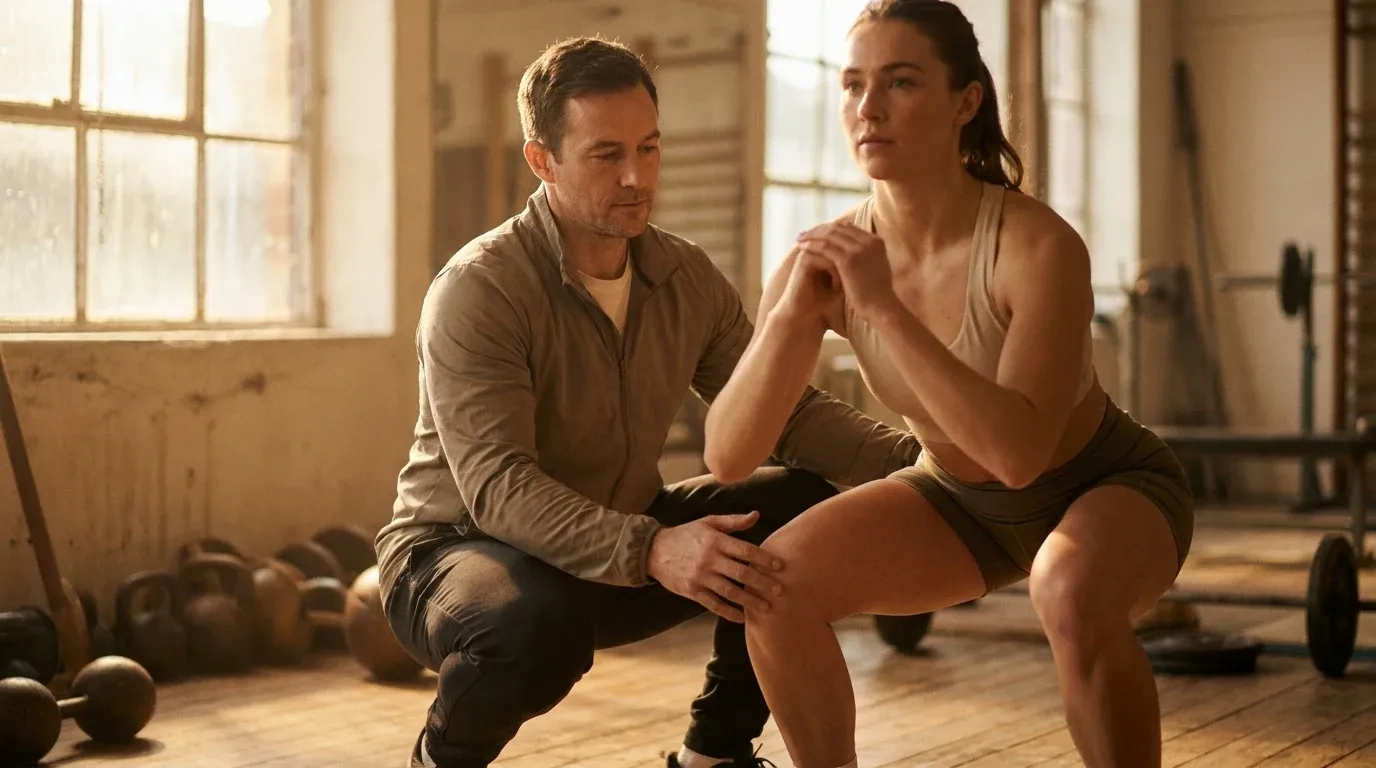
Most coaches learn to correct movement the same way they learned to move themselves. They watch an athlete squat or hinge, something looks off, and they offer a cue based on what worked for them years ago. It's intuitive, it's fast, and it misses a significant amount of what's actually happening at the joint level.
A biomechanical framework built around fulcrum-and-lever principles changes that. It gives you a repeatable, science-backed method to assess movement, catch injury risk before it becomes injury, and translate what you see into cues clients can use immediately. No physics degree required.
Why Small Form Errors Cause Big Joint Problems
The human body operates on lever systems. Every joint is a fulcrum. The bones acting across it are levers. The muscles pulling on those levers generate force. And like any lever system, small changes in load position or angle produce disproportionately large changes in the force required to maintain control.
Here's the practical version: when a client's knee tracks even slightly inward during a squat, the mechanical load on the medial compartment of the knee doesn't increase by a small amount. Research has shown that even a modest valgus collapse can increase joint contact forces by 20 to 30 percent. Repeat that over hundreds of repetitions across months of training, and you've built a reliable pathway to a patellofemoral or ACL injury, neither of which announces itself until it's too late.
The same logic applies at the shoulder. A client pressing overhead with the humerus positioned forward of the scapular plane shifts the lever arm of the rotator cuff muscles. The supraspinatus has to generate significantly more force to maintain the head of the humerus in the glenoid socket. It's a small positional error. The cumulative stress is not small at all.
This is why pain-based feedback is a poor coaching tool. By the time a client reports discomfort, the tissue has already been accumulating load beyond its capacity for weeks or months. Biomechanical assessment catches the lever imbalance before the tissue starts to fail.
What Biomechanical Screening Actually Catches
Self-reporting misses injury risk for a straightforward reason: clients don't feel compensation patterns. The body is extraordinarily good at redistributing load across adjacent structures. When the primary mover is compromised or weak, a synergist steps in. The movement gets done. Nothing hurts. The client tells you everything feels fine. The coach who relies on that feedback walks away satisfied.
But the synergist wasn't designed to carry primary load long-term. It degrades faster than the structure it's substituting for. And when it finally fails, the breakdown looks sudden and unpredictable, even though it was visible in the movement pattern from the start.
A structured biomechanical screen makes compensation patterns visible. Watching a client perform a single-leg Romanian deadlift, for example, reveals how load is distributed between the posterior chain, the hip stabilizers, and the lumbar extensors. A client who lists to the contralateral side under load isn't just "weak on one side." Their hip abductors are failing to hold the lever arm of the pelvis, so the lumbar spine is compensating by laterally flexing. That's a pattern. It has a name, a mechanical explanation, and a correction.
Coaches working with older populations should pay particular attention here. Research consistently shows that movement compensations accumulate silently over decades, and that structured movement assessment before programming is among the most effective tools for keeping training sustainable long-term. If you work with clients over fifty, Strength Training After 50: What Experts Actually Recommend covers the programming side of that equation in detail.
Three movement patterns reveal the most about compensation during a quick initial screen:
- Bodyweight squat: Watch for knee valgus, forward lean beyond functional range, and heel rise. Each deviation maps to a specific lever imbalance.
- Single-leg stance: A Trendelenburg sign (contralateral hip drop) indicates gluteus medius weakness, which loads the IT band and the lumbar spine above it.
- Overhead reach: Observe whether the thoracic spine extends appropriately or whether the lumbar spine hyperextends to compensate for restricted t-spine or shoulder mobility.
None of these require specialized equipment. They require a coach who knows what they're looking at and why it matters.
Turning Lever Principles Into Coaching Cues
Understanding fulcrum-and-lever mechanics is only useful if you can communicate it to a client who has never thought about a moment arm. The good news is that lever principles translate directly into physical cues. You don't explain the physics. You produce the correct joint position.
Take the deadlift. The spine acts as a long lever with the lumbar vertebrae as the fulcrum. When a client rounds the lumbar spine at the start of the pull, they extend the effective lever arm against which the erector spinae must pull. The force demand on those muscles increases sharply. The cue "protect your lower back" produces nothing useful. The cue "drive the floor away with your heels and show me your chest" changes the spinal position mechanically without requiring the client to understand spinal mechanics at all.
Cues that work with lever principles rather than against them tend to share a few characteristics:
- They're positional, not effort-based. "Push your knees out" changes the lever arm at the hip. "Try harder" doesn't.
- They redirect force rather than demand more of it. "Pull the bar into your hips as you stand" changes the load path on a deadlift without asking for more exertion.
- They're simple enough to hold under fatigue. Complex multi-step cues fail when a client is on their fifth set. One clear image or action survives.
For coaches working with beginners, building this foundation early is significantly more efficient than correcting entrenched patterns later. The early weeks of training are when movement habits form, and when biomechanical coaching has its highest return on investment. How 6 Weeks With a Trainer Builds Real Gym Confidence explores why that initial coaching window shapes long-term training behavior.
Building a Repeatable Assessment Protocol
The practical challenge with biomechanical screening is consistency. When coaches assess by feel, two coaches watching the same client often identify different problems. That inconsistency undermines both client trust and your ability to measure progress over time.
A repeatable protocol removes that variability. It doesn't need to be long. A five-to-ten-minute movement screen performed at intake and then at regular intervals creates a movement baseline. Changes become measurable. You can track whether an intervention actually changed the compensation pattern, not just whether the client feels better.
Structure your protocol around three or four loaded and unloaded movements. Assess from multiple angles where possible. Front-on reveals frontal plane deviations like knee valgus and lateral trunk shift. Lateral view shows sagittal plane issues: forward lean, lumbar flexion, hip shift. Note what you see in writing. Subjectivity creeps in the moment you're relying on memory.
The value of this approach compounds over time. A client who trains consistently for a year leaves behind a documented movement history. You can see exactly when a compensation appeared, correlate it with a program change or a load increase, and intervene before the tissue cost becomes significant. This is the kind of longitudinal coaching insight that separates a practice built on evidence from one built on habit.
It's also worth noting that the benefits of this approach extend well beyond injury prevention. Movement quality directly affects training efficiency. A client squatting with optimal lever mechanics loads the target muscles more effectively, which means better hypertrophy and strength outcomes per session. The same framework that protects joints also improves results. Research on longevity and training volume consistently finds that staying in the sport long enough to accumulate quality work is what drives the best outcomes, and Strength Training's Longevity Sweet Spot: What Science Found breaks down exactly what that looks like in practice.
The Bigger Picture for Coaches
Injury prevention is often framed as risk management. It's that, but it's also a performance argument. Every injury your client avoids is weeks or months of training they don't lose. Research on detraining shows that fitness losses begin within two weeks of stopping training and that strength can decline measurably within three to four weeks. You can read the specifics in How Fast Do You Actually Lose Fitness When You Stop?. The arithmetic is simple: keeping clients healthy keeps them progressing.
Coaches who adopt a biomechanical framework also differentiate themselves in a crowded market. The US personal training industry generates over $14 billion annually, and clients increasingly expect more than motivation and programming. They expect expertise. A coach who can explain why a movement pattern is creating risk, show it in the client's own movement, and correct it with a single cue is delivering something most coaches can't.
You don't need to overhaul everything you do. Start with the intake screen. Add three standard movement assessments. Learn the lever logic behind the five or six most common compensation patterns you see. Then build cues that address the mechanical root, not the symptom on the surface.
The clients who stay healthy, keep training, and reach their goals are the clients who refer others and stay with you for years. That outcome starts with seeing their movement clearly from the first session.