
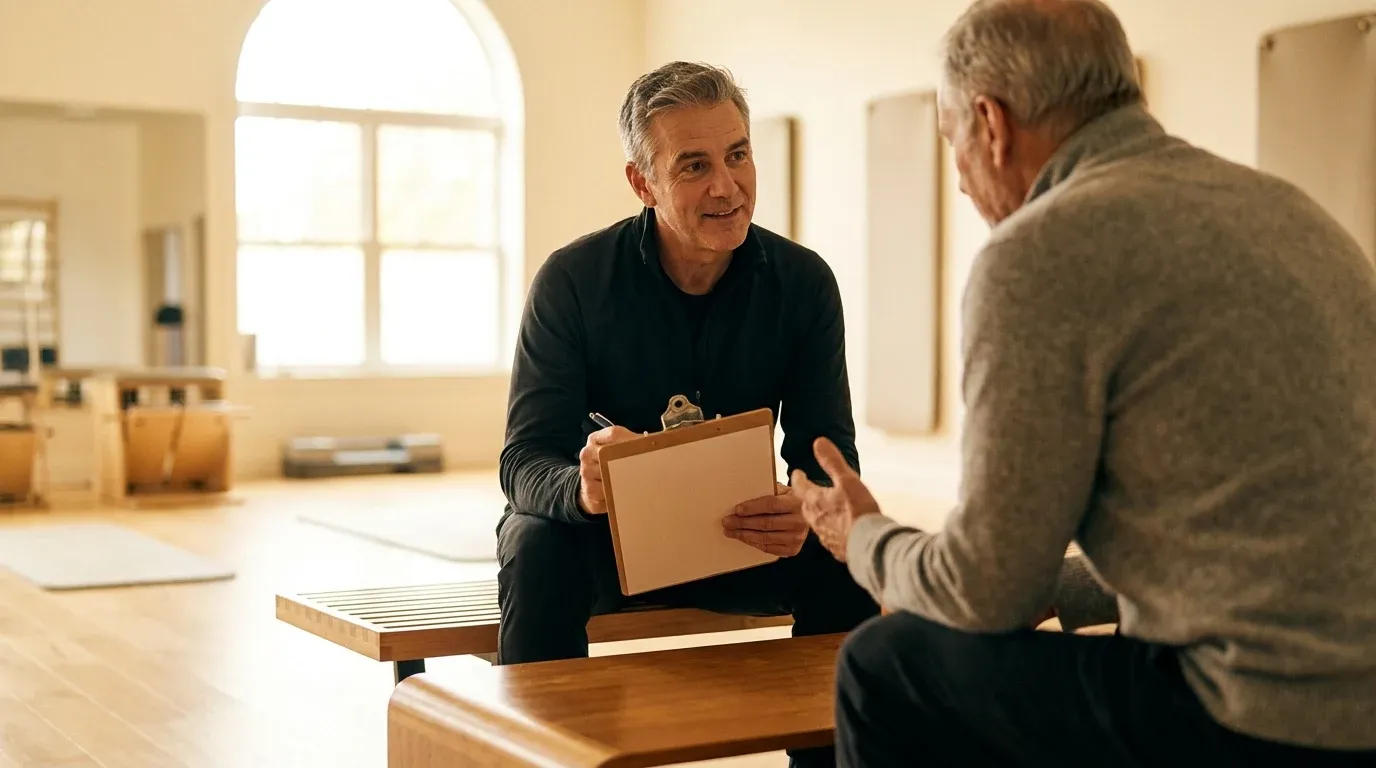
Finding a personal trainer after 50 is a different process than it was at 30. The priorities have shifted, the margin for error is smaller, and the questions you need to ask before committing to anyone are more specific. This isn't about lowering your expectations. It's about raising the right ones.
The good news is that working with a trainer in your 50s, 60s, or beyond can be genuinely transformative. Research consistently shows that strength training in older adults improves bone density, reduces fall risk, and supports metabolic health. But getting there requires matching yourself with someone who understands how physiology changes with age, not just someone who can design a hard workout.
Why Goal-Based Matching Matters More After 50
At 30, you can absorb a lot of training errors. Poor programming, insufficient recovery time, skipping mobility work. Your body compensates. After 50, that buffer shrinks. Recovery takes longer, connective tissue is less forgiving, and pushing intensity without structure carries a steeper cost.
This is why the first filter in your trainer search shouldn't be price or proximity. It should be whether the trainer has explicit experience working with adults in your age range. Not just "all fitness levels" listed on a website, but documented work with older clients around goals like maintaining functional strength, managing joint health, or returning to exercise after a long break.
Goal alignment also determines how a trainer will structure your program from week one. A trainer whose default is high-intensity interval training or heavy powerlifting cycles may not be wrong for every 50-year-old, but they need to demonstrate that they'll adapt their approach to your baseline, not assume you'll adapt to theirs. 4 Things Great Personal Trainers Do Differently outlines exactly how the best coaches adjust their methods based on the individual rather than defaulting to a one-size-fits-all template.
What a Good First Assessment Actually Looks Like
Before a single workout is designed, a trainer worth working with will gather information. Not just a health history form, but a real conversation and physical evaluation. This is where you separate trainers who are genuinely qualified to work with older adults from those who are not.
A thorough first session should cover three areas.
- Current fitness level and movement capacity. This includes basic strength tests, balance assessments, and mobility screening. A sit-to-stand test, single-leg balance hold, and shoulder range-of-motion check are simple but revealing. They tell a trainer where you are today, not where you were ten years ago.
- Exercise history and injury background. Have you had a knee replacement? A rotator cuff repair? Chronic lower back issues? This context shapes every exercise choice going forward. A trainer who doesn't ask about it in session one is missing critical information.
- Preferred training environment and schedule constraints. How you train consistently is more important than how you train perfectly. A trainer who understands your logistics, whether that's limited commute time, a home gym setup, or a preference for morning sessions, is more likely to build something sustainable.
What Great Coaches Actually Do in Session One goes deeper on how effective trainers use that initial meeting to build a program foundation, not just test the waters.
Strength, Balance, and Mobility Are Non-Negotiables
If you're evaluating a trainer and they can't clearly articulate how they'll address these three areas, that's a signal to keep looking.
Strength is the foundation. Muscle mass declines at roughly 3 to 5 percent per decade after 30, and that rate accelerates after 60. Resistance training is the most effective tool for slowing that decline. Any trainer working with adults over 50 should have a clear framework for progressive overload that doesn't compromise joint safety.
Balance becomes a clinical priority as you age. Falls are the leading cause of injury-related death among adults 65 and older in the United States. Balance training, including single-leg work, proprioceptive exercises, and dynamic stability drills, should be integrated into sessions, not treated as an afterthought.
Mobility affects everything else. Limited hip mobility compromises your squat mechanics. Restricted thoracic rotation affects your posture and shoulder function. A trainer who skips mobility work to save time is building on a deteriorating foundation. Ask specifically how they incorporate mobility into their programming, not just as a warm-up, but as a trainable quality in its own right.
Building these habits outside of formal sessions matters too. The 10-Minute Daily Habit That Protects Muscle After 40 covers a simple approach you can layer into your routine between sessions to maintain what you're building in the gym.
Certifications and Specializations to Look For
Not all personal training certifications are equal, and a general certification from a major accrediting body is a starting point, not a guarantee of competence with older adults. When you're evaluating trainers, ask about additional credentials that speak directly to your demographic.
Relevant specializations include certifications in senior fitness, corrective exercise, or functional movement. Organizations like the National Academy of Sports Medicine (NASM), the American Council on Exercise (ACE), and the National Strength and Conditioning Association (NSCA) all offer advanced credentials in these areas. A trainer who has pursued that continuing education has made a deliberate choice to serve this population well.
Beyond credentials, ask for references or case studies from clients in a similar age range and with similar goals. Testimonials from 28-year-olds training for their first marathon don't tell you much about how this trainer handles a 58-year-old managing osteoarthritis and returning to exercise after a decade off.
Training Location Options That Actually Work After 50
One underestimated barrier to consistent training for adults over 50 is logistics. Driving to a gym three times a week sounds simple until you factor in work schedules, caregiving responsibilities, mobility limitations, or simply the mental friction of commuting to a facility you don't love.
The expansion of in-home and online personal training has made quality coaching genuinely accessible in ways it wasn't a decade ago. Here's how to think about each option.
- In-gym training gives you access to equipment variety and direct hands-on coaching. For those learning new movement patterns, having a trainer who can physically adjust your position has real value. Gym-based sessions with a certified trainer in the US typically run between $60 and $120 per hour, depending on the market and the trainer's experience level.
- In-home training removes the commute and lets your trainer work around what you actually have available. For older adults who prefer privacy, have limited mobility affecting their commute, or simply do better training in a familiar environment, this format often produces more consistent attendance. In-home trainers typically charge a slight premium for travel, bringing the range to $80 to $150 per session.
- Online coaching has matured significantly. Video-based sessions allow real-time coaching and feedback, and asynchronous programming models let you work on a trainer's schedule you can flex around your own. Quality online personal training programs typically run $150 to $400 per month for ongoing coaching, though full-service options with daily check-ins and custom programming can reach $500 per month or more.
The format that keeps you showing up consistently is the right format. Don't let the idea of a "proper" gym environment push you into a setup that doesn't fit your life.
Red Flags to Walk Away From
Some warning signs are universal across all clients. Others are particularly relevant for adults over 50.
- A trainer who skips the assessment and jumps straight to programming is skipping the most important step.
- Anyone who dismisses your injury history or tells you to "just push through" joint pain is not someone you want managing your health.
- Trainers who default to the same generic program for every client regardless of age, history, or goal are not doing individualized coaching.
- Pressure to commit to long-term packages before you've completed even a trial session is a sales tactic, not a fitness strategy.
A trainer who is genuinely right for you won't feel threatened by your questions. They'll welcome them.
How to Start the Search
Start by getting specific about what you want. Not "get in shape" but something like: build enough leg strength to hike comfortably, improve balance to feel steady on uneven ground, or develop a sustainable resistance training routine you can maintain for the next decade. Specific goals attract specific expertise.
Then ask your primary care physician or a physical therapist for referrals. These professionals often work alongside trainers and can point you toward someone they trust with older clients. Online trainer directories through NASM, ACE, or the American College of Sports Medicine (ACSM) let you filter by specialty and location.
Plan for a discovery call or initial consultation before committing financially. Most qualified trainers offer a brief introductory conversation at no cost. Use it to ask about their assessment process, their experience with your demographic, and how they'd approach your specific goals.
The right trainer after 50 isn't the hardest trainer, or the most credentialed trainer, or even the most expensive one. They're the trainer who takes your current reality seriously, builds from where you actually are, and earns your consistency by making sessions feel worth showing up for.