
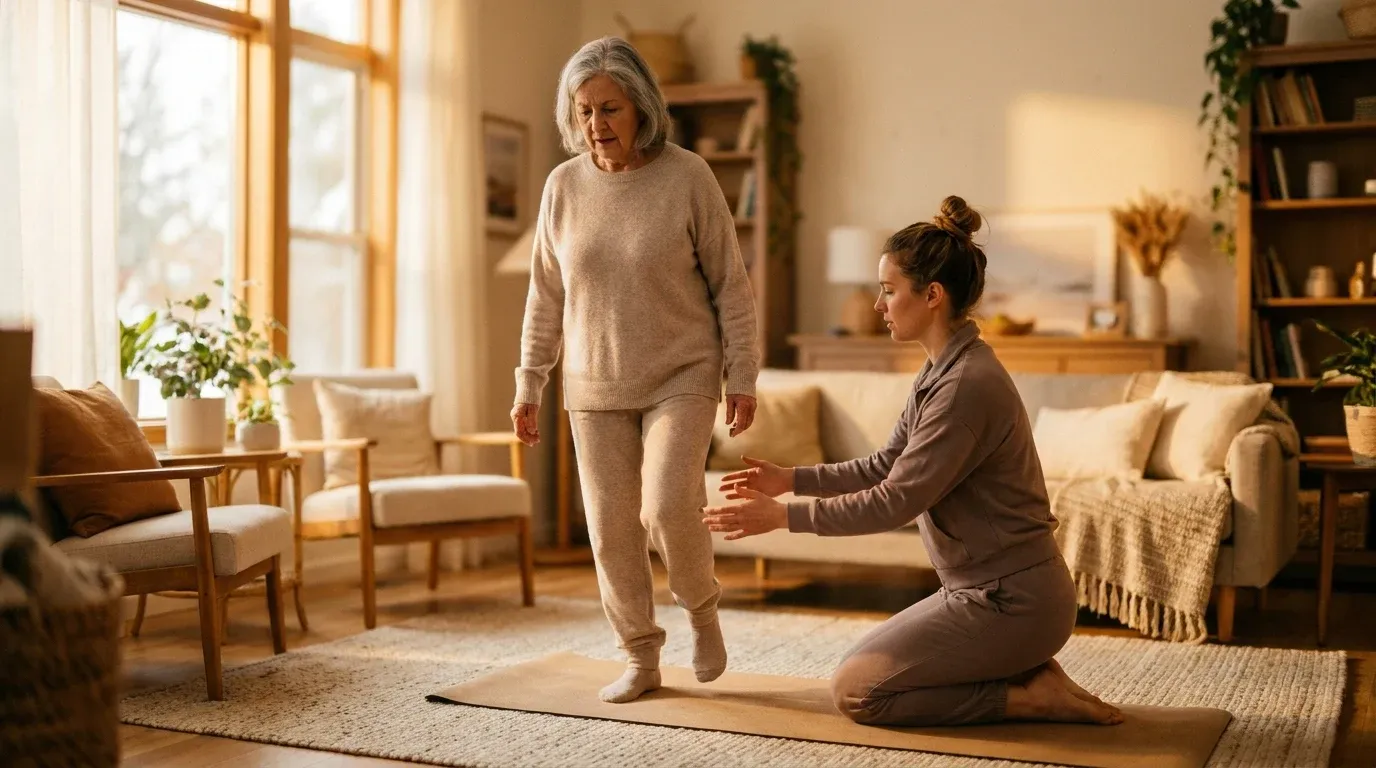
Most fitness content assumes you're the one doing the shopping. You know your goals, your schedule, your budget. But a growing number of adult children are now navigating something entirely different: finding a qualified trainer for a parent who is 65, 75, or even 85 years old, living alone or in a care setting, and dealing with a body that has very specific needs.
This guide is for you. Not for your parent's trainer. For you, the person making the calls, comparing credentials, and trying to figure out what "senior fitness specialist" actually means in practice.
Why General Fitness Credentials Aren't Enough
A personal trainer certified through NASM or ACE is qualified to work with a broad population. That does not make them qualified to work with an 80-year-old with mild osteoporosis, a history of falls, and limited range of motion in both knees. The programming requirements are genuinely different.
Fall prevention training has become one of the fastest-growing specialties in the coaching industry. According to the CDC, falls are the leading cause of injury-related death among adults 65 and older in the United States. More than 36 million falls are reported each year in that age group. Trainers who specialize in this area build sessions around balance, proprioception, gait stability, and reactive strength. These are not skills that come standard with a general fitness certification.
Look specifically for trainers who hold credentials such as the National Academy of Sports Medicine's Senior Fitness Specialization, the American College of Sports Medicine's Certified Exercise Physiologist designation, or the Functional Aging Specialist (FAS) certification from the Functional Aging Institute. These programs require coursework in age-related physiology, fall risk screening, and adaptive exercise design.
The broader shift in how trainers are trained is also worth noting. As the role of a personal trainer evolves toward longevity-focused coaching, more practitioners are developing fluency in chronic disease management, mobility decline, and age-specific goal-setting. That's the direction you want to be moving in when searching for your parent's trainer.
In-Home Training Is Often the Most Practical Option
Getting an older adult to a gym consistently is a significant logistical and motivational challenge. Transportation, weather, parking, locker rooms, and unfamiliar equipment all create friction. For many aging parents, that friction is enough to make the whole arrangement collapse within a few weeks.
In-home trainers remove most of that friction. They come to your parent's space, assess what's available, and build a program around it. A good senior-focused in-home trainer will work with a dining room chair, a hallway for walking drills, a set of light resistance bands, and whatever floor space exists. They're not expecting a home gym.
What they will do is conduct a genuine environmental assessment. That means identifying fall hazards in the home, understanding which rooms have adequate clearance, and noting whether there's a bed, couch, or sturdy table that can be safely used for support during standing exercises.
In-home senior training typically runs between $70 and $130 per session in most US markets, depending on location and credential level. That's comparable to general personal training rates, but the expertise you're paying for is considerably more specialized. Some trainers offer packages of 8 to 12 sessions that bring the per-session cost down slightly and help establish a consistent routine.
Platforms That Connect Families With Senior Trainers
Finding a qualified trainer through a general search can be hit or miss. Several platforms have emerged specifically to address the senior fitness gap, making it easier to filter by specialization, location, and experience level.
ElderFIT is one of the more established platforms in this space, connecting families and care coordinators with trainers who have documented experience working with older adults. Trainers on the platform are vetted for relevant credentials and often specialize in specific conditions such as Parkinson's disease, post-stroke recovery, or joint replacement rehabilitation. You can search by zip code and filter by home visit availability.
SilverSneakers, which operates primarily through Medicare Advantage plans, offers both in-person and virtual fitness options for adults 65 and older. If your parent is enrolled in a qualifying Medicare Advantage plan, SilverSneakers access may already be included at no additional cost. The platform has a network of over 15,000 partner locations across the US and a library of on-demand classes designed for older adults.
Bark and Care.com also list senior fitness trainers, though you'll need to be more rigorous about verifying credentials yourself when using general-purpose platforms. Always ask for proof of certification, not just self-reported experience.
For families comfortable with virtual sessions, some trainers work over video call effectively, particularly for lower-intensity movement programs. That said, for parents with significant mobility limitations or fall risk, in-person oversight is generally safer during the early stages of a program.
Community Programs as a Lower-Cost Alternative
If cost is a limiting factor, don't overlook structured community programs. The YMCA runs SilverSneakers-affiliated classes and its own older adult fitness programming across hundreds of locations in the US, UK, and Canada. Group classes led by instructors trained in senior fitness offer a social dimension that many older adults find motivating in ways that one-on-one training doesn't always replicate.
Many hospital systems and physical therapy networks also run community wellness programs for older adults, often at subsidized rates. These are worth investigating through your parent's primary care physician, who may be able to make a direct referral. In some cases, fall prevention programs run by hospitals are covered partially by Medicare.
The limitation of group programs is individualization. A class designed for seniors with varied abilities can't always accommodate one person's specific balance issues or joint restrictions. If your parent's needs are complex, a community class might work well as a complement to individual coaching, not a full replacement for it.
The Questions to Ask a Potential Senior Trainer
When you're evaluating a trainer for yourself, you're probably asking about programming philosophy, availability, and maybe training style. When you're hiring for an aging parent, the questions are meaningfully different. Here's what actually matters.
- Do you conduct a fall risk assessment before starting? Any trainer working with older adults should perform or request documentation of a formal fall risk screen, such as the Timed Up and Go (TUG) test or the Berg Balance Scale. If they don't know what those are, that's useful information.
- How do you modify exercises for someone with limited range of motion or joint pain? Ask for specific examples. A qualified trainer should be able to describe seated alternatives, supported balance work, and low-impact progressions without hesitation.
- Have you worked with clients who have [your parent's specific condition]? Whether it's heart disease, diabetes, a recent hip replacement, or early cognitive decline, experience with your parent's actual health situation matters more than general senior fitness credentials.
- How do you communicate with family members or caregivers? Transparency is essential. You need a trainer who will flag concerns, report on progress, and communicate if something seems off during a session.
- What does a typical first session look like? The answer should involve assessment, conversation, and very little intense exercise. A trainer who jumps straight into a full workout on day one is not approaching this correctly.
- What happens if my parent misses sessions or resists exercising? Behavioral engagement is part of the job when working with older adults. A good trainer has strategies for this, not just frustration.
It's also worth asking whether the trainer carries liability insurance and has current CPR and AED certification. These are baseline professional requirements that should be non-negotiable.
Managing Expectations on Both Sides
One of the underestimated challenges in this process is your parent's buy-in. You may be convinced that regular supervised exercise would improve their quality of life. They may not be. Autonomy matters enormously to older adults, and hiring a trainer without their genuine participation in the decision is likely to create resistance.
Where possible, involve your parent in the interview process. Let them meet or speak with the trainer before committing to sessions. Frame the goal around what they care about, whether that's staying in their home longer, keeping up with grandchildren, or managing pain. Not around fall statistics or mortality risk, even if those are the reasons you're doing this.
The research on resistance training and its effects on mood and quality of life in older adults is increasingly strong. Even light resistance training carries significant mental health benefits that extend well beyond physical function. Framing exercise in those terms, as something that can make daily life feel better rather than something designed to prevent disaster, tends to land better with older adults who are ambivalent about starting.
And if your parent does engage and starts to build a routine, pay attention to recovery. Older adults need more time between sessions to adapt, and sometimes the most effective recovery strategy is structured rest. A good trainer will already know this. But you can advocate for it too.
Finding the right trainer for an aging parent takes more research than finding one for yourself. The credential bar is higher, the questions are more specific, and the stakes are more immediate. But the right match, one who understands fall risk, respects your parent's autonomy, and builds trust over time, can be genuinely life-changing for both of you.