
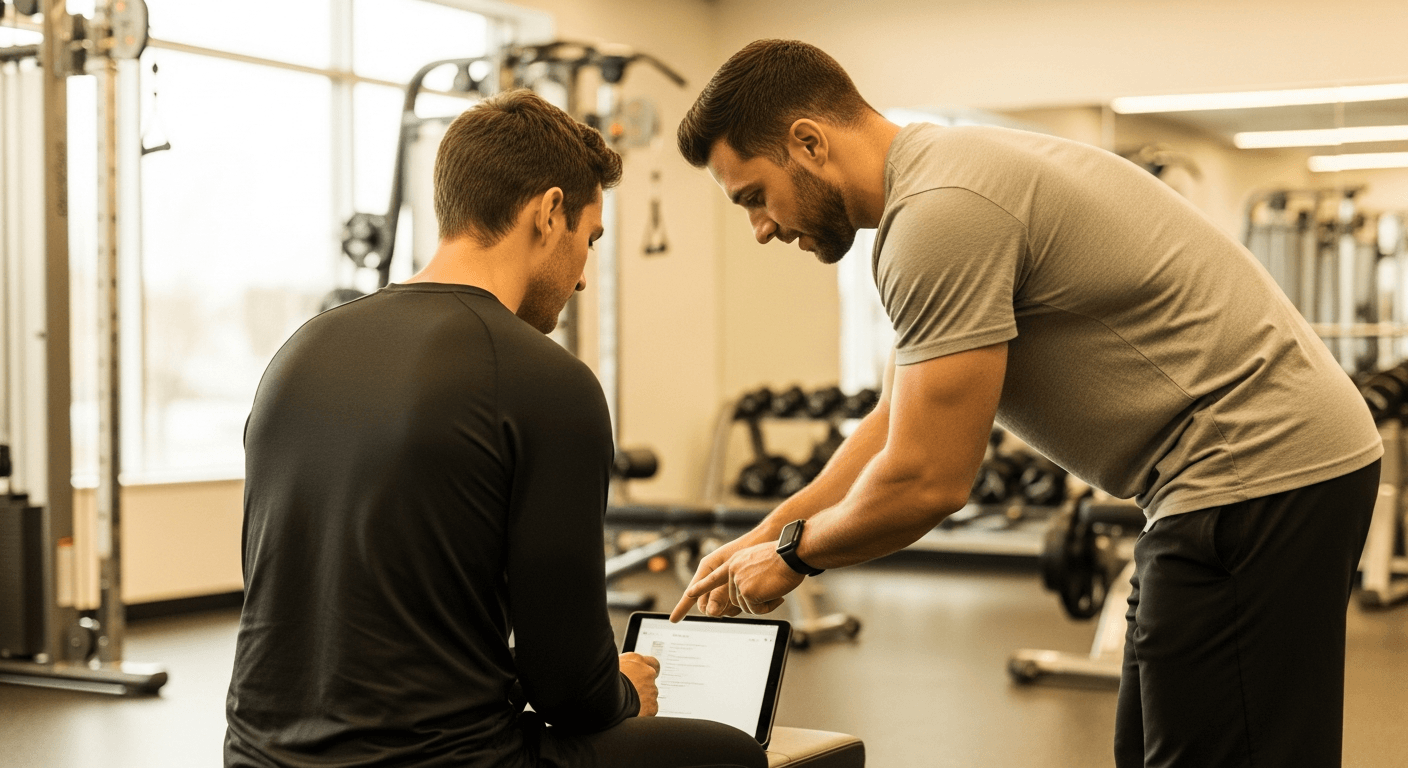
If you hired a personal trainer in 2022, you probably had a clear choice to make: train in person at a gym or sign up for an online coaching program. That binary is gone. In 2026, the standard model is hybrid, and both clients and coaches who don't understand what that means are already behind.
Data from ABC Trainerize and My PT Hub published in early 2026 confirm what many in the industry have been watching build for three years: hybrid personal training, defined as a structured combination of in-person sessions and remote coaching delivered through apps, video, and messaging, is now the majority delivery model among professional coaches. It's not a premium add-on. It's the baseline.
What "Hybrid" Actually Means in Practice
The word gets used loosely, so it's worth being specific. A hybrid training model in 2026 typically includes a set number of in-person sessions per month, daily or weekly check-ins through a coaching app, remotely delivered workout programming, and ongoing support outside of scheduled sessions. That last part is where most of the value lives.
Clients who train exclusively in person see their coach for maybe three hours a week. The other 165 hours are unmanaged. Hybrid models close that gap, not by adding more sessions, but by extending the coach's presence into the spaces where behavior actually forms: the morning before a workout, the evening after a stressful day, the weekend when habits tend to fall apart.
This isn't just a delivery shift. It's a fundamental change in what personal training is being asked to do.
AI Is Handling the Admin, Not the Coaching
One of the more significant structural changes behind the hybrid shift is how AI tools have absorbed the operational load of running a coaching business. Program templates, session scheduling, progress tracking, automated check-in prompts, and even basic nutrition logging are now handled by AI-assisted platforms. Coaches using tools like Trainerize, CoachRx, or My PT Hub report spending significantly less time on administrative tasks than they did three years ago.
That freed capacity isn't going toward taking on more clients in every case. Many coaches are using it to go deeper with the clients they have. Behavior change conversations, motivational support, accountability calls, and long-term goal planning are the areas where skilled coaches are now concentrating their attention.
This distinction matters if you're a client evaluating coaches. The question isn't whether your trainer uses AI tools. Most do. The question is what they're doing with the time those tools free up. A coach who's just running a higher volume of clients with the same surface-level contact isn't offering you a better product. A coach who's using that time to actually understand your psychology, your schedule, and your obstacles is.
The Service Bundle Has Expanded Significantly
Exercise programming used to be the product. In 2026, it's closer to the entry point. The coaches retaining clients at high rates are building what the industry now commonly calls comprehensive service models, bundles that layer habit coaching, recovery guidance, sleep optimization, and nutrition support alongside the workouts themselves.
This isn't scope creep. It's a response to what clients actually need to see results. Research consistently shows that training outcomes are heavily influenced by sleep quality, recovery practices, and daily nutrition behavior, none of which get addressed inside a one-hour gym session. Coaches who only touch the workout are essentially ignoring the majority of the variables that determine whether a client succeeds.
Recovery, for example, is now a standard coaching topic rather than an afterthought. Coaches are helping clients understand how factors like sleep debt, stress load, and training volume interact. For clients doing endurance work, understanding how long genuine recovery from hard training actually takes is practical information, not a luxury. It directly affects programming decisions and training timelines.
Sleep is another area that's moved from peripheral to central. With new data emerging around how sleep patterns affect performance and adaptation, coaches who can have informed conversations about sleep behavior offer a measurably better service. Tools like MIT's PhenoMol model for interpreting recovery biomarkers are beginning to influence how sophisticated coaches structure training loads around individual recovery signatures.
What This Means for Pricing
Hybrid models have also reshaped the pricing landscape. Clients are no longer just paying for sessions. They're paying for access, structure, and ongoing support. That changes both what coaches can charge and what clients should expect to pay.
According to current benchmarks, mid-tier hybrid coaching programs in the US are running between $300 and $600 per month depending on session frequency and the depth of the support stack. High-touch programs with weekly check-ins, nutrition coaching integration, and daily app access are reaching $800 to $1,200 per month at the premium end. For a detailed breakdown of where rates sit across experience levels and niches, the 2026 benchmarks for online coaching pricing offer a useful reference point.
The coaches commanding the upper end of that range are almost always specialists. Coaches who've built a clear niche, whether that's postpartum fitness, athletic performance, or metabolic health, are consistently out-earning generalists. The revenue gap between specialist and generalist coaches has widened measurably in 2026, and it's not a small difference. If you're a coach still trying to train everyone, that's a strategic conversation worth having seriously. The data on the revenue gap between specialist and generalist coaches makes the case clearly.
The Industry Context Behind the Shift
The hybrid default didn't emerge from nowhere. It's the product of several converging factors: the infrastructure built during the pandemic, the maturation of coaching apps, rising client expectations, and a broader wellness culture that now treats fitness as integrated with overall health rather than separate from it.
The US personal training market hit $15.6 billion in 2026, and the growth is concentrated in segments that offer more than session delivery. Gym-only trainers are facing pressure from digital-native competitors who can offer 24/7 support at lower overhead costs. The coaches and studios growing fastest are those who've built hybrid infrastructure that gives clients a coherent experience whether they're in the gym or at home. If you're trying to understand where the money is moving in this industry, the breakdown of where the $15.6 billion is going is worth reading.
What Clients Should Ask Before Signing With a Trainer
If you're looking for a coach in 2026, the standard questions about credentials and experience still matter. But you also need to ask directly how in-person and remote coaching are integrated, because that structure determines the quality of support you'll actually receive.
Here are the questions worth putting to any trainer you're seriously considering:
- How are remote sessions structured? Are they video calls, app-based check-ins, or message threads? What's the expected response time?
- What happens between in-person sessions? Is there a system for daily accountability, or do you essentially disappear until the next gym appointment?
- Does your program include habit coaching or recovery guidance? Or is it purely workout-focused?
- How is my progress tracked remotely? What data do you collect and how does it influence my programming?
- What platform do you use, and what access do I have? A coach who can't show you a clear technology stack for remote delivery probably doesn't have one.
A trainer who can answer these questions specifically and confidently is offering a real hybrid model. One who responds with vague references to "being available" or "checking in occasionally" is offering in-person training with informal contact on the side. Those are very different products at similar price points.
For Coaches: Building a Hybrid Model That Actually Retains Clients
Client retention is where hybrid models prove their value, or fail to. The coaches with the highest retention rates in 2026 share a few structural habits worth noting.
They treat the first 30 days as a critical onboarding window, not just a time to gather assessment data, but to establish communication rhythms, clarify expectations, and identify the behavioral patterns most likely to derail progress. Clients who feel oriented and supported in the first month stay significantly longer than those who are handed a program and left to figure out the rest.
They also treat the app as a relationship tool, not just a logistics platform. Coaches who send personalized feedback on logged workouts, reference past conversations in check-ins, and acknowledge progress in real time create a sense of continuity that in-person-only training can't match. That continuity is what clients are actually paying for in a hybrid model.
Finally, the coaches retaining clients at scale are the ones who've built service structures comprehensive enough to address what's actually affecting results. That means knowing enough about sleep, recovery, and nutrition to have credible conversations, even if those conversations refer clients to other specialists for deeper support. A coach who notices that a client's recovery is consistently poor and can point them toward relevant information on why sleep quality directly affects training adaptation is doing a better job than one who just adjusts sets and reps.
The Standard Has Changed. The Expectation Should Too.
Hybrid personal training became the default because it works better than the alternatives for most clients most of the time. It's more flexible, more continuous, and more responsive to the full picture of a client's life. The coaches thriving in 2026 are the ones who built that model deliberately, not the ones who added an app to their existing gym sessions and called it hybrid.
If you're a client, you now have the right to expect a coherent hybrid structure from any trainer you hire. If you're a coach, the question isn't whether to offer hybrid. It's whether the hybrid model you're offering is genuinely better than what the market can deliver on autopilot.