

On-Demand Content: How Coaches Are Building Passive Revenue in 2026
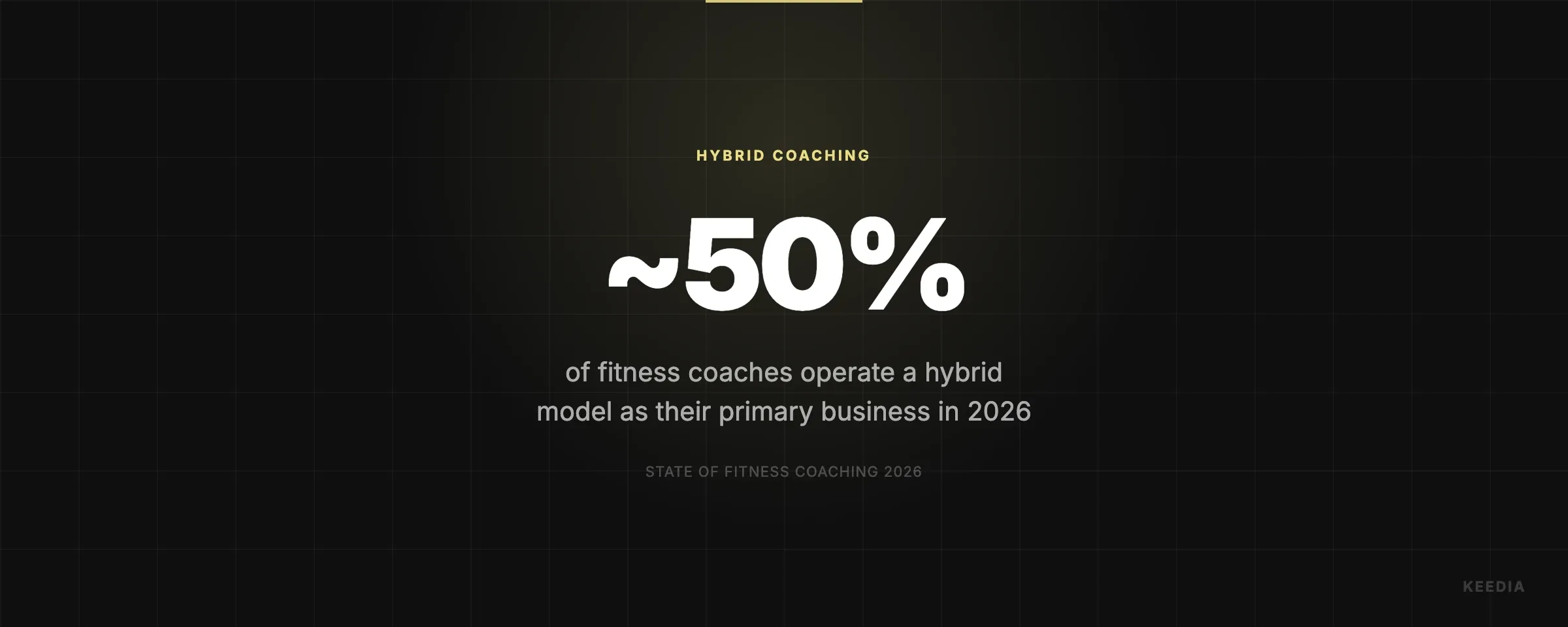
Nearly half of all personal trainers now run hybrid as their primary delivery model. That stat alone tells you the industry has moved. But the more interesting shift is happening inside hybrid itself. Live online sessions are table stakes. The segment that's actually growing, the one separating coaches earning $60,000 a year from those earning $120,000, is on-demand content: pre-recorded programs, app-based training plans, digital course libraries.
This isn't a side hustle conversation. For a growing number of coaches, on-demand products account for 30 to 50 percent of total revenue. Here's how that actually works, what platforms are driving it, and where most coaches go wrong before they ever hit record.
Why On-Demand Is the Fastest-Growing Segment Within Hybrid
The appeal is obvious from a business standpoint. You build a product once. It sells while you sleep, train clients, or take a week off. That compounding effect doesn't exist in 1:1 services, where your income ceiling is directly tied to your available hours.
For a fuller picture of where the industry stands, State of Personal Training in 2026: Numbers, Trends and What's Changing for Coaches breaks down the broader structural shifts happening across coaching models right now. On-demand sits at the intersection of every major trend: remote access, content consumption habits, and client demand for flexibility.
There's also a discoverability advantage that 1:1 coaching simply doesn't have. A well-produced on-demand program, hosted on the right platform with proper SEO, continues generating search traffic and sales months or years after launch. A live coaching slot, by contrast, disappears the moment it's filled. The asymmetry is significant.
What the Numbers Actually Look Like
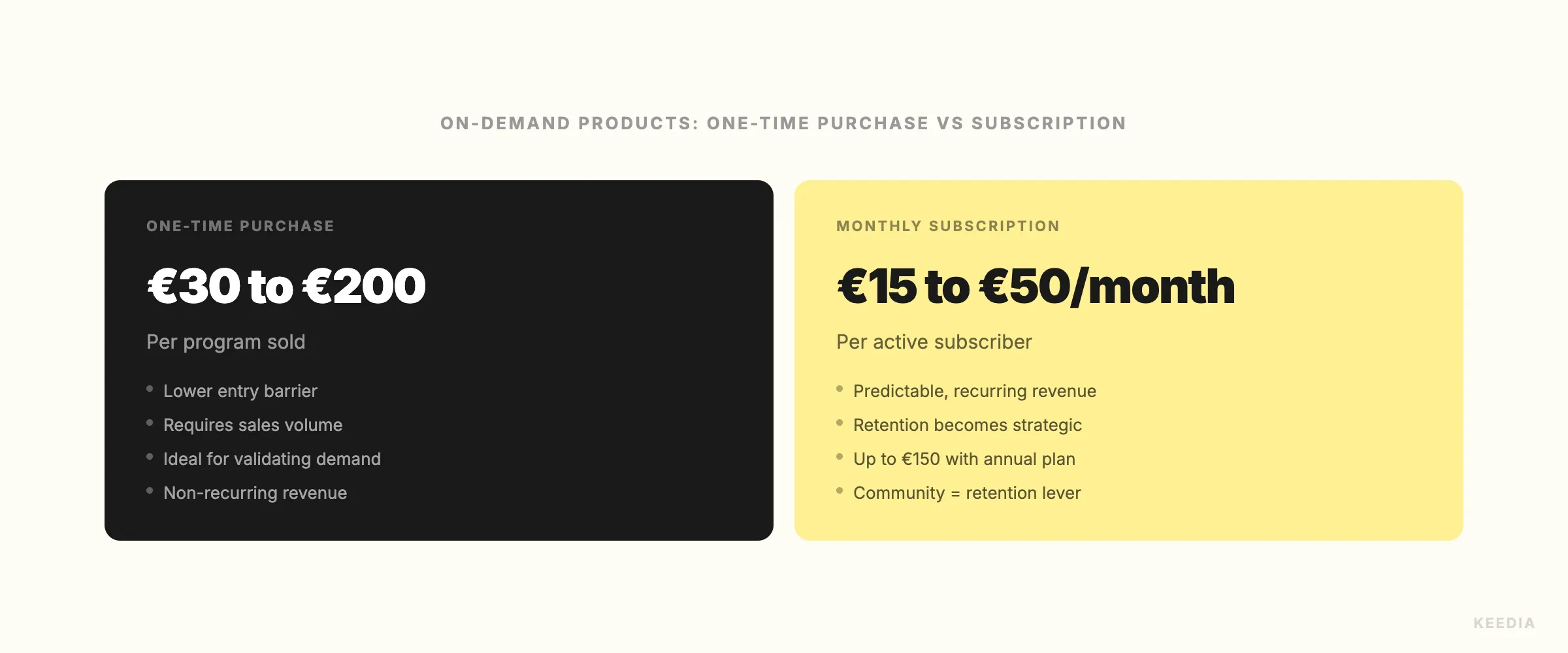
On-demand coaching products typically fall into two pricing tiers. One-time purchase programs range from $30 to $200, depending on depth, format, and the coach's brand authority. Subscription-based digital libraries or app-based plans sit between $50 and $150 per month.
The one-time purchase model has a lower conversion barrier. Clients don't need to commit long-term, which makes impulse purchases more common. But that also means you need volume. A $49 training program needs 200 buyers to hit $10,000. That's not passive if you're constantly scrambling for cold traffic.
The subscription model solves that volume problem over time, but retention is a real challenge. Completion rates for on-demand programs average between 15 and 30 percent, which is dramatically lower than live coaching engagements. Clients who feel anonymous inside a digital product cancel faster than clients who feel accountable to a person. This is why pricing strategy and retention architecture matter as much as the content itself. The dynamics around client retention at 90 days and what triggers churn apply directly to on-demand subscriptions, even though most coaches treat them as a separate problem.
The Biggest Mistake: Building Content Before Building an Audience
This is where most coaches waste six months and a lot of energy. They spend weeks recording videos, designing PDFs, building out a course platform, and crafting a launch email, only to send it to a list of 300 people, 40 of whom actually open it. Sales: four units. Revenue: $196.
The order of operations matters enormously. Audience first, product second. Always.
Before you produce a single on-demand asset, you need to prove demand with a live version. Run the program as a cohort. Coach it live. Collect feedback. See what questions come up in every session. Those questions become your on-demand content. The clients who go through the live version become your first testimonials, your case studies, the social proof that converts cold traffic later.
This approach also removes the guesswork from pricing. If clients paid $300 to go through a live version of your program, you have a data point. You know the transformation has value. You can confidently price the on-demand version at $97 or $149 and frame it as accessible entry-level access to something proven.
Coaches who skip this step build content in isolation, based on what they think clients want, rather than what clients have already demonstrated they'll pay for.
Platforms Coaches Are Actually Using
Platform choice depends on what kind of product you're building. There's no universal answer, but here's how the landscape breaks down in 2026.
- TrainHeroic and Trainerize are the dominant options for app-based training programs. Both allow you to build structured workout plans with video demonstrations, progress tracking, and client-facing apps. TrainHeroic has stronger community features and works well for strength and conditioning coaches. Trainerize integrates nutrition tracking and habit modules, which suits coaches with a broader wellness scope.
- Kajabi and Teachable are better suited for course-style delivery, where the content is educational as well as practical. Think mobility programs, nutrition fundamentals, periodization education. Kajabi's built-in email marketing and landing page tools make it the stronger business ecosystem. Teachable is cheaper to start and simpler to operate.
- YouTube remains the most powerful top-of-funnel tool available to coaches at no cost. It's a search engine. Clients looking for how to build a pull-up, understand zone 2 training, or structure a deload are finding coaches through YouTube every day. A well-optimized free video library builds trust and drives warm traffic to paid products. Coaches who treat YouTube as a business asset rather than a vanity platform see compounding returns over 12 to 24 months.
It's worth noting that AI tools are increasingly embedded in platform workflows. Coaches are using AI to generate program variations, write email sequences, and build landing page copy. AI tools for coaches: what's actually worth using in 2026 covers which specific tools are delivering real workflow value versus which ones are just noise.
What Content Actually Converts
Not all on-demand content sells equally. The products that consistently convert share a few characteristics.
First, they solve a specific, named problem. "12-Week Fat Loss Program" is vague. "12-Week Fat Loss for Women Over 40 Who Lift Three Days a Week" converts at a meaningfully higher rate. Specificity signals relevance. Clients self-select when the description sounds like it was written about them.
Second, the best-selling on-demand programs are anchored in outcomes, not content volume. More videos doesn't mean more value in the client's mind. What matters is whether the program is credibly structured to deliver a result within a defined timeframe. Programs built around established frameworks, like block periodization, progressive overload protocols, or evidence-based recovery methods, carry implicit credibility that generic "workout of the day" compilations don't.
Third, the coaches who consistently sell on-demand products at volume have invested in their personal brand. They show up consistently on one or two platforms. They have a point of view. Clients don't just buy a program; they buy access to a coach's methodology. That's why pricing psychology matters here too. Coaches who undercharge for on-demand content often undermine their own brand positioning, a dynamic explored in detail in why raising rates gets better results.
Solving the Retention Problem With Community
The 15 to 30 percent completion rate for on-demand programs isn't a content quality problem. It's a structure problem. Clients disengage when they feel like they're learning alone.
The most effective fix is simple: add a community layer. Coaches who attach a Slack or Discord channel to their on-demand product see meaningfully higher engagement and completion rates. Clients post check-ins. They ask questions. They see other people progressing. That social accountability loop, even at a distance, is enough to keep a significant percentage of clients active past the first two weeks.
This community layer also creates a natural upsell pathway. A client who completes a $97 on-demand program, who has been active in the community, who has seen results, is a warm lead for a live group coaching offer or a higher-ticket 1:1 package. The on-demand product functions as the entry point in a properly structured coaching business, not the entire business.
Building Toward Compounding Revenue
The coaches who are genuinely earning significant passive income from on-demand content in 2026 didn't build one product. They built a suite of products at different price points, serving clients at different stages of a journey.
A free YouTube library builds awareness. A $49 beginner program captures buyers early. A $149 advanced program serves clients who've already gotten results. A $97 per month subscription keeps them engaged and progressing. Each layer feeds the next.
That architecture takes time to build. Most coaches who are succeeding with on-demand today started two to three years ago with a live cohort, a small email list, and a willingness to do things manually before automating them. The compounding returns aren't instant. But unlike 1:1 coaching, where your income resets if you take a month off, a well-built digital product catalog keeps generating revenue regardless of what you're doing with your calendar.
The coaches treating on-demand content as a real business line, rather than a passive income fantasy, are the ones building something that lasts.