
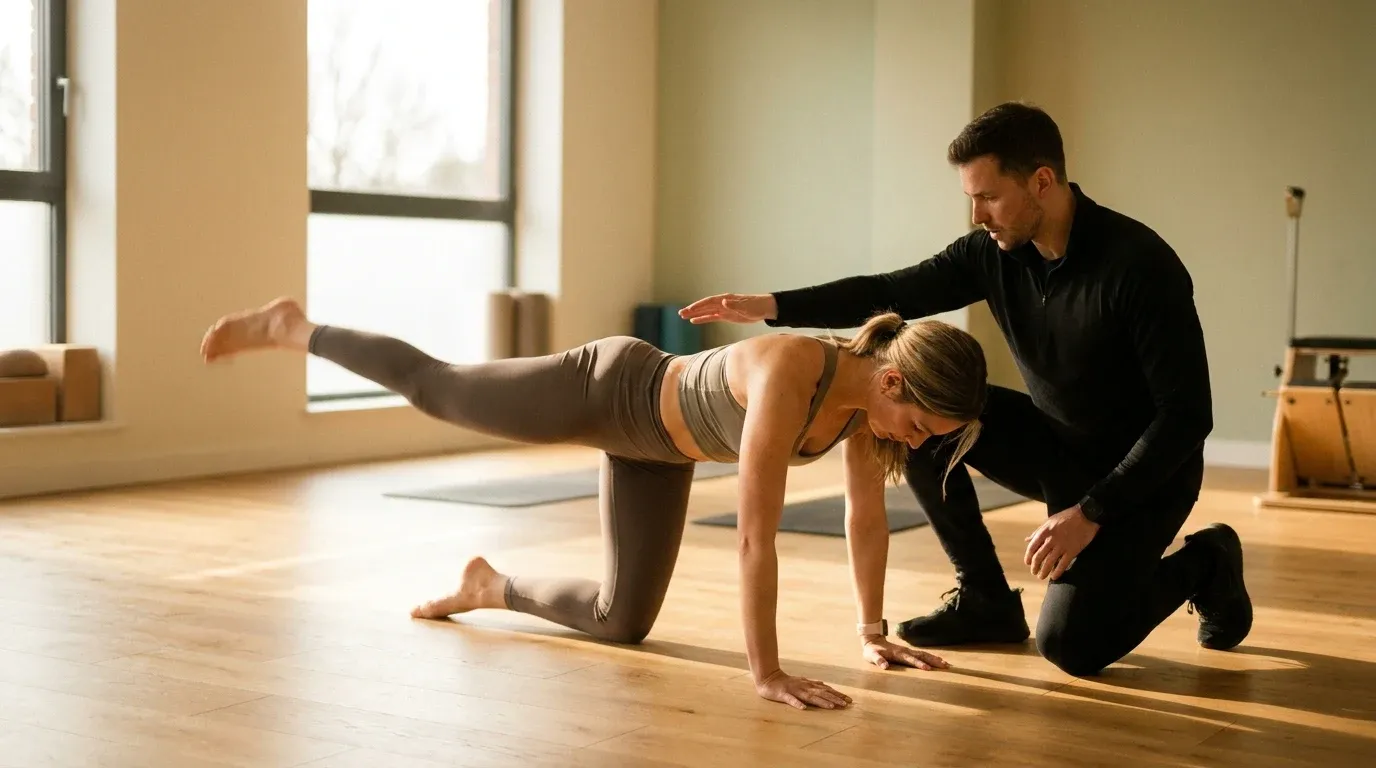
Most coaches organize their sessions with glutes in one block and core in another. It's a logical approach, but it burns time. When a client has 45 minutes and you're trying to cover strength, mobility, and stability, adding separate finishers for every muscle group starts to feel like math that doesn't add up.
The quadruped rainbow solves that problem. It's a single movement pattern that loads the glutes through a full arc while simultaneously demanding deep core stabilization throughout. Done well, it earns its place in almost any session, regardless of the client's training age.
What the Quadruped Rainbow Actually Does
Start from a standard quadruped position: hands under shoulders, knees under hips, spine neutral. From there, the working leg extends behind and sweeps in a wide arc, touching the floor to the outside, lifting through the top, and tapping down on the inside. That arc is the "rainbow." Then it reverses.
The glute activation here is real and measurable. Research on quadruped hip extension variations consistently shows high levels of gluteus maximus and gluteus medius recruitment, particularly when the leg moves through abduction and internal rotation, which is exactly what the arc demands. You're not isolating the glute in a fixed plane. You're loading it across multiple directions, which more closely mirrors how it functions during walking, running, and lateral movement.
At the same time, the non-working side has a full-time job. As the leg sweeps, the pelvis wants to rotate and hike. The transverse abdominis, the deep multifidus, and the quadratus lumborum all engage to prevent that from happening. That's not a secondary benefit. For many clients, learning to hold a stable pelvis under a moving limb is exactly the skill they're missing.
Why This Movement Fits Coaching Sessions Better Than You'd Expect
The efficiency argument is straightforward. If you can generate meaningful glute and deep core training within a single drill, you free up programming space for other priorities. That matters when you're coaching clients who train three times a week and need a full-body effect from every session.
As platforms like Betterness continue to expand local wellness networks and more coaches move toward outcome-based session design, efficiency metrics are becoming part of how quality coaching is measured. Spending two separate blocks on glutes and core when one integrated movement covers both is harder to justify, both to clients and to any platform tracking adherence or progress.
The quadruped rainbow also travels well. It needs no equipment, minimal space, and works on any surface. For coaches running in-home sessions, hotel room programs, or outdoor training, that matters.
Programming It as a Warm-Up
Used at the start of a session, the quadruped rainbow does double duty. It activates the glutes before any loaded lower-body work, which research consistently links to better force output during squats and hip hinges. It also wakes up the deep core stabilizers before the spine is asked to handle external load.
A simple warm-up protocol:
- 2 sets of 8 to 10 reps per side, slow and controlled, with a 2-second pause at each end of the arc
- Focus cue: "Keep your hip bones level the entire time. The moment they tilt, that's where you stop the arc."
- Tempo: 3 seconds to sweep, 2-second hold, 3 seconds to return
At this tempo, two sets take under four minutes. For the glute activation and core priming you get in return, that's a strong trade.
Programming It as a Finisher
At the end of a session, when the nervous system is fatigued and form discipline starts to slip, the quadruped rainbow becomes a useful challenge. The client already knows how to do it. Now they're doing it under fatigue, which trains the deep stabilizers in the conditions they'll actually face during daily movement and sport.
A simple finisher protocol:
- 3 sets of 12 to 15 reps per side, continuous movement with no pause
- Rest: 30 seconds between sides, 45 seconds between sets
- Coaching cue: "Don't let your lower back arch as you get tired. If it does, reduce range before you lose position."
This format works well on lower-body days or full-body sessions where you want to close with something that reinforces the patterns you've built during the main block.
Progressions Across Your Entire Client Roster
One of the strongest arguments for making this movement a programming staple is how well it scales. You don't need separate exercises for different client levels. You adjust the same pattern.
Beginner clients: Start with a shortened arc. Instead of sweeping from outside to inside, limit the range to what the client can control without pelvic shift. Use a slow, deliberate tempo and prioritize positional awareness over range. Many beginners will find the balance challenge alone is enough stimulus at first.
Intermediate clients: Full arc with a tempo protocol as described above. Add a resistance band above the knees to increase glute medius demand. The band also acts as a feedback tool. If the client loses control of the pelvis, the band tension changes in a way they can feel, which makes self-correction easier.
Advanced clients: Elevate the hands on a surface to increase the balance challenge. Add a light ankle weight (1 to 3 pounds is usually sufficient) to increase the lever arm load on the glute. You can also introduce a tempo variation where the arc is performed at speed for the first half of each set, then slowed to a 4-second pace for the second half. This taxes both fast-twitch and slow-twitch fibers in the same set.
Another advanced option is to combine the rainbow with a brief isometric hold at the top of each rep, extending the leg straight back and holding for 3 seconds before continuing the arc. This is effectively a single-leg balance on the working side's hip, which adds a significant stability demand.
Common Errors and How to Catch Them Early
The most common fault is pelvic rotation. As the leg sweeps to the outside, clients will often let the same-side hip drop or rotate. This defeats much of the core stabilization benefit and can create unwanted lumbar stress. If you see it, shorten the arc before you do anything else.
The second issue is wrist discomfort in clients with limited wrist extension. Forearm-based quadruped (elbows down, forearms flat) is a simple fix that doesn't change the hip or core mechanics at all. Some coaches prefer this position for all clients since it also reduces the temptation to sink into the shoulders.
Third, watch for clients who rush the movement. The quadruped rainbow done fast becomes a momentum exercise. The arc needs to be under muscular control at all times. A simple cue: "If I took a photo at any point in the arc, your position should look intentional." That framing tends to work across different client types.
Pairing This With Recovery and Load Management
Because the deep core musculature is under sustained isometric load throughout each set, some clients will report local fatigue in the lower back and lateral hips the following day, particularly early in their exposure to the movement. This is normal and typically resolves within two to three sessions as the stabilizers adapt.
If you're programming this for clients who are also managing broader training loads, it's worth revisiting how recovery is built into their week. A structured approach to the core pillars of recovery can help you identify where to position this movement without stacking too much demand on the same muscle groups across consecutive days.
Sleep, nutrition timing, and stress management all affect how well clients adapt to new movement patterns. If a client is seeing slower-than-expected progress, those variables are worth assessing before you change the exercise itself.
Making the Case to Clients
Some clients will look at the quadruped rainbow and underestimate it. It doesn't look impressive. It doesn't require any weight. The fix is simple: let them feel it. Run one set with correct tempo and full arc control, then ask them to describe what they felt. Almost universally, they'll identify the glute and the lower back or lateral trunk. That's your teaching moment.
As tools like velocity-based training sensors become more accessible to everyday coaches, there's an ongoing conversation in the industry about which movements produce measurable outcomes efficiently. The quadruped rainbow won't show up on a force plate. But the glute strength and pelvic stability it builds will show up in every lift, every sprint, and every step your clients take outside the gym.
That's the case you make. Not "this is easy." But "this is exactly what your body needs to perform better at the things that actually matter to you."
Program it, cue it well, and progress it deliberately. It earns its spot in any session structure.