
At some point, someone probably told you to keep your feet shoulder-width apart, toes pointed forward, and knees tracking directly over your feet. That advice isn't wrong, exactly. It's just incomplete. What works for one person's squat can actively work against another's, and most cookie-cutter cues fall apart the moment anatomy enters the conversation.
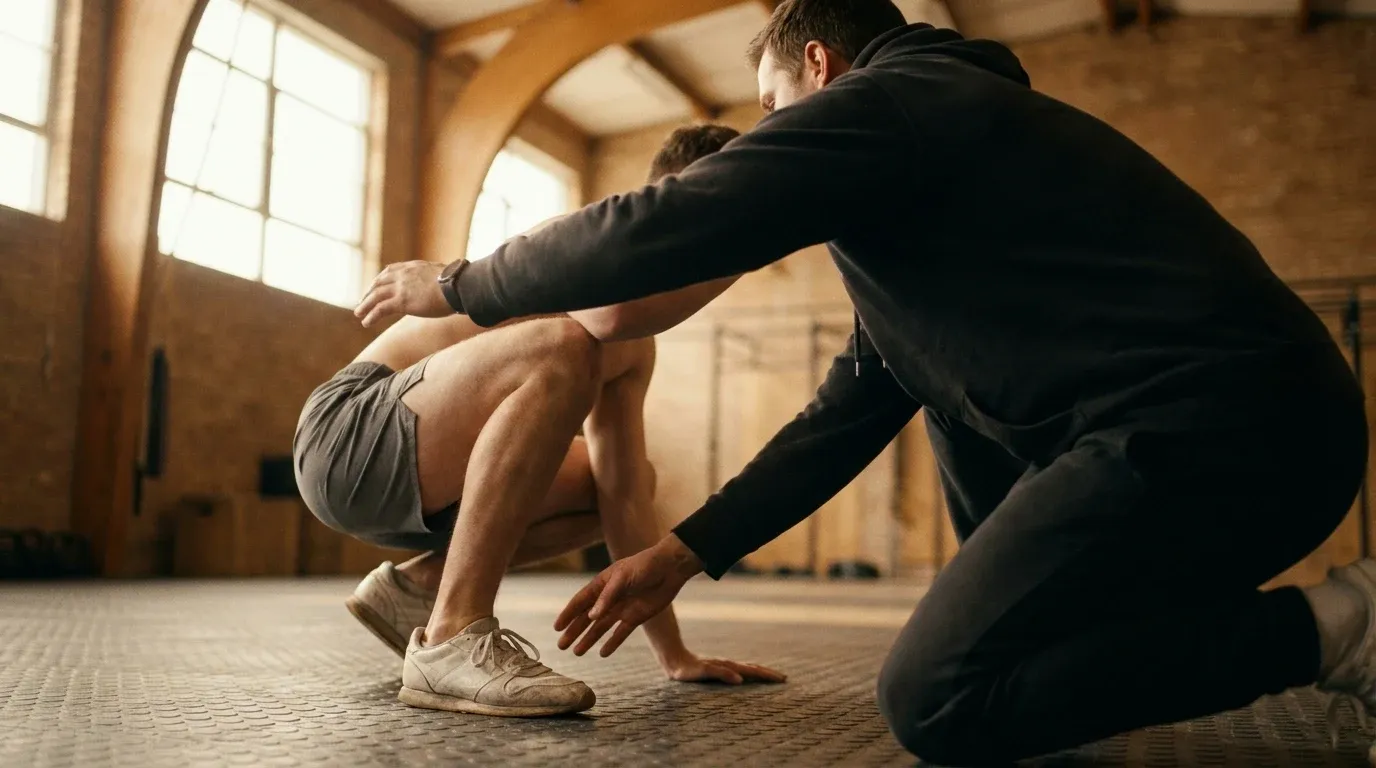
Good coaches know this. They're not working from a poster on the gym wall. They're watching how you move, asking about your history, and building a technique that fits your body. Here's what that process actually looks like.
Your Hip Anatomy Is Running the Show
The squat is fundamentally a hip-dominant movement. That means the structure of your hip joint, not your flexibility or strength, sets the outer limits of what's mechanically available to you. Two people can train the same program for the same amount of time and still have completely different ideal foot positions because their hip sockets are shaped differently.
Hip socket depth, angle of inclination, and femoral version (how your thigh bone sits in the socket) vary significantly between individuals. Research confirms that bony architecture accounts for a meaningful portion of the variation in how people naturally stand and move. You can't stretch or foam-roll your way out of anatomy.
A wider stance with more toe-out often works well for people with deeper hip sockets or more anteversion. A narrower, more parallel stance tends to suit shallower sockets or neutral femoral positioning. Neither is superior. Both can build serious strength and movement quality when coached correctly.
This is why copying the squat stance of your favorite athlete or trainer can backfire. Their form is personalized to them. Forcing your body into someone else's mechanics under load is one of the fastest routes to frustration and injury.
Mobility Is a Factor, But Not the Whole Story
Trainers hear it constantly: "I need to work on my mobility before I can squat properly." Sometimes that's true. Limited ankle dorsiflexion, for instance, can force the heel to rise and shift the load forward in ways that stress the knees and lower back. That's a real mobility issue with direct technique consequences.
But mobility is often blamed for problems that are actually anatomical or coaching-related. If someone's squat consistently looks different from the textbook version, the first question a good coach asks is whether the deviation is a problem at all, or whether it's simply that person's optimal position.
Targeted mobility work still matters. Regular attention to thoracic extension, hip flexor length, and ankle range of motion gives your joints more working room. But the goal of that work isn't to make your squat look like someone else's. It's to reduce any restrictions that prevent you from moving well within your own structure.
Foot Pressure Changes Everything
Here's something many gym-goers never hear: where you distribute pressure through your foot during a squat dramatically changes which muscles are doing the work.
Driving through the heels emphasizes the glutes and hamstrings. Allowing more pressure toward the ball of the foot increases quad demand. Neither approach is wrong. The question is what you're training for and what your movement patterns need.
For someone with weak glutes and a tendency to shift into quad dominance, a coach might cue heel pressure explicitly. For a sprinter or athlete who needs to develop force through a more forefoot position, the prescription looks different. This is individualization in practice, not just theory.
A useful coaching cue that bridges both is to think about spreading the floor or pressing evenly through all four corners of the foot: the heel, the base of the big toe, and the base of the pinky toe. That distributes pressure intentionally rather than letting habit dictate where you end up.
The problem is that most people don't have awareness of their foot pressure during loaded movement. Building that proprioception takes deliberate practice and, ideally, coaching feedback. If you've been training for years without anyone ever addressing your foot contact, there's a reasonable chance you have a loading pattern that's limiting your progress without you knowing it.
If you're deciding whether to work with someone in person or remotely on technique issues like this, it's worth thinking through your options carefully. The article Online vs. In-Person Coaching: How to Pick the Right Format breaks down the tradeoffs based on your specific training needs.
Goal-Setting Changes Your Ideal Technique
A powerlifter, a trail runner, and someone returning from knee surgery all need to squat. They should not all squat the same way.
The powerlifter wants maximal load. That typically means a wider stance, more forward torso lean, and a technique optimized to move the bar the shortest distance with the largest muscle contribution. Bar position, bracing, and depth are all engineered toward that goal.
The trail runner wants to build bulletproof single-leg strength and load tolerance. Their squat work is often narrower, more upright, and geared toward translating to the unilateral demands of the trail.
The person post-injury has different constraints entirely. Depth, loading, and stance all need to be calibrated around what the healing tissue can tolerate while still building strength. If this sounds familiar, the guidance in How to Return to the Gym After Injury Without Setbacks gives a solid framework for approaching that process thoughtfully.
When you know your goal, your trainer can reverse-engineer a squat pattern that actually serves it. Without that clarity, technique cues are just guesses.
Progress Isn't Only About Adding Weight
The fitness industry defaults to weight on the bar as the primary measure of progress. It's concrete, trackable, and satisfying. But experienced coaches track a wider set of signals, and some of the most meaningful improvements don't show up on a barbell.
Here's what that can look like in practice:
- Movement quality across the day. A client who reports that getting out of a chair feels easier, or that knee discomfort during stairs has decreased, is making genuine progress. That's the squat pattern integrating into daily life.
- Energy and recovery between sessions. If you're training consistently and feeling better between workouts rather than ground down, that's a sign the stimulus and recovery balance is right. Chronic fatigue between sessions is not a badge of effort.
- Consistency over time. Showing up with a reliable, practiced movement pattern over months builds the kind of neuromuscular groove that eventually allows real strength gains. Sporadic heavy sessions don't.
- Bar speed and effort perception. A lift that looks identical to last month but felt significantly easier is progress. The nervous system has become more efficient. That often precedes a weight increase.
Coaches who understand recovery as part of the training equation, not separate from it, tend to produce better long-term outcomes. There's growing evidence that recovery practices are central to sustainable performance, not optional extras. If you haven't thought about this side of training seriously, Recovery Is Now a Longevity Strategy, Not an Afterthought makes the case clearly.
What a Good Squat Assessment Actually Looks Like
A competent trainer doesn't just watch you squat once and hand you a cue sheet. They run a structured assessment that includes a few key elements.
First, they watch an unloaded squat with no instruction. This tells them what your default pattern is before any external feedback. Then they might test foot position variations, asking you to try different stances and watching what changes. They'll observe whether your knees track over your toes (for your foot position), whether your heels stay down, how your torso angle behaves, and where the load appears to live.
They'll also ask questions. Do you have any history of knee, hip, or lower back issues? What sports or physical activities have you done consistently? Do you sit for most of the day? All of that shapes the starting point.
If you're new to working with a trainer, it helps to know what to expect from the beginning. Your First Session With a Trainer: What to Expect covers how that initial process typically unfolds and how to make the most of it.
Stop Optimizing Someone Else's Squat
Social media has made it easy to find compelling squat content. Elite athletes, coaches, and influencers post form breakdowns, cue compilations, and before-and-after transformations. Most of it is genuine and well-intentioned. Almost none of it was designed for your body.
The most useful thing you can do with external squat content is treat it as a menu, not a prescription. Certain cues might resonate because they address something real in your pattern. Others won't land at all, and that's fine. The goal is to build awareness of what's happening in your own movement, not to replicate someone else's highlight reel.
Personalizing your squat is not a sign that something is wrong with you. It's a sign that you're training intelligently. Your hip anatomy, foot pressure, mobility profile, and training goals are specific to you. Your squat should be too.
That process takes time, feedback, and a coach who's willing to look at the whole picture. When you find that, the squat stops being a frustration point and becomes exactly what it's supposed to be: one of the most effective, durable movements in your training life.