

Most coaches lose clients between sessions, not during them. The workout is fine. The program is solid. But in the 167 hours between appointments, the client is on their own — and silence from a coach reads, consciously or not, as indifference. Motivation drops. Skipped sessions accumulate. Then comes the cancellation email.
The fix isn't more calls or longer sessions. It's a structured weekly check-in system that takes clients under three minutes to complete and costs you less than 10 minutes a week to act on. Here's exactly how to build one.
Why the Gap Between Sessions Is Where Retention Is Won or Lost
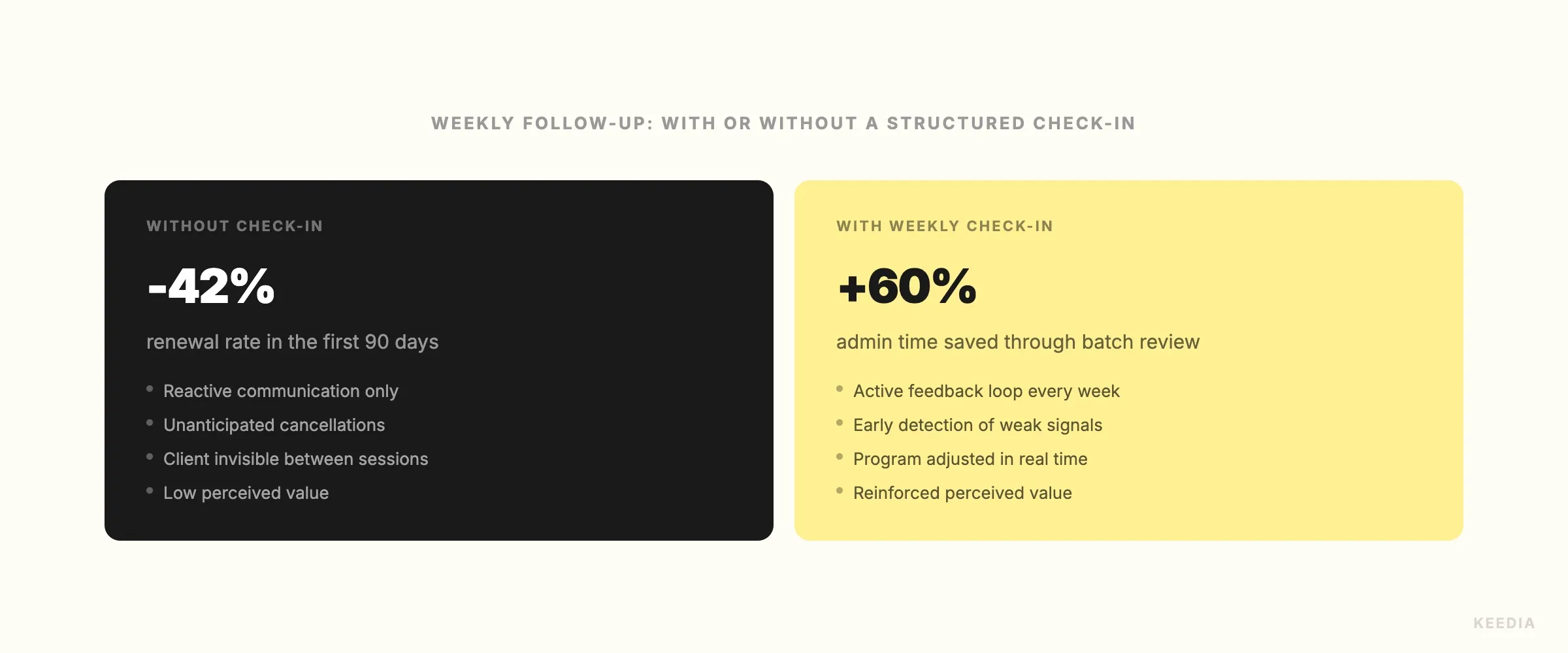
Research on coaching retention consistently points to the first 90 days as the highest-risk window. Clients who receive structured, consistent communication from their coach during that period are significantly more likely to renew. The mechanism isn't complicated: frequent touchpoints create a feedback loop that makes clients feel seen, tracked, and accountable. That feeling is worth more than most coaches realize.
For a deeper look at the data driving this pattern, client retention at 90 days: what triggers churn breaks down exactly which behaviors predict cancellations before they happen. The numbers are sobering. Clients who go two weeks without any coach contact are far more likely to churn than those who receive even a brief, structured touchpoint.
The check-in doesn't need to be long. It needs to be consistent and purposeful.
The 5-Question Framework That Covers Everything Worth Knowing
A high-retention check-in form asks five questions. Nothing more. Each question targets a specific dimension of the client's week, and the entire form should take a client under three minutes to complete. Longer than that and completion rates drop sharply.
- Adherence: Did you complete your planned sessions this week? (Yes / Mostly / No, with a short follow-up if needed)
- Energy and recovery: How would you rate your energy and recovery over the past seven days? (1–10 scale)
- Nutrition compliance: How closely did you follow your nutrition targets? (1–10 scale, or a simple percentage estimate)
- A win from the week: What went well, even if small? (open text, one or two sentences)
- One challenge or question: What's one thing you struggled with, or a question you want me to address? (open text)
That last question is the most valuable one on the form. It surfaces friction before it becomes a reason to quit. A client who writes "I've been exhausted all week and don't know why" is giving you a direct intervention opportunity. A client who writes nothing is still giving you data.
Async Beats Calls for Busy Clients
Scheduled check-in calls sound attentive. In practice, they're a logistical nightmare for working professionals. Missed calls, rescheduled calls, calls that run long because there's no structure. Completion rates for scheduled weekly calls are consistently lower than for asynchronous forms, and the information quality is often worse because clients haven't had time to reflect.
The format that performs best: a form sent Friday afternoon, reviewed by the coach Monday morning. The timing matters. Friday gives clients a natural moment to reflect on their week before the weekend. Monday gives you a full picture before the new training week begins, so your response can be actionable.
Tools for this don't need to be sophisticated. A Google Form, a Typeform, a form inside your coaching software, or even a templated email with structured questions all work. The format matters less than the consistency. Send it the same time every week, every week, without exception.

The Batching Method That Cuts Admin Time by 60%
Here's where most coaches lose efficiency. They receive a check-in response Thursday morning and respond immediately. Another comes in Friday, they respond. Another Saturday. Each response pulls them out of whatever else they're doing, and the cumulative time adds up to far more than it should.
Coaches who batch all check-in reviews into a single 20 to 30 minute window report spending roughly 60% less time on admin while clients perceive more attentiveness, not less. The reason is simple: batching creates focus. When you sit down to review eight check-ins at once, you move through them with purpose. You spot patterns across clients. You respond more efficiently because you're in a single cognitive mode.
Set Monday morning as your check-in review block. Close everything else. Read through all submissions, flag any that need more than a brief response, and send responses in sequence. For most clients, your response will be two to four sentences. For clients who've signaled something concerning, it might be longer, or it might prompt a short voice note or a direct message asking to schedule a call.
The distinction is important: most responses are fast, and that's by design. Reserve your deeper attention for the clients who actually need it that week.
Using Check-In Data as a Retention Defense System
The check-in form isn't just a communication tool. It's an early warning system. When a client reports low energy for two consecutive weeks, or marks "No" on session adherence twice in a row, that's a pattern. And patterns are almost always visible before cancellations.
Proactive retention is categorically more effective than reactive retention. Reaching out to a client who has gone quiet, who has skipped sessions, or who has been rating their motivation at 4 out of 10 for three weeks is far more likely to succeed than trying to re-engage someone who has already decided to cancel. The check-in gives you the data to act early.
Your intervention doesn't have to be elaborate. A message that says "I noticed your energy's been low the past couple of weeks. Do you want to jump on a quick call this week to troubleshoot?" does the job. It shows you're paying attention. It opens a conversation. And it does so before the client has started mentally preparing their cancellation message.
This kind of proactive attention is also directly tied to the perceived value of your coaching. As the State of Personal Training in 2026 data shows, clients increasingly expect personalization and responsiveness as baseline features of a premium coaching relationship. The check-in system is how you deliver that without being available 24/7.
Turning Data Into Visible Coaching Proof
The most powerful thing you can do with check-in data isn't file it away. It's reflect it back to the client in a way they can see.
When a client reports low energy and a tough week with recovery, and you respond by adjusting Tuesday's session intensity, you've done something important. You've made the data loop visible. The client sees that what they report directly shapes what they experience. That connection, when felt consistently, is what makes a coaching relationship feel irreplaceable.
Practically, this looks like short statements in your response or in the program notes: "I saw you struggled with energy this week, so I've pulled back Tuesday's intensity and added a longer warm-up. Let's see how your recovery markers look by Friday." That sentence took you 15 seconds to write. The impact on client trust is disproportionate to the effort.
This also applies to nutrition and programming decisions. If a client is consistently hitting nutrition targets but stalling on body composition, the check-in data creates the evidence base for a conversation about energy balance or training stimulus. If a client is consistently exceeding session targets but reporting elevated fatigue, that's a signal worth addressing with a structured deload. For coaches working on recovery and periodization, deload protocols: what the research actually says is worth revisiting to sharpen those decisions.
What a Full System Looks Like in Practice
To make this concrete, here's a simple weekly cadence that requires less than 10 minutes of coach time per client, per week:
- Friday 4 PM: Automated form goes out to all clients (set this up once in your tool of choice).
- Monday 9 AM: 25-minute review block. Read all responses, respond to each, flag any that need a follow-up call or program adjustment.
- Monday throughout the day: Any flagged program adjustments are made in the client's training file before their next session.
That's the whole system. It's not complicated. What makes it work is the discipline to run it consistently, every single week, regardless of whether you feel like it.
If you're managing a larger client roster and looking for ways to scale this without adding admin overhead, AI tools for coaches: what's actually worth using in 2026 covers several options that can help automate the routing and flagging of check-in responses without losing the personal touch clients expect.
The Business Case Is Simple
Client acquisition costs between $200 and $500 per new client in most coaching markets, depending on your niche and how you market. Retaining a client for one additional month costs you 10 minutes of structured time per week. The math is obvious, but it's easy to deprioritize check-ins when your schedule is full and everything feels fine.
Everything feeling fine is exactly when the check-in matters most. That's when you catch the clients who are quietly disengaging, who are struggling with something they haven't brought up, or who have started wondering whether they're getting enough value to justify renewing.
The check-in system doesn't just retain clients. It gives you the data to coach better, the structure to work more efficiently, and the touchpoints that make clients feel the relationship is worth keeping. Build it once. Run it every week. Watch your renewal rates respond.