
Most serious lifters have their program dialed in. They track progressive overload, they hit their macros, they protect their sleep. But there's a physical quality almost every gym program ignores entirely, and new research suggests that ignoring it could shorten your life.
Balance and agility. Not exactly the sexiest training variables. But the science is catching up fast.
Why Balance Is Now a Longevity Marker
Research published in November 2026 has added balance and agility to the short list of physical markers linked to long-term survival. Alongside grip strength and VO2 max, the ability to control your body in space, on one leg, mid-movement, under fatigue, is now being tracked by researchers as a meaningful predictor of how well you age.
This aligns with a broader body of evidence on the relationship between physical capacity and aging. What 110,000 Americans Teach Us About Aging and Exercise points to the same pattern: the people who maintain a wide range of physical skills, not just raw strength, tend to fare significantly better over time.
The mechanism isn't mysterious. Balance relies on the integrated function of your proprioceptive system, your vestibular system, and your neuromuscular control. As you age, all three decline, and that decline accelerates if you never train them. Falls become more likely. Reactive movement slows. Coordination erodes. And with it, your independence.
The good news: balance is trainable at any age, and you don't need a separate program to develop it.
The 30-Second One-Leg Stand Test
Before you adjust anything in your training, you need a baseline. The one-leg stand test is your starting point. It's simple, requires no equipment, and gives you a clear, honest number.
Here's how to do it:
- Stand barefoot on a flat surface near a wall for safety
- Lift one foot and hold it just off the ground, slightly behind you
- Start a timer the moment your foot leaves the ground
- Stop when your raised foot touches down, your standing foot shifts, or you grab a support
- Test both legs. Record your best time
Under 10 seconds is a red flag at any age. Research links the inability to hold a one-leg stand for 10 seconds in midlife to a significantly elevated risk of death within the following decade. The target most researchers use is 30 seconds with eyes open, 10 seconds with eyes closed.
If you're a regular lifter and you're struggling to hit 20 seconds, that's information worth acting on. This test is now your training goal, not just a curiosity.
Why Lifters Skip Balance Work (And Why That Logic Doesn't Hold)
The most common objection is time. You're already training four or five days a week, and adding a separate balance session feels like too much. That's a reasonable concern, and it's also a false constraint.
Balance training doesn't need to be its own block. It slots naturally into what you're already doing. A five-minute warm-up addition and one or two accessory substitutions per session is enough to build meaningful capacity over a training block.
The second objection is the fear of losing strength gains. The research here is reassuring. Single-leg and stability work, when programmed correctly, doesn't cannibalize your compound lifts. It reinforces them. Unilateral lower-body work in particular strengthens the stabilizer patterns that make bilateral movements safer and more efficient.
If you're managing your overall training load carefully, adding balance work is far less disruptive than most lifters expect. How Hard Should You Actually Train at the Gym? offers a useful framework for thinking about intensity and volume before you start adding anything new to your schedule.
How to Layer Balance Work Into Your Program
The practical approach breaks down into three insertion points: warm-ups, accessory blocks, and transitions. You don't need all three. Start with one and assess.
In Your Warm-Up (5 Minutes)
This is the lowest-friction entry point. Before your first working set, replace static stretching or aimless foam rolling with two or three targeted balance drills. Options that work well:
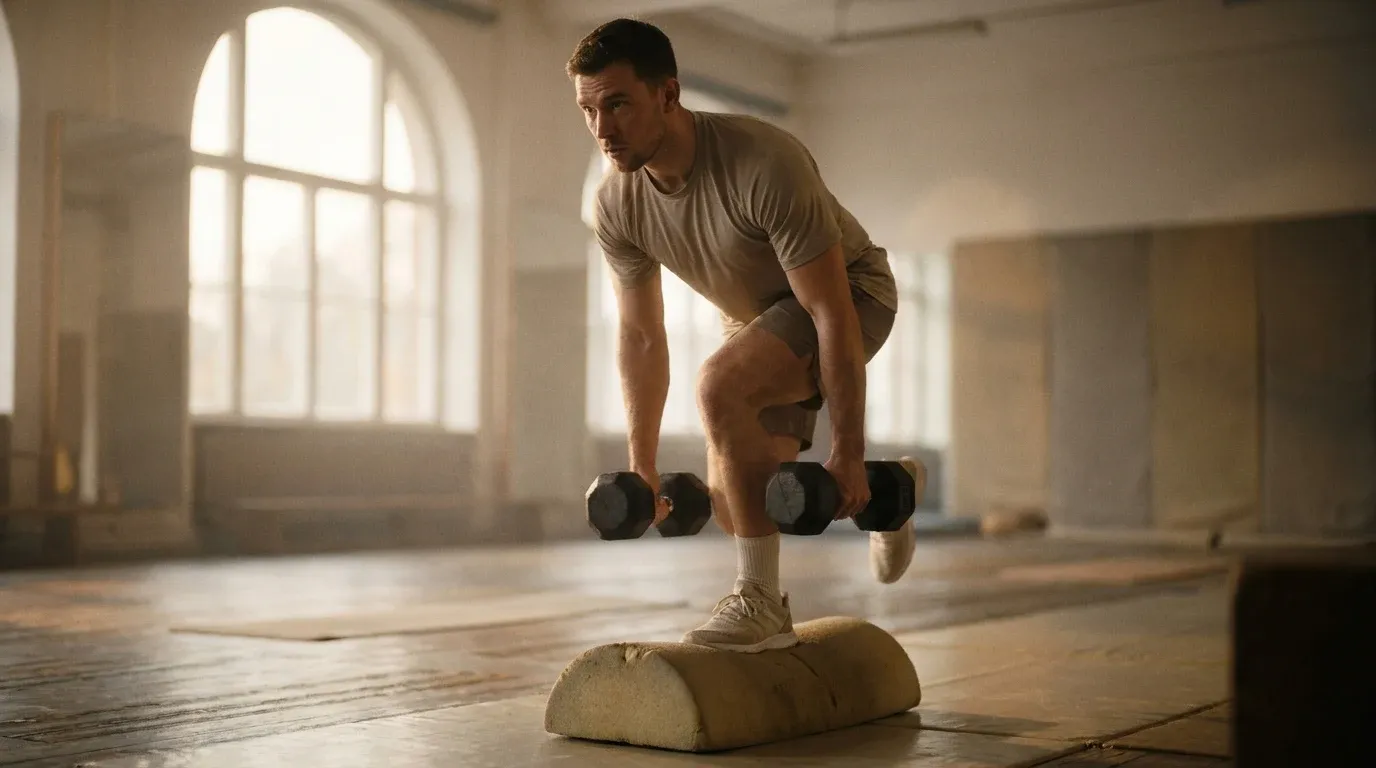
- Single-leg Romanian deadlift (bodyweight): 2 sets of 8 per side. Hinge slowly, control the return. This primes your posterior chain and proprioceptive system simultaneously
- Standing hip CARs (controlled articular rotations): Slow, full-range rotations on one leg, 5 per side. Forces you to stabilize while moving through range
- Lateral hop and stick: Small lateral jumps landing on one foot, hold for 2 seconds before the next rep. 6 reps per side. Introduces reactive element
Total time: 4 to 6 minutes. It doesn't feel like much in a session, but over eight to twelve weeks, the neuromuscular adaptation is real.
In Your Accessory Block
If you already program accessory work after your main lifts, this is where you can add more progressive load. The goal here is 2 to 3 sets of a single-leg or stability exercise per session, progressed over your training block.
A simple eight-week progression for lower body days might look like this:
- Weeks 1-2: Bodyweight single-leg Romanian deadlift, 3x8 per side
- Weeks 3-4: Same movement with a light dumbbell (10-20 lbs), 3x8
- Weeks 5-6: Loaded Bulgarian split squat, 3x6 per side
- Weeks 7-8: Deficit single-leg Romanian deadlift with moderate load, 3x6
The progression principle is the same as any other lift. Add load or complexity as you adapt. Don't skip the light weeks. The early phases are building the neural patterns everything else depends on.
Reactive and Agility Work
Agility, the ability to change direction quickly and accurately, is distinct from static balance but just as important for longevity markers. You can address it briefly at the start of a session with minimal equipment.
Two to three minutes of lateral shuffle, cone cuts, or simple hop-to-stick patterns before lifting is enough. You don't need a full agility ladder protocol. The stimulus is what matters: asking your nervous system to coordinate rapid, reactive movement before it goes into the controlled, predictable patterns of barbell training.
This kind of work also pairs well with recovery management. If you're unsure whether a given day warrants more intensity or should stay lighter, Rest vs. Movement: How to Read Your Recovery Signals gives you a practical framework for that decision.
Programming It Across a Training Week
You don't need to add balance work to every session. Two to three sessions per week is sufficient for meaningful adaptation. Here's how it might distribute across a standard four-day lifting split:
- Day 1 (Lower body, strength focus): Warm-up balance drills + accessory single-leg work
- Day 2 (Upper body): No specific balance addition needed; shoulder stability work already fits here if relevant
- Day 3 (Lower body, hypertrophy focus): Reactive agility warm-up + single-leg accessory progression
- Day 4 (Upper body or full body): Optional: one-leg stand holds during rest periods, 30 seconds each side
The one-leg stand holds during rest periods are genuinely effective and cost you nothing. You're standing around anyway. Use that time to train the specific test you're trying to improve.
Tracking Progress and Knowing When to Advance
Retest the one-leg stand every four weeks. Use the same conditions each time: barefoot, same surface, same time of day if possible. Progress will likely feel slow at first, particularly with eyes closed, and then accelerate once the neural adaptations consolidate.
Signs you're ready to advance your balance programming:
- You can hold the one-leg stand for 30 seconds without compensation on both sides
- Your single-leg accessory work feels controlled at the current load with no lateral wobble
- You're not experiencing delayed onset muscle soreness in the stabilizers you were targeting
When those boxes are checked, increase load on the accessory movements and introduce more complex variations: single-leg work on a slight incline, eyes-closed balance holds, or adding an upper-body movement during the single-leg stance.
Balance training, like strength training, rewards patience and consistency over intensity. The lifters who try to rush the progression and go heavy on single-leg work before the stabilizer patterns are established tend to compensate with the hip or lower back, which defeats the purpose.
The Bigger Picture
Strength is foundational. But strength alone doesn't cover the full range of physical capacities that determine how well you function at 60, 70, or beyond. The research is clear that a broader physical profile, one that includes coordination, stability, and reactive movement, is what separates people who age well from those who don't.
Adding balance work to your lifting program is not about replacing what you've built. It's about filling a gap that most gym programs leave wide open. Five to ten minutes per session, two to three times a week, progressed intelligently over a training block. That's the commitment required.
Your one-leg stand time is your starting point. Test it this week. Then build from there.