

Most gym-goers obsess over the physical side of adaptation: progressive overload, protein intake, sleep hours logged. But two new studies suggest the nervous system is doing far more heavy lifting than anyone gave it credit for. And if you're ignoring it, you're leaving real progress on the table.
What's Happening in Your Brain After a Hard Session
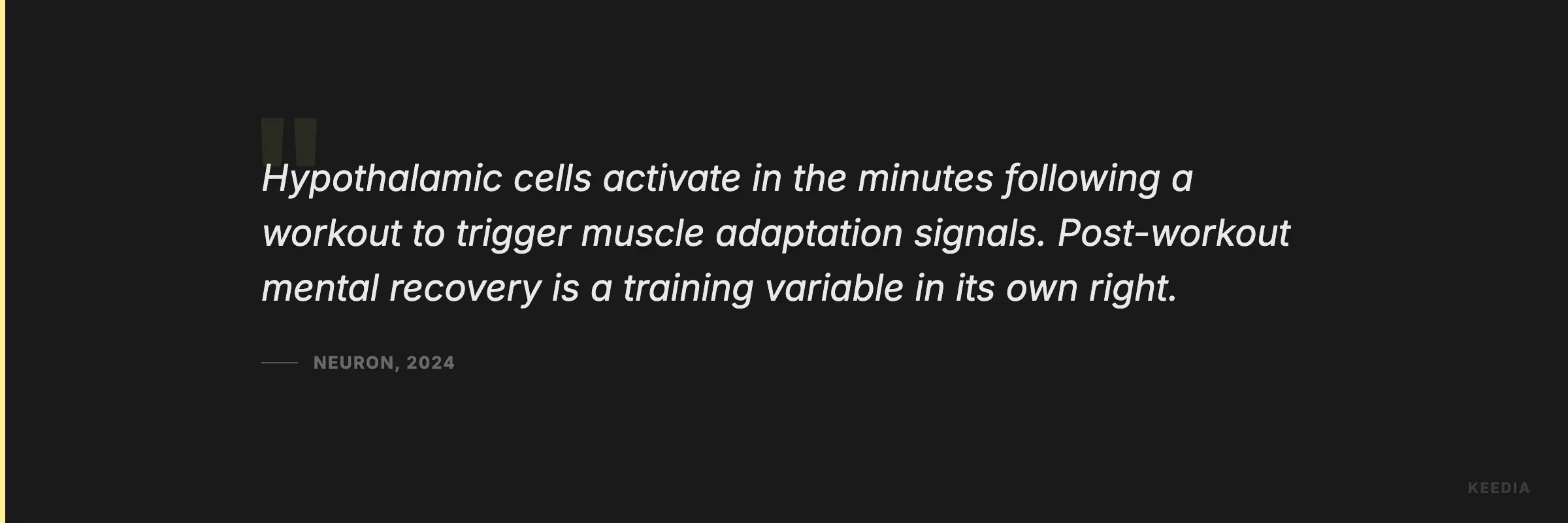
A study published in Neuron identified a specific population of cells in the hypothalamus that activate after exercise and appear to drive the signaling cascade that tells your muscles to adapt. These aren't muscle cells. They're brain cells. And they fire up in the post-workout window, not during the workout itself.
That distinction matters more than it sounds. It means the adaptation signal isn't purely mechanical. Your nervous system is essentially filing the paperwork after the session ends, translating the physical stress of training into biological instructions for growth and endurance improvement.
If you spike your stress response immediately after training, whether through a heated argument, a chaotic commute, or doom-scrolling for an hour, you may be interrupting that process before it can run its course.
Your Heart's Nerves Are Being Physically Remodeled
The second finding is just as striking. Research on aerobic exercise showed that regular cardio training physically reshapes the stellate ganglia, the nerve clusters that regulate your heart rate and cardiac output. This isn't a functional change or a chemical shift. The structure of those nerves actually changes in response to consistent aerobic work.
This reinforces something researchers have been circling for years: the nervous system isn't a fixed system that simply controls your muscles. It's a dynamic, trainable tissue. The heart's neural wiring adapts to exercise the same way muscle fibers do, just through different mechanisms and on a slightly different timeline.
That has direct implications for how you think about cardio training. You're not just building a stronger heart muscle. You're rewiring how that heart is controlled. And like any rewiring, it requires time, consistency, and conditions that allow structural change to take hold.
The Three Things That Blunt Neural Adaptation
Here's where the research gets uncomfortable for a lot of trained individuals. The same signals that suppress nervous system recovery are extremely common in the modern training lifestyle.
Mental fatigue. Cognitive load, whether from a demanding job, decision fatigue, or screen overexposure, activates overlapping neural pathways with physical training. When those pathways are already saturated, the adaptive signaling from your hypothalamus and peripheral nervous system has less bandwidth to operate. One meta-analysis found that mentally fatigued athletes underperform on endurance tasks by a measurable margin, independent of physical conditioning.
Chronic stress. Elevated cortisol doesn't just suppress muscle protein synthesis. It actively interferes with the neural remodeling processes that make your cardiovascular and muscular systems more efficient. If you're training hard while running on chronic stress, your nervous system is fighting a two-front war it can't fully win.
Poor sleep. This one isn't news, but the mechanism is becoming clearer. Slow-wave sleep is when the central nervous system consolidates the adaptation signals generated during training. Cut that short consistently, and you're not just tired. You're functionally reducing your return on every session you're logging. The work happened. The processing didn't.
The Post-Workout Window Is a Neural Window, Not Just a Nutrition Window
Most athletes already know about the anabolic window for protein intake. The post-workout protein window is real, though its timing is less critical than supplement companies have long suggested. But emerging neuroscience points to an equally important window for neural recovery.
In the 30 to 60 minutes following a training session, the hypothalamic cells identified in the Neuron study are most active. That's the window where your nervous system is doing its adaptation work. Flooding that window with high-stimulus input, whether that's aggressive content, stressful conversations, or high-intensity cognitive tasks, appears to compete with that process.
Practically, this means your post-workout routine deserves the same attention as your warm-up. A 20-minute cooldown that includes low-stimulation activity, light stretching, or even quiet breathing isn't a waste of time. It may be protecting the most valuable phase of your training cycle.
How to Program Around Your Nervous System
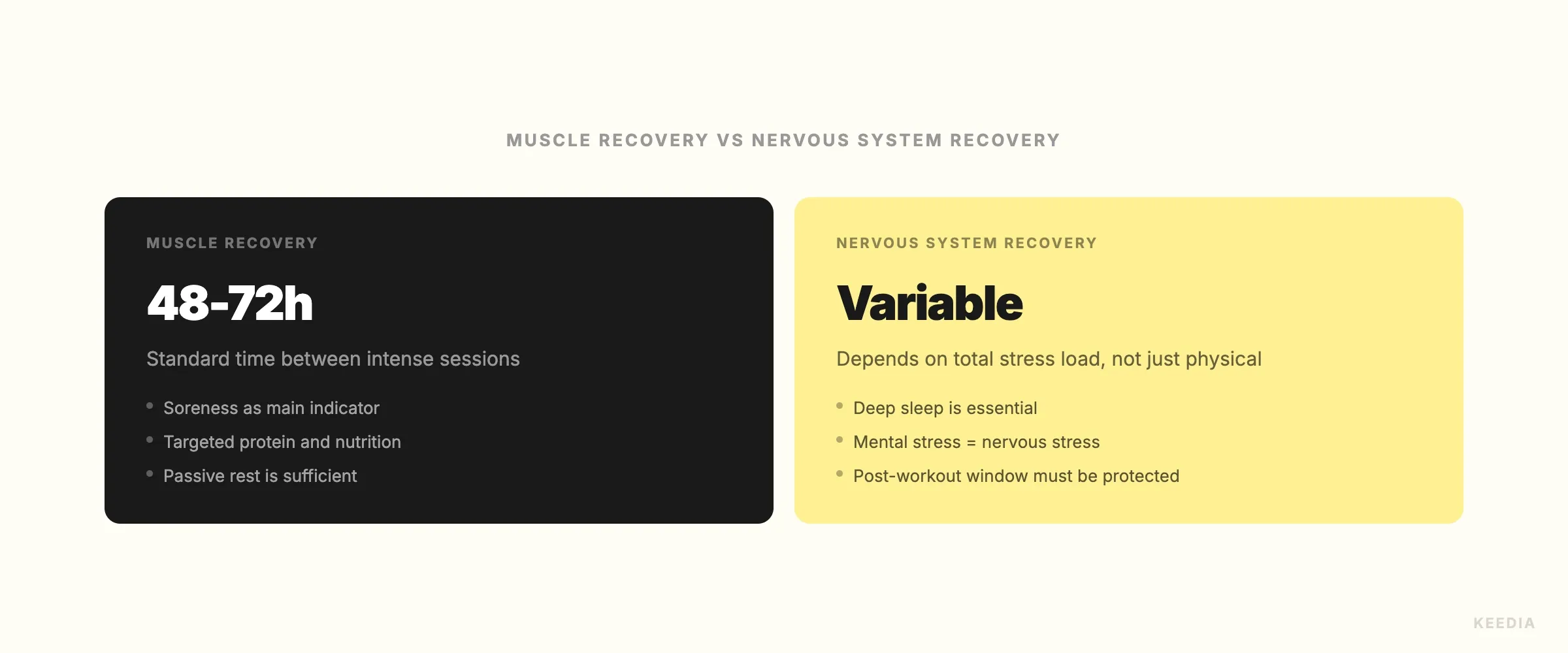
The standard model for programming rest days uses muscle soreness and perceived exertion as the primary signals. Those still matter. But nervous system readiness is a separate variable, and it doesn't always track with how sore your legs are.
You can have fully recovered quads and a nervous system that's still running depleted from three consecutive high-intensity days, a bad week of sleep, or a period of elevated life stress. Training through that state isn't grit. It's inefficiency. You're adding load to a system that hasn't finished processing the last load you gave it.
A few practical shifts:
- Use heart rate variability (HRV) as a daily readiness marker. HRV reflects autonomic nervous system status and is a more direct measure of neural recovery than soreness alone. Several consumer wearables now offer reliable HRV tracking at accessible price points, typically $30 to $250 for a capable device.
- Treat high-stress life periods as added training load. If you're in a brutal work sprint or navigating a difficult personal situation, reduce training volume or intensity accordingly. Your nervous system doesn't distinguish between emotional stress and physical stress at the neurochemical level.
- Build neural deload weeks, not just physical ones. A deload that still involves poor sleep and chronic mental overload isn't actually a deload for your nervous system. Structure lighter training weeks to coincide with periods of lower cognitive and emotional demand when possible.
- Prioritize sleep architecture, not just sleep duration. Eight hours of fragmented sleep is not equivalent to seven hours of consolidated slow-wave sleep for neural adaptation purposes. Consistent sleep timing, a cool room, and minimal alcohol improve sleep architecture meaningfully.
This also connects to findings on training failure points. New guidelines on training to failure suggest that pushing to absolute muscular failure more than once or twice per week may generate more neural fatigue than additional hypertrophy benefit. The nervous system cost of repeated failure sets is higher than it looks on paper.
Fitness Starts at Different Baselines, and So Does Neural Adaptation
One additional nuance worth raising: neural adaptation isn't uniform across fitness levels. Research has shown that less conditioned individuals need more training stimulus to achieve the same physiological results as trained athletes. That same principle likely applies to nervous system adaptation. A beginner's hypothalamus and cardiac nerves are adapting to exercise for the first time, which is metabolically and neurologically expensive.
If you're earlier in your fitness journey, this isn't a discouraging finding. It's a clarifying one. Your recovery demands are genuinely higher per unit of work performed, not because you're weak, but because your nervous system is doing more foundational remodeling. Treating recovery as an afterthought at that stage compounds the problem.
Recovery Is Now a Technical Skill
The fitness industry has been slow to operationalize recovery. Sleep advice gets a paragraph at the end of training plans. Stress management is treated as a lifestyle footnote rather than a performance variable. These new findings suggest that framing is wrong.
Building a structured recovery practice isn't optional maintenance for serious athletes. It's the condition under which the training you're already doing actually converts into the adaptations you're chasing. Your muscles respond to load. Your nervous system responds to what you do after the load.
The athletes who will get the most out of the next generation of training research aren't necessarily the ones training harder. They're the ones who understand that the brain is an organ you train, too, and start treating it accordingly.
As understanding grows around muscle quality versus sheer mass, especially as it relates to long-term health outcomes, the neural dimension of fitness becomes harder to ignore. Strength and endurance are outputs. The nervous system is the system running the output.