
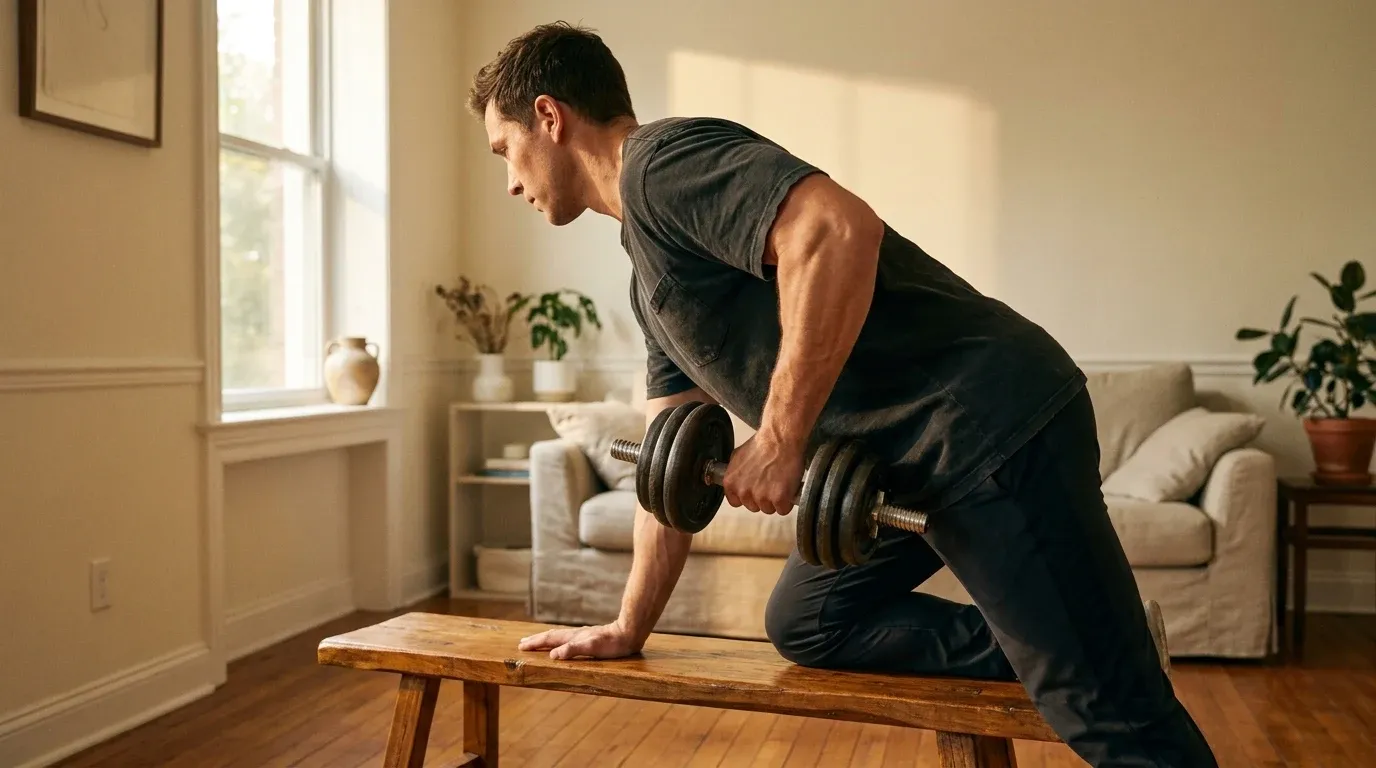
Most home workout content gives you a list of exercises and calls it a program. That's not enough. If you want to build real muscle at home, you need structure, progressive overload, and an honest understanding of what your setup can and can't deliver. Here's what actually works.
1. Apply Progressive Overload Without a Full Rack
Progressive overload is the single non-negotiable principle behind muscle growth. Your muscles need a reason to adapt, and that reason is increasing demand over time. Without a squat rack and a barbell, most people assume this is impossible at home. It isn't.
You have more levers than you think. Tempo manipulation, pauses, reduced rest periods, increased range of motion, and single-limb variations all qualify as progressive overload. A slow-tempo push-up with a three-second eccentric and a two-second pause at the bottom is harder than a standard push-up, and it produces more mechanical tension on the muscle fibers that matter.
Research consistently shows that training close to failure drives hypertrophy regardless of load. A set of bodyweight squats taken to near-failure stimulates similar muscle protein synthesis as a moderate-weight barbell set when volume is equated. The key phrase is "close to failure." Easy reps don't build muscle. Hard ones do.
Track your sessions. Write down reps, tempo, and rest periods. Increase one variable every one to two weeks. That's a progressive overload system, no barbell required.
2. Know Your Equipment Tier and Its Ceiling
Not all home setups are equal. Understanding what each tier can realistically deliver stops you from chasing results your equipment can't produce, and helps you invest smartly if you want to level up.
- Bodyweight only: Excellent for building a base of relative strength, muscular endurance, and control. Ceiling starts showing for experienced lifters trying to add significant mass to the lower body, since loading the legs heavily without external weight is genuinely difficult beyond pistol squat progressions.
- Resistance bands: Add meaningful tension and are particularly effective for upper body work. Band-resisted push-ups, rows with a door anchor, and pull-aparts produce real stimulus. The limitation is inconsistent resistance curves and difficulty quantifying load progression precisely.
- Adjustable dumbbells: The most versatile home investment for strength development. A quality set covering 5 to 50 pounds handles the majority of hypertrophy-focused training for most people. Expect to spend $200 to $400 for a reliable adjustable pair. This tier removes most ceiling concerns for beginner to intermediate lifters.
- Hybrid setups (bands + dumbbells + pull-up bar): This combination covers nearly every movement pattern and provides enough overload to support serious long-term muscle development. A pull-up bar costs under $30. Combined with adjustable dumbbells and a set of bands, you have a functional strength system for well under $500.
It's also worth noting that big gyms are adding reformer Pilates and other specialty modalities, which signals how much the industry now acknowledges that varied, lower-equipment training produces legitimate results. Home training isn't a compromise. It's a credible format.
3. The Science Says Home Training Works Better Than You Think
There's a persistent belief that gym training is categorically superior to home training for building muscle. The research doesn't fully support that. Multiple controlled studies comparing home-based resistance training to gym-based training show comparable gains in strength and muscle mass when training volume and intensity are matched.
One reason for this is that perceived effort, not location, drives adaptation. If you're consistently training hard, your muscles don't know or care whether there's a cable machine nearby. Strength training has expanded well beyond the gym environment, and the results people are achieving outside traditional facilities reflect that shift.
What does matter is adherence. A gym membership you use twice a month produces zero results. A home program you follow four times a week produces significant ones. Convenience is a performance variable, and home training has a meaningful edge there for most people's daily schedules.
High-intensity effort also compounds this equation. Research shows that even three minutes of intense effort can outperform much longer moderate sessions in terms of physiological impact. Intensity at home beats volume at the gym you rarely visit.
4. Schedule and Environment Are the Real Variables
The most underestimated factor in home training success isn't your equipment. It's your environment and your schedule. These two variables predict adherence more reliably than motivation, fitness level, or even program quality.
Environment design means making the decision to train as frictionless as possible. Keep your equipment visible, not stored in a closet. Designate a specific area, even if it's a corner of a bedroom with a yoga mat, as your training space. When that space exists, starting a session becomes a physical cue rather than a willpower decision. Research in behavioral psychology consistently shows that environmental cues outperform intention when it comes to habit formation.
Scheduling means treating your workouts as non-negotiable appointments. Block them in your calendar. Assign them a specific time that has the lowest chance of conflict based on your week. Morning training has the highest completion rate for home workouts because it happens before the day's interruptions accumulate. That said, the best time to train is consistently whenever you train.
If you're working with a coach remotely, structured accountability makes a measurable difference. Systems like WhatsApp check-ins used by coaches to maintain client follow-up have shown strong results in keeping home trainees on track between sessions. Accountability doesn't have to be expensive. It just has to be consistent.
5. Four Weekly Program Structures That Match Your Setup
Here's where this becomes immediately actionable. Each structure below maps to a specific equipment tier and a realistic training week. These are not vague templates. They are starting points you can use this week.
Bodyweight only. Three days per week, full body. Day one: push focus (push-up variations, dips using a chair, pike push-ups for shoulders). Day two: pull and hinge focus (Australian rows using a table, single-leg deadlifts, good mornings). Day three: squat and core (Bulgarian split squats, lateral lunges, plank progressions). Rest at least one day between sessions. Add one more rep or one harder variation each week.
Resistance bands only. Three to four days per week, upper/lower split. Upper days target chest, back, shoulders, and arms using band press, band row, band pull-apart, and band curl. Lower days target quads, hamstrings, and glutes using banded squat, banded Romanian deadlift, and lateral band walk. Increase band resistance every two to three weeks or add a pause to each rep.
Adjustable dumbbells. Four days per week, push/pull/legs split. Push day: dumbbell press (flat and incline), lateral raises, tricep kickbacks. Pull day: dumbbell row, dumbbell curl, rear delt fly. Legs day: goblet squat, Romanian deadlift, dumbbell lunge, calf raise. Repeat one push and one pull day per week, with legs in between. Increase load by the smallest available increment when you hit the top of your rep range for two consecutive sessions.
Hybrid setup. Four to five days per week, structured hypertrophy block. Combine a pull-up bar for vertical pulling, dumbbells for pressing and loaded leg work, and bands for isolation and warm-up activation. Structure sessions around compound movements first, isolation work second. Run four-week blocks. In weeks one and two, establish your working sets. In weeks three and four, increase load or reduce rest. Deload in week five, then repeat with new targets.
Recovery matters across all tiers. Sleep, protein intake, and managing stress are not optional extras. They're the difference between a program that produces results and one that just keeps you busy. If you're curious about recovery tools, the evidence on CBD for muscle soreness suggests it may reduce DOMS without boosting performance directly, which is worth understanding before spending money on it.
Start Where You Are, Not Where You Think You Should Be
The biggest reason home training fails isn't equipment. It's the gap between the program someone thinks they should be doing and the one they'll actually follow. Pick the tier that matches your current setup. Run the corresponding program for eight weeks before changing anything. Track your sessions. Increase one variable at a time.
Muscle responds to consistent, progressive stress. It doesn't require a specific location to do it.