

Most gym-goers pick a lane. You either lift or you run. You're either building muscle or chasing cardiovascular fitness. For years, that binary thinking shaped how people trained. New large-scale evidence suggests it's also been quietly limiting how long they live.
A study published in the British Journal of Sports Medicine, drawing on data from more than 147,000 adults, has delivered the clearest signal yet: combining strength training with aerobic exercise offers greater protection against early death than either approach alone. The numbers are hard to argue with, and they come with practical implications for how you should structure your week.
What the Study Actually Found
Researchers tracked participants across years of follow-up, cataloguing training habits and mortality outcomes. The findings were consistent and striking. Adults who did strength training alone reduced their all-cause mortality risk. Adults who did aerobic exercise alone reduced it further. But the group that combined both saw the strongest protective effect of all.
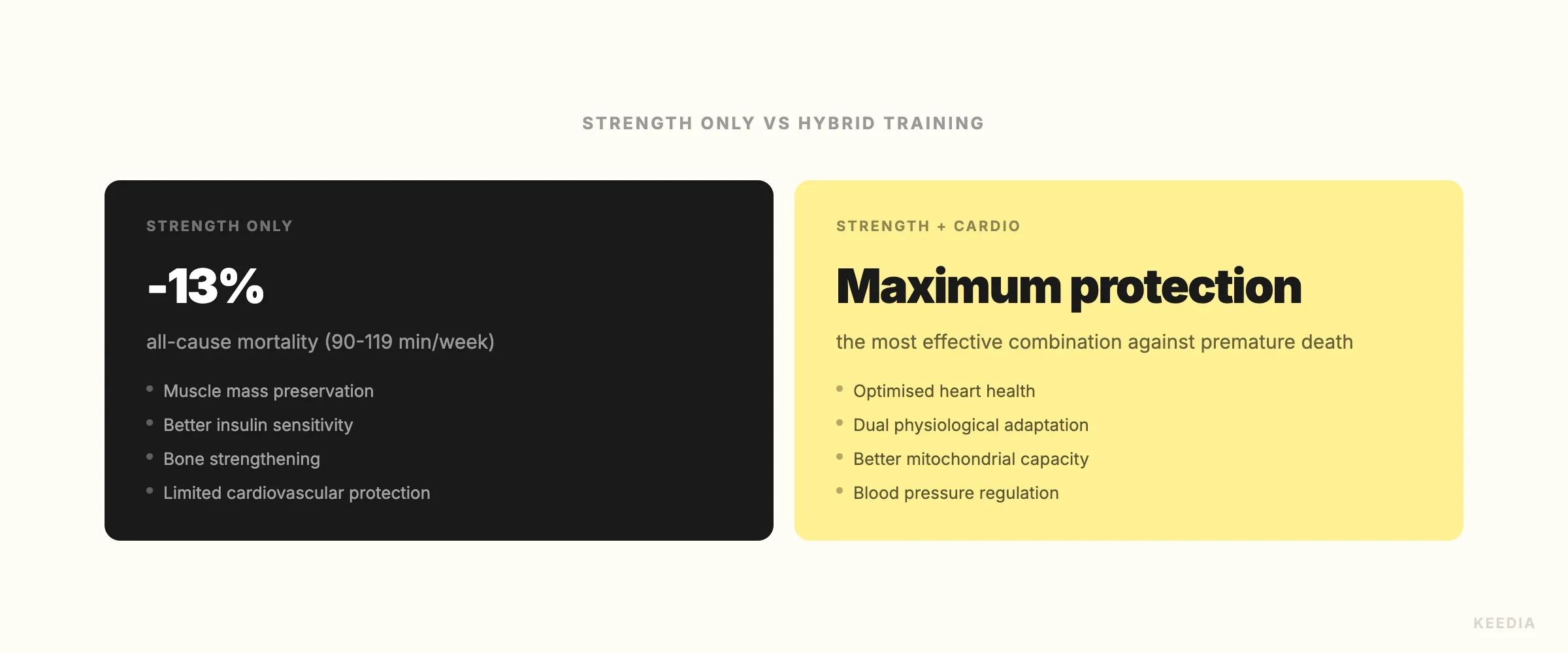
The dose matters too. Strength-only training at 90 to 119 minutes per week was already associated with a 13% reduction in all-cause mortality compared to doing nothing. That's meaningful on its own. But when moderate aerobic activity was layered on top, the risk reduction increased substantially, reinforcing that cardio isn't optional if longevity is the goal.
The study didn't require elite training volumes. The protective benefits appeared at realistic, achievable weekly commitments. That's one of the more important details buried in the data: you don't need to be an athlete to access these outcomes. You need to be consistent.

Why Both Training Modalities Work Better Together
Strength training and aerobic exercise protect the body through different but complementary mechanisms. Resistance training preserves lean muscle mass, improves insulin sensitivity, supports bone density, and maintains the metabolic activity that tends to decline with age. These adaptations reduce the risk of metabolic disease, falls, and functional decline.
Aerobic training targets cardiovascular efficiency. It strengthens the heart muscle, reduces resting blood pressure, improves oxygen delivery to tissues, and supports mitochondrial function at the cellular level. Cardio also has well-documented effects on mental health. Research consistently shows that regular aerobic activity reduces symptoms of anxiety and depression. If you're looking at exercise for anxiety and depression and what the evidence actually shows, the case for consistent cardio is strong and independent of any longevity data.
When you combine both training types, you're covering the full spectrum of physiological risk factors. The muscle mass protects your metabolic health. The cardiovascular work protects your heart and brain. The overlap produces synergistic effects that neither discipline delivers in isolation.
The Science Behind the Hybrid Training Model
This study is the largest and most rigorous endorsement yet of what the fitness industry has been moving toward for years. Hybrid training formats, which blend strength work with endurance conditioning, have grown significantly in popularity. Competitive formats like HYROX have gone from a niche European event to a globally recognized fitness category. Functional fitness, CrossFit-adjacent training, and strength-cardio programming have all gained mainstream traction.
What this data does is remove the anecdote from the argument. Hybrid training isn't just more engaging or more varied. It's more protective. The 147,000-person sample size gives this conclusion a level of statistical weight that smaller studies haven't been able to provide. This is the science catching up to what many coaches and athletes already suspected.
Nutrition plays a role in how well your body supports this kind of dual-demand training. Getting enough protein is non-negotiable when you're combining resistance work with regular cardio. The research on protein intake for muscle building is clear: adequate protein preserves lean mass, supports recovery, and maintains the muscle quality that underpins every longevity benefit listed above.
Your Evidence-Backed Weekly Training Template
The study's findings translate cleanly into a practical weekly structure. You don't need to reinvent your approach. You need to make sure both training types are present and recurring.
Here's the template that aligns most closely with the protective dose ranges identified in the research:
- 3 days of strength training: Full-body or split resistance sessions, 45 to 60 minutes each. Compound movements like squats, deadlifts, rows, and presses should anchor each session. This puts you well within the 90 to 119 minute weekly threshold where mortality benefits begin, and beyond it if you're training closer to an hour per session.
- 2 days of aerobic work: Low-to-moderate intensity cardio, 30 to 45 minutes per session. Walking, cycling, rowing, swimming, or a steady-state run all qualify. You don't need high-intensity intervals to access cardiovascular protection, though you can include them periodically if recovery allows.
- 2 days of active recovery or rest: Recovery isn't passive. Sleep, mobility work, and nervous system management are part of the structure. Understanding whether your nervous system is ready to train is increasingly relevant here, particularly if you're stacking multiple training days back to back.
This 3-2-2 structure is adaptable. If your schedule only allows two strength sessions, that still falls within the protective range. If you want to add a third cardio day, the data supports doing so. The key principle is that neither strength nor aerobic work disappears from the week entirely.
Common Mistakes That Undercut the Benefits
The most frequent error is treating cardio as a punishment or afterthought. Many gym-goers log their three lifting sessions and call it done. The study data suggests that approach leaves meaningful longevity benefits on the table. Aerobic work isn't filler. It's half the formula.
The second mistake is overcomplicating recovery. Adding a sauna session to your post-training routine, for example, is a legitimate recovery tool. Research on sauna frequency, duration, and temperature suggests regular heat exposure supports cardiovascular recovery and reduces inflammation. But recovery habits only work if the training load they're supporting is also structured correctly.
A third mistake is ignoring the nutritional side of hybrid training. Running a high-output weekly schedule without adequate fueling accelerates fatigue and blunts the adaptations you're training for. The quality of your diet affects both the cardiovascular and muscular outcomes you're chasing. Research into legumes and cardiovascular health is one example of how dietary choices directly intersect with the same outcomes this study is measuring.
Who This Applies To
The 147,000-person dataset wasn't made up of elite athletes. It reflected real adults living real lives, which is exactly what makes the findings applicable to you regardless of your current fitness level.
If you're new to training, the message is straightforward: start with both. Don't spend six months lifting before you add cardio. Don't spend a year running before you pick up weights. The combination delivers a greater return than any linear approach.
If you've been training for years and already use a hybrid model, this data validates what you're doing and offers a framework to check your ratios. Are you getting enough weekly resistance work? Are your aerobic sessions consistent, or do they disappear the moment your schedule gets busy?
If you're coming back from time off, this study also provides a useful baseline. You don't need to hit elite volumes to see protective outcomes. You need to hit the floor. And the floor, based on this data, is surprisingly accessible.
The Bigger Picture
What this research makes undeniable is that training for longevity isn't about picking the right sport or following the perfect program. It's about covering both physiological bases, consistently, across years of your life.
The hybrid training model isn't a trend. It's an evidence-backed framework for staying alive longer and functioning better while you do. The 147,000-person study is the strongest large-scale confirmation of that yet, and the template it supports is one you can start applying this week.
Three days lifting. Two days cardio. Two days recovery. That's not a complicated ask. It's just the most evidence-backed version of a training week currently available.