
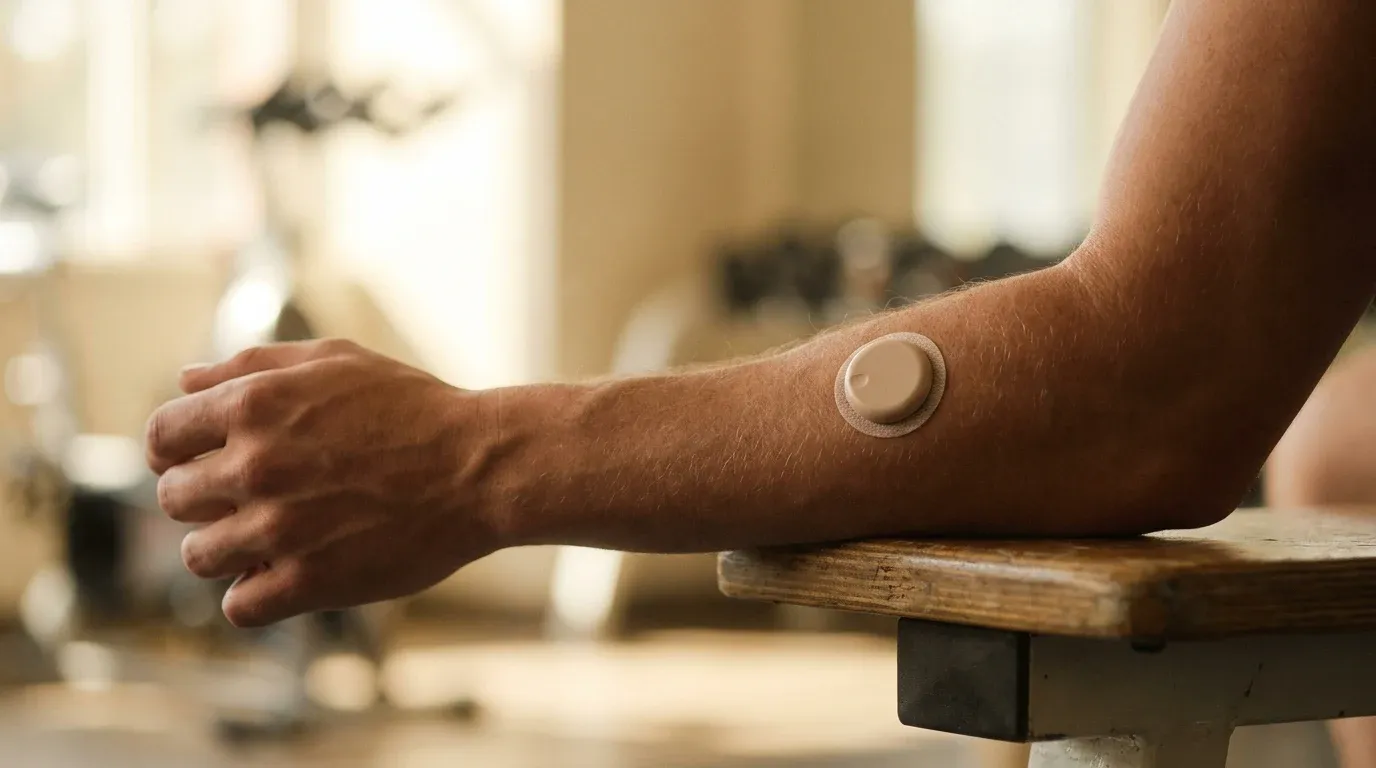
For years, continuous glucose monitors (CGMs) were reserved for people managing diabetes. You needed a prescription, a doctor's visit, and a clinical reason to strap one on. That's changed. The FDA has cleared over-the-counter CGMs for non-diabetic users, and the devices are already hitting pharmacy shelves and fitness apps. If you lift, this matters more than you might think.
Real-time blood sugar data used to be the kind of edge only elite sports programs could afford. Now it's available to anyone willing to pay roughly $89 to $150 per month for a sensor. What you do with that data, though, is a different question entirely.
What a CGM Actually Measures
A CGM is a small sensor worn on your upper arm or abdomen that reads glucose levels in interstitial fluid every few minutes. It syncs to an app, giving you a continuous graph of how your blood sugar rises and falls throughout the day. You can see what happens after meals, during workouts, during sleep, and under stress.
For people without diabetes, blood glucose typically stays within a range of roughly 70 to 140 mg/dL. The goal for most healthy individuals is to avoid dramatic spikes and crashes. But here's where it gets interesting for lifters: even within that "normal" range, the pattern of your glucose response has real implications for body composition, energy, and recovery.
Glucose is the primary fuel source for high-intensity training. How efficiently your body manages it before, during, and after a session can influence how hard you train, how quickly you recover, and whether you're storing or burning fuel.
Individual Variation Is the Whole Point
One of the most important things research on CGMs has revealed is how wildly different people respond to the same foods. A study tracking identical meals across hundreds of participants found that blood sugar responses varied dramatically from person to person. Two lifters eating the same pre-workout meal can have completely different glucose curves.
This makes generic carb timing advice unreliable at the individual level. The conventional recommendation to eat fast carbs 30 to 60 minutes before training might cause one person to spike and crash mid-session while another performs perfectly on the same approach. A CGM lets you stop guessing and actually see your response.
This also connects to broader fueling concerns that don't always get enough attention. 80% of female athletes are underfueling, often because they're working off generalized calorie or carb guidelines that don't reflect their actual metabolic response. Personalized glucose data gives a clearer picture of whether the fuel you're taking in is actually getting used the way you intend.
What the Data Tells You About Training Windows
CGMs can reveal something most training programs never address: your natural glucose rhythm across the day. Some people show higher fasting glucose and more stable daytime readings, making them better candidates for morning training. Others show a stronger post-meal glucose response in the afternoon, which can translate to better energy availability for later sessions.
Tracking your glucose in relation to your workouts can help you answer a few specific questions:
- Are you starting your session in an optimal fuel state? A glucose reading that's too low going into a heavy lift can compromise strength output and increase cortisol response.
- Are you recovering glucose efficiently post-training? After resistance training, muscles become highly insulin sensitive, making it an ideal time to replenish glycogen without excess fat storage.
- Are your carb sources actually working for you? You might find that white rice spikes you sharply while oats give you a more stable curve, or vice versa. The answer isn't the same for everyone.
These insights don't replace structured programming, but they add a layer of personalization that's genuinely hard to get any other way. If you're trying to decide how to structure your nutrition around training, the data from even two weeks of CGM wear can shift your approach significantly. This ties directly into the decision-making behind body composition phases. Knowing when to bulk or cut requires understanding how your body is currently responding to fuel, not just what the scale says.
CGMs and the Plateau Problem
Plateaus are frustrating because they feel random. You're training consistently, eating reasonably, and nothing is moving. More often than not, the issue is somewhere in the gap between what you think you're doing and what's actually happening metabolically.
CGM data can expose a few common plateau drivers that are otherwise invisible:
- Chronic low-grade glucose instability. Frequent blood sugar fluctuations throughout the day can elevate cortisol and contribute to increased fat retention, particularly around the midsection. You might not feel these swings, but your body is responding to them.
- Suboptimal pre-workout fueling. If you're consistently starting sessions in a depleted or poorly fueled state, training intensity drops subtly over time. The workouts feel fine, but you're not generating the stimulus you think you are. Research supports a dose-response relationship between training volume and muscle gain, which means underperforming sessions compound over time. A 140,000-person study on weekly lifting dose reinforces how much training quality matters for outcomes.
- Post-workout nutrition mistiming. Eating too long after resistance training means missing the window of peak muscle insulin sensitivity. A CGM makes that post-exercise glucose curve visible, so you can time your refeed with more precision.
None of these are revolutionary ideas, but CGM data moves them from theory to observable feedback. That's the difference between adjusting your approach based on results you can see versus guessing based on general principles.
What CGMs Won't Tell You
It's worth being direct about the limits. A CGM measures glucose. It doesn't measure muscle protein synthesis, hormonal status, sleep quality, or training readiness. It's one data stream, not a complete performance picture.
There's also a real risk of over-interpreting the data. Seeing a post-meal glucose spike of 30 to 40 mg/dL is not automatically a problem. That's often a normal, healthy response to eating carbohydrates. Chasing a perfectly flat glucose line is not the goal and can actually push people toward unnecessarily restrictive eating patterns.
If you're already dealing with signs of overtraining, adding another layer of data monitoring without addressing recovery fundamentals won't fix the underlying issue. CGM data is most useful when the basics are already in place: consistent sleep, adequate protein, a structured program, and appropriate rest periods. On that last point, knowing when to back off is a skill in itself. Understanding when a deload week is warranted is part of any serious long-term lifting strategy.
CGMs also don't account for the psychological weight of constant self-monitoring. For some people, that level of real-time feedback is motivating and clarifying. For others, it breeds anxiety or disordered relationships with food. Know yourself before you commit to wearing one for months on end.
How to Get Started Without Overcomplicating It
If you decide to try a CGM, here's a practical approach that won't send you down a rabbit hole of obsessive data tracking.
Wear the sensor for two full weeks without changing anything in your diet or training. Just observe. You're establishing a baseline and learning how your body responds to your current habits. Note your glucose patterns around workouts, meals, sleep, and rest days.
In week three, make one targeted adjustment. Maybe you shift your pre-workout meal timing, swap a carb source, or add a small protein-and-carb snack post-training. Track how that single change affects your curve. This methodical approach gives you clean, usable information rather than chaos.
After a month, you'll likely have enough data to make two or three meaningful adjustments to your fueling strategy. At that point, many users find they don't need to wear the sensor continuously. They've built an accurate internal model of how their body responds and can check in periodically rather than monitoring constantly.
The Bottom Line
Over-the-counter CGMs don't replace a solid training program, consistent nutrition, or adequate recovery. But they do give you something that was genuinely inaccessible to most people six months ago: real-time, personalized metabolic data. For lifters stuck at a plateau, trying to optimize body composition, or simply curious about how their body actually responds to food and exercise, that's a meaningful tool.
Use the data to ask better questions about your fueling. Don't use it to chase perfection. Your glucose isn't a performance score. It's a signal, and learning to read it accurately takes a few weeks of honest observation before it becomes genuinely useful.