
You've probably met someone at the gym who seems to glide through workouts that leave you gasping. Their form is effortless. Their recovery is fast. They never seem to be working quite as hard as everyone else. New animal research suggests that gap might have roots in childhood, specifically in how much you moved when your body was still developing.
A study published October 14, 2026 found that physical activity during growth fundamentally reshapes movement mechanics, making exercise measurably less costly in terms of energy expenditure in adulthood. The implications for anyone who has ever felt like training is harder for them than it seems to be for others are significant.
What the Research Actually Found
The study used guinea fowl as its model, a species that researchers favor for biomechanical research because their locomotion shares meaningful structural parallels with human gait. Young birds were assigned to carry small loads during their growth period, essentially introducing resistance to their natural movement patterns from an early age. A control group remained sedentary through the same developmental window.
When both groups reached adulthood, the researchers compared how much energy each group burned performing identical movements. The birds that had been active with resistance during growth used significantly less metabolic energy to complete the same tasks than their sedentary counterparts. The difference wasn't about fitness in the conventional sense. It was about mechanical efficiency rooted in how the musculoskeletal system had developed.
In other words, early physical activity didn't just make the birds stronger or more conditioned. It changed the underlying architecture of how they move, and that architectural advantage carried forward into adulthood without any additional training required to maintain it.
Why This Might Apply to You
Animal models are never a direct one-to-one translation to humans, and the researchers are appropriately cautious about overstating the findings. That said, the biological mechanisms involved, including tendon development, bone geometry, muscle fiber composition, and the structural relationship between joints and load-bearing tissues, are not unique to birds. These are systems that develop in all vertebrates, including humans, and they're most plastic during growth phases.
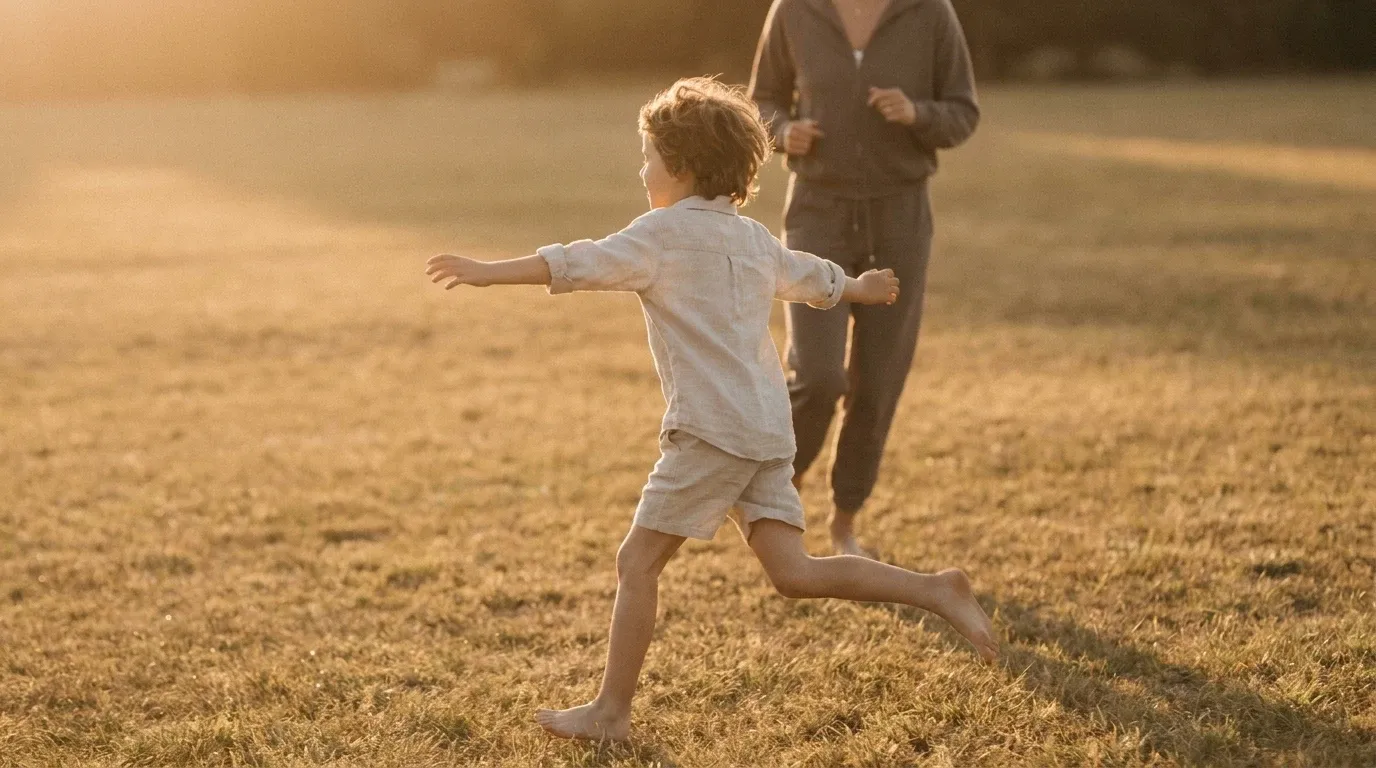
Childhood is the window when musculoskeletal tissue is most responsive to mechanical loading. Kids who run, jump, climb, and play sports aren't just burning energy. They're giving their tendons, bones, and muscles the mechanical input that shapes how those structures ultimately form. That shaping process appears to influence how efficiently the adult body can move.
This connects to what exercise scientists have observed in human populations for years: people who were physically active during childhood tend to demonstrate better movement economy as adults, even after accounting for current fitness levels. The new guinea fowl data gives that observation a more precise mechanistic explanation.
The Energy Cost of Movement Is Not Equal for Everyone
Here's something most gym programming doesn't account for: the metabolic cost of a given movement varies considerably between individuals. Two people doing the same squat with the same load are not necessarily experiencing the same physiological demand. Limb length, tendon stiffness, muscle insertion points, and joint geometry all affect how efficiently force is produced and transferred. Some of those variables are influenced by genetics. Others, this research suggests, are shaped by movement history during development.
If you grew up sedentary, whether due to circumstance, health, geography, or simply the way your childhood was structured, your musculoskeletal system may have developed with less mechanical optimization than someone who spent their youth playing team sports or doing physical labor. That's not a moral failing. It's a biological reality with practical consequences for how hard exercise feels.
This also partially explains why some people respond to training so much faster than others. When movement is already mechanically efficient, adding load or volume on top of that foundation produces different results than building from a less optimized baseline. The foundation itself matters.
What This Means for Adult Gym-Goers
The honest answer is that you can't go back and redo your childhood. But the research doesn't suggest you're stuck, either. It offers context, not a ceiling.
Musculoskeletal tissue retains some degree of adaptability throughout life. Tendon stiffness, for example, responds to consistent loading even in older adults. Bone density can be improved with resistance training at any age. The adaptations are slower and less dramatic than they would have been during a developmental growth phase, but they're real. Understanding how to train after 30 without getting injured becomes especially relevant here, because the goal for adults who are building an efficiency foundation later is consistency over intensity.
If exercise feels disproportionately hard for you compared to your training partners, a few things may be true simultaneously. Your cardiovascular system may need more time to adapt. Your movement patterns may be less economical, which means technique work has a higher return on investment for you than for someone who grew up in sport. And your perception of effort may be calibrated differently because your body is spending more energy per repetition.
None of that means training less. It means training smarter, with realistic expectations and a longer time horizon.
The Compounding Effect of Early Activity
What makes this research particularly striking is the duration of the effect. The guinea fowl that were active during growth maintained their mechanical efficiency advantage as adults, even without ongoing structured activity between the developmental window and testing. The adaptation wasn't temporary. It was built into how the body assembled itself.
For humans, this reinforces what developmental pediatricians and physical educators have argued for decades: getting kids moving isn't just about preventing childhood obesity or building healthy habits. It's about giving the musculoskeletal system the inputs it needs during the window when those inputs have the most lasting structural effect.
Research into how movement habits shift across the lifespan, including how daily activity targets change meaningfully with age, underscores that the relationship between movement and the body is not static. The earlier that relationship is established, the deeper the structural roots it puts down.
There's also a broader wellness dimension here. Exercise doesn't just build fitness. It reshapes biology in ways that compound over time. The molecular mechanisms by which exercise reverses muscle aging are still being mapped, but what's becoming clear is that physical activity interacts with development and aging in ways far more fundamental than calorie burn or cardiovascular output alone.
For Parents and for Anyone Starting Late
If you have children or are involved in youth development, this research adds another layer to the case for unstructured outdoor play, youth sports programs, and physical education. You're not just building healthy kids. You may be influencing the metabolic efficiency of their adult movement for life.
If you're an adult who came to fitness late, perhaps after a sedentary childhood or years away from exercise, you're not building from zero. You're building from a different starting point. Coaches who work with people returning to training after long breaks, whether after illness, injury, or simply years of inactivity, often note that progress can feel frustratingly slow at first before the body begins to adapt. Returning to structured movement after a significant physical transition requires patience and a willingness to let adaptation happen on its own timeline.
The key is consistency. The research identifies childhood activity as a powerful shaper of adult movement efficiency, but it doesn't suggest that adult training is futile for those who missed that window. What it does suggest is that for late starters, the adaptation timeline is longer, and the importance of not quitting too soon is higher.
The Bigger Picture
Exercise science is increasingly moving away from a one-size-fits-all model of training. Individual variation in response to exercise is real, large, and rooted in factors that go well beyond current fitness level or motivation. Genetics, sleep quality, nutrition, stress load, and now developmental movement history all contribute to why two people following the same program can have dramatically different experiences.
That's not a reason to give up. It's a reason to stop comparing your output to someone else's and start paying closer attention to your own trajectory. Training intelligently in adulthood means accounting for the full picture of what your body brings to each session, including the history it carries that you may not even be aware of.
The goal isn't to replicate the movement efficiency of someone who grew up playing competitive sport. The goal is to build the most efficient version of your own movement, starting from wherever you are, and to keep building long enough for the adaptations to accumulate. That's always been the real work of training. This research just explains more clearly why it's worth doing.