
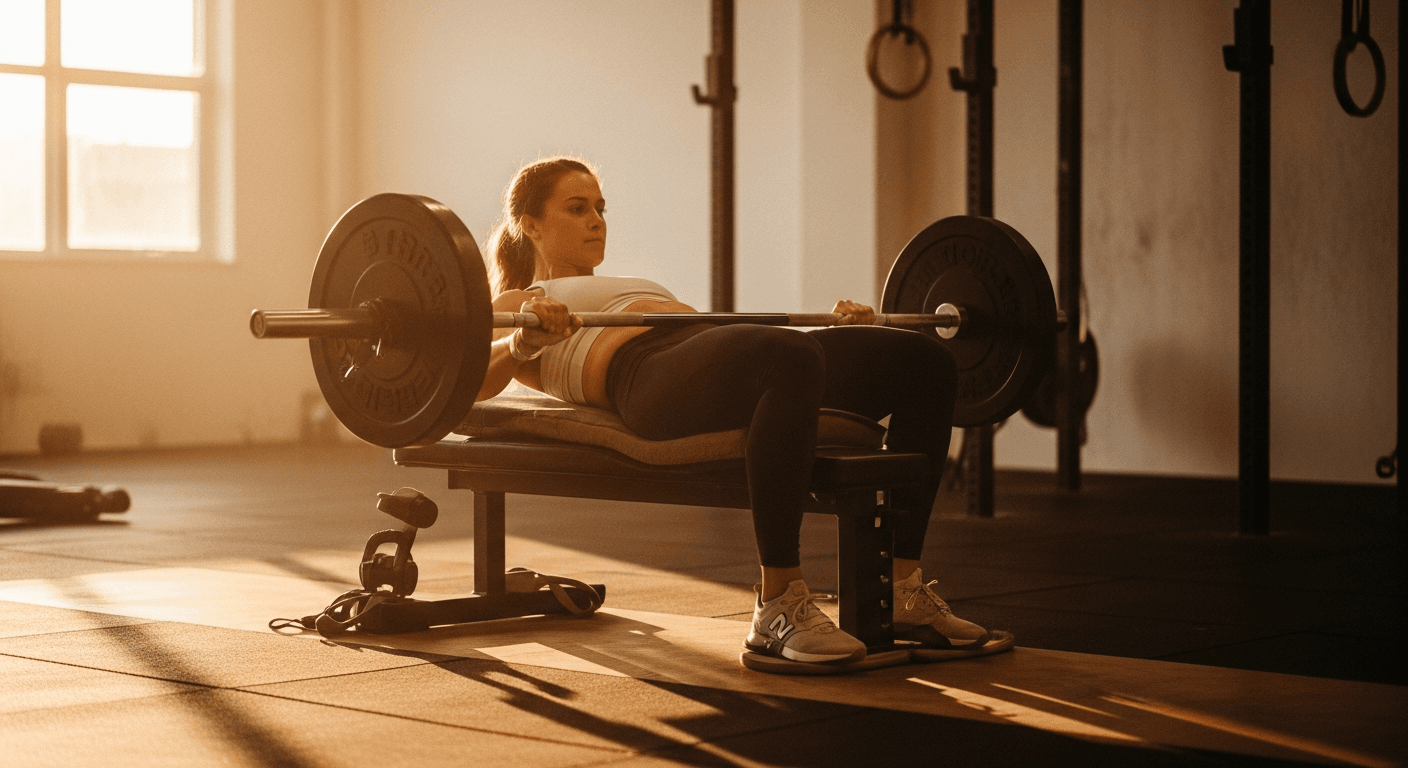
Most lifters who want stronger, better-developed glutes do the same thing: squat more. It's an understandable instinct, but it leaves a significant amount of potential on the table. The research is clear that squats, deadlifts, and hip thrusts each load the glutes in fundamentally different ways. A program built around only one of them is an incomplete program.
This guide builds a practical, science-backed weekly glute training structure from the ground up. Not a rough outline. A real program with exercise selection, frequency, volume targets, and the most common mistakes that quietly stall progress.
Why the "Just Squat More" Approach Falls Short
The three primary glute exercises differ not just in feel but in their strength curves. A strength curve describes where in a movement's range of motion a muscle produces the most force, and for glute development, this distinction matters enormously.
Hip thrusts peak in glute activation at full hip extension, the top of the movement, where your hips are locked out against the bench. Squats produce the highest glute activation in the bottom position, often called "the hole," when the hip is deeply flexed and the muscle is under a significant stretch. Deadlifts, by contrast, load the glutes across a broader portion of the range of motion, making them a strong complement to both.
This means each exercise fills a role the others don't. Relying exclusively on squats trains the glutes under a stretch but neglects the shortened position where hip thrusts dominate. Prioritizing only deadlifts gives you range but misses the targeted peak contraction that drives hypertrophy in the fully extended position. Programming all three isn't redundancy. It's coverage.
The Three Categories Your Program Needs
Beyond the big compound lifts, a complete glute program requires coverage across three loading categories. Miss any one of them and you're almost certainly under-developing part of your glutes.
Horizontal loading includes exercises like hip thrusts and glute bridges. These load the glutes in hip extension, where the muscle is most active at its shortest length. Research consistently shows hip thrusts produce higher gluteus maximus activation than squats, particularly in the top range. They belong at the start of your program, not as an afterthought.
Vertical loading covers squats, Romanian deadlifts, and conventional deadlifts. These recruit the glutes heavily under stretch, which is a key driver of muscle growth. Romanian deadlifts are especially useful here because they extend the range of the hip hinge and keep the glutes under tension longer than a conventional pull.
Abduction work targets the gluteus medius and gluteus minimus, the two muscles that sit on the side of your hip and are almost entirely neglected in standard strength training. Banded lateral walks, clamshells, and cable hip abductions are the tools here. Skipping this category means roughly a third of your glute musculature is undertrained, which affects both aesthetics and hip stability.
How Often Should You Train Glutes
Frequency is one of the most debated variables in hypertrophy training, and the glutes are a useful case study. The gluteus maximus is a large, powerful muscle, but it also recovers relatively quickly compared to smaller muscles like the biceps or calves. For intermediate and advanced lifters, 3 to 4 dedicated glute sessions per week is feasible without accumulating excessive fatigue.
Beginners typically do well with 2 focused sessions per week, allowing more recovery time as the muscle adapts. Intermediate lifters can push toward 3 sessions. Advanced lifters chasing growth can structure 4 sessions per week by distributing volume intelligently, alternating heavier compound work with lighter isolation and abduction days.
The key word is "dedicated." Training glutes at the end of a session when you're already depleted from squats and pulls is one of the most common programming errors in the gym. If glute development is a priority, move hip thrusts or glute-specific work to the start of at least some of your sessions. Fatigued muscles don't develop as efficiently, and consistently saving your hardest target for the end of training is a reliable way to slow your results.
Volume: How Many Sets You Actually Need
The research on hypertrophy volume gives us useful landmarks. For the gluteus maximus, a maintenance range sits around 10 sets per week. Growth begins to occur from roughly 10 to 20 sets per week, with the sweet spot for most intermediate and advanced lifters sitting between 16 and 20 sets per week.
Going significantly beyond 20 sets per week is where the returns start diminishing and recovery becomes a limiting factor. More volume is not automatically better volume. The goal is progressive, trackable overload within a manageable weekly total.
Here's a practical way to distribute that volume across a week:
- Session 1 (Heavy horizontal focus): Barbell hip thrusts 4 sets, Romanian deadlifts 3 sets, cable hip abduction 3 sets. Total: 10 sets.
- Session 2 (Vertical focus): Barbell back squat or Bulgarian split squat 4 sets, conventional deadlift 3 sets. Total: 7 sets.
- Session 3 (Lighter isolation and abduction): Dumbbell hip thrusts or glute bridge 3 sets, banded lateral walks 3 sets, cable kickbacks 3 sets. Total: 9 sets.
That lands you at roughly 26 working sets across the week, which sits at the upper end for most lifters. If you're earlier in your training, start with Sessions 1 and 2 only, totaling around 17 sets, and add the third session when recovery allows.
A Sample Weekly Structure
Here's how those sessions might fit into a realistic training week:
- Monday: Session 1 (heavy horizontal, abduction)
- Tuesday: Upper body or rest
- Wednesday: Session 2 (vertical loading)
- Thursday: Upper body or rest
- Friday: Session 3 (lighter glute isolation)
- Saturday: Full body or active recovery
- Sunday: Rest
This structure gives you roughly 48 hours between each glute session, which is enough for the gluteus maximus to recover while still accumulating weekly volume in a productive range. You can also rotate exercise variations week to week to reduce repetitive stress and maintain training engagement without disrupting the underlying structure.
The Mistakes Quietly Killing Your Glute Progress
Beyond neglecting hip thrusts and skipping abduction work, a few other patterns reliably stall glute development.
Treating all sets as equal. Three sets of hip thrusts with poor lockout and no mind-muscle connection are not equivalent to three sets performed with deliberate hip extension and a controlled tempo. Technique quality matters more in glute training than in most lifts because the muscle is easy to underload relative to your actual effort level. You can grind through a set of squats and still get a training effect. With hip thrusts, sloppy reps often just recruit the lower back and hamstrings instead.
Never progressing the load. Glute training attracts a lot of high-rep, light-load work, partly because hip thrusts feel awkward with heavy barbells and partly because the burn from banded work feels productive. Both are fine tools. But progressive overload is the primary driver of hypertrophy. If you've been doing the same band resistance and the same dumbbell hip thrust weight for three months, your glutes have adapted. They need a new stimulus.
Ignoring sleep and recovery. Muscle growth happens between sessions, not during them. Consistent, quality sleep is one of the most underutilized tools in any training program, and it's especially relevant when you're pushing toward 3 to 4 sessions per week. If recovery is compromised, frequency becomes a liability rather than an advantage.
Copying programs designed for other goals. A powerlifting program will develop strong glutes as a byproduct, but it's not designed for glute hypertrophy. A general fitness program will likely undertrain the glutes entirely. If glute development is your priority, your program needs to reflect that explicitly, not as a side effect of something else.
Putting It Together
The framework here is straightforward: cover all three loading categories, train with enough frequency to accumulate 16 to 20 meaningful sets per week, prioritize glute work when you're fresh rather than fatigued, and progress your loads over time.
The specifics can flex around your schedule and equipment. You don't need a barbell for every session. Dumbbell hip thrusts, resistance bands, cable machines, and bodyweight split squats all work within this structure. What doesn't flex is the underlying principle: volume and effort have to be managed strategically, not simply maximized.
Build the structure first. Then fill it with exercises that match your equipment and experience level. That's the version of glute training that actually produces results over months, not just soreness after a single session.