
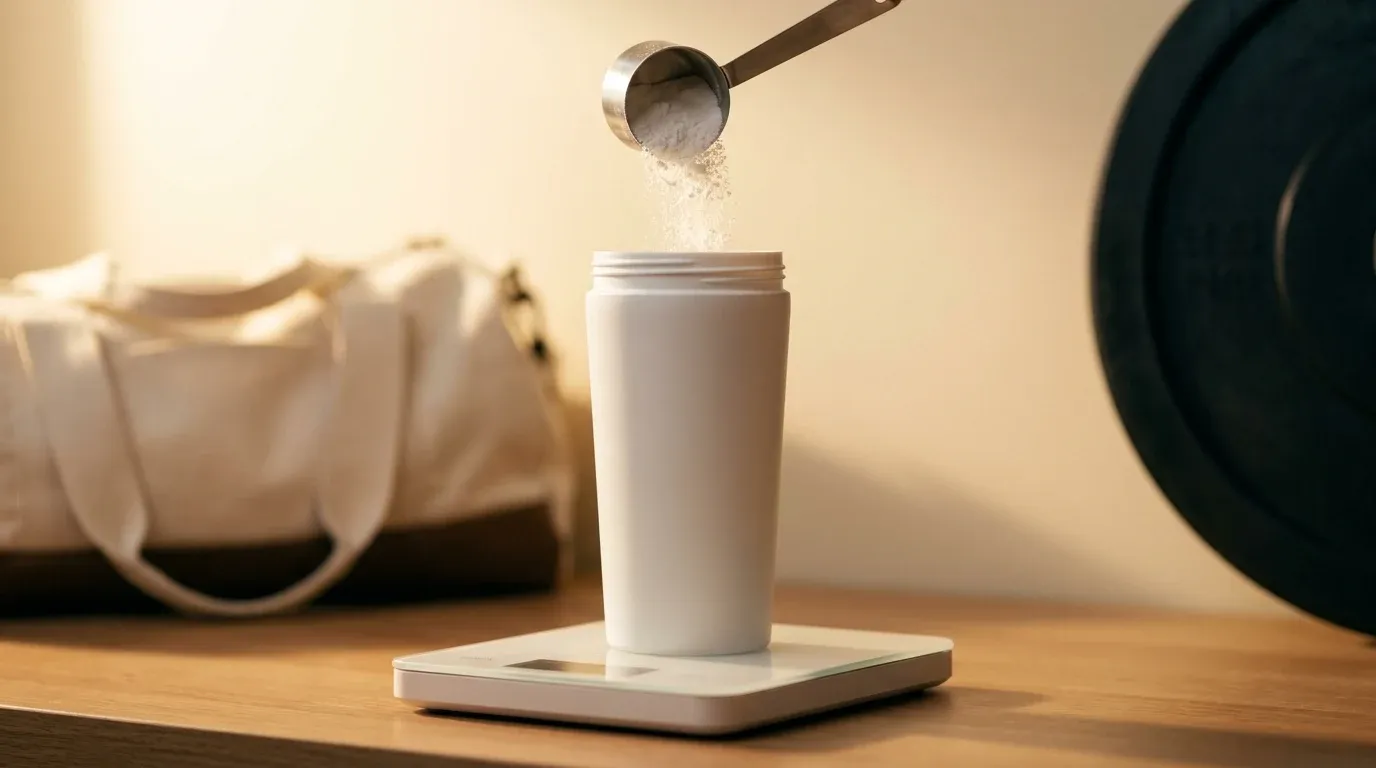
The number one reason lifters avoid creatine isn't doubt about its effectiveness. It's fear. Specifically, the fear of stepping on the scale after two weeks and seeing a number that looks like fat gain. That fear is understandable, but it's based on a fundamental misreading of what creatine actually does inside your body.
Here's the short version: creatine does cause weight gain. But the weight you're gaining in the early weeks isn't fat. It isn't even really new tissue. Understanding exactly what it is, and why it happens, changes the entire calculation.
What Creatine Does at the Cellular Level
Creatine is stored primarily in skeletal muscle as phosphocreatine. When you supplement with creatine monohydrate, you're increasing the total creatine content of your muscle cells. And creatine is osmotically active, meaning it pulls water into the cells where it's stored.
This is intramuscular water retention. Not subcutaneous water sitting under your skin, giving you a puffy or bloated appearance. The water is being drawn into the muscle fibers themselves. For most people, this process accounts for the bulk of scale weight gained during the first one to two weeks of supplementation.
Research consistently shows that an initial loading phase (typically 20g per day split into four doses over five to seven days) produces between 0.9kg and 1.8kg (roughly 2 to 4 pounds) of scale weight increase. This is almost entirely fluid. A standard maintenance dose of 3 to 5g per day produces a smaller, more gradual increase over two to four weeks.
Water Retention vs. Fat Gain: Why the Distinction Matters
Fat gain requires a sustained caloric surplus. Your body doesn't manufacture adipose tissue from a supplement. Creatine contains no calories. It doesn't trigger insulin release. It doesn't alter fat metabolism in a way that promotes storage. The idea that creatine causes fat gain isn't just unsupported by research. It contradicts basic physiology.
The confusion comes from the scale. Most people don't experience their weight gain as "this is clearly water inside my muscles." They experience it as numbers going up, clothes feeling slightly tighter around the waist, and mild bloating during the loading phase. The loading phase bloating is real, though it's temporary and relates to gastrointestinal adaptation rather than fat accumulation. Skipping the loading phase and going straight to 3 to 5g per day eliminates most of this for the majority of users.
If you're tracking body composition rather than just scale weight, the picture becomes clearer. Tools like DEXA scans, bioelectrical impedance (used consistently), or even progress photos and tape measurements show that fat mass doesn't increase in response to creatine supplementation. This is one of many reasons why leaning on scale weight alone is a poor metric. If you haven't thought carefully about this distinction, Body Composition vs BMI: Which Number Actually Matters? is worth reading before you make any supplement decisions.
What the Latest Research Actually Shows
The science on creatine is unusually solid. With over 500 peer-reviewed studies published, it's one of the most researched sports supplements in existence. But newer research has added important nuance around how its effects on water retention and actual muscle hypertrophy interact and differ.
For years, some researchers debated whether creatine's performance benefits were primarily driven by water-induced cell swelling (which can act as an anabolic signal) or by its well-established role in ATP regeneration during high-intensity efforts. Recent work suggests both mechanisms contribute, but they operate on different timelines.
The water retention happens fast. Within days. The genuine hypertrophy, the actual growth of contractile muscle tissue driven by creatine's ability to support greater training volume over time, develops over weeks and months. This matters because it means the scale weight you see at week two is not a preview of your final physique. It's a temporary fluid shift on top of a foundation that's actually building.
One well-designed meta-analysis examining resistance-trained individuals found that those supplementing with creatine gained significantly more lean mass over 4 to 12 weeks compared to placebo groups, even after controlling for water retention. The gains were real. They just arrived on a timeline that requires patience.
Week by Week: What to Expect
Setting realistic expectations is the best thing you can do before starting creatine. Here's a general breakdown of what the evidence suggests for most people using a maintenance-dose approach (3 to 5g per day, no loading phase):
- Days 1 to 7: Muscle creatine stores begin saturating. You may notice a slight increase in scale weight (0.5 to 1kg is typical) and potentially a modest improvement in workout performance, though this varies by individual.
- Weeks 2 to 3: Stores are approaching saturation. The scale weight increase is mostly complete at this stage. Some people report feeling slightly fuller in the muscles, which is an accurate perception. This is the window where people often panic and stop supplementing.
- Weeks 4 to 8: The performance benefits start compounding. You're training harder, recovering better, and completing more volume. This is where genuine hypertrophy begins to separate creatine users from non-users in research settings.
- Beyond 8 weeks: The water retention stabilizes and becomes background noise. Any additional weight gain from this point is driven by actual muscle growth and your caloric intake, not the supplement itself.
It's worth noting that individual response varies. About 25 to 30 percent of people are classified as "creatine non-responders," typically because their baseline muscle creatine levels are already high. These individuals will see minimal scale changes and minimal performance benefits. If you're eating a high amount of red meat regularly, you may fall into this category.
The Factors That Actually Drive Fat Gain
If you start creatine and gain fat, creatine isn't the culprit. Fat gain happens when energy intake consistently exceeds energy expenditure over time. Full stop.
What sometimes happens is that people start a new training program alongside creatine, feel stronger, train harder, develop a bigger appetite, and eat more. If that increased eating tips them into a surplus, body fat can increase. This isn't the supplement's fault. It's a tracking and awareness issue.
Similarly, if your training is poorly structured or you're doing more than your recovery can handle, the performance benefits of creatine won't materialize the way you expect. Overtraining Without Rest Is Quietly Wrecking Your Progress covers why more isn't always more, and that applies whether you're supplementing or not.
Should You Be Worried About Bloating?
Mild bloating during early creatine use is the most commonly reported side effect, and it's usually tied to the loading phase or to taking creatine on an empty stomach. For most people, it resolves within the first two weeks without any intervention.
Practical steps that reduce bloating include skipping the loading phase, splitting your daily dose if you're sensitive (2.5g twice a day instead of 5g at once), taking it with a meal, and drinking adequate water throughout the day. Staying well-hydrated actually helps manage the fluid dynamics rather than making retention worse.
If you're dealing with significant gastrointestinal discomfort, creatine hydrochloride (HCl) is more soluble and sometimes better tolerated, though the evidence base for it is smaller than for monohydrate. Monohydrate remains the gold standard for a reason. It's cheap, extensively studied, and effective. A month's supply typically costs $15 to $25 in the US, making it one of the most cost-efficient supplements available.
Making an Informed Decision
Creatine is not a magic supplement, but it's close to the opposite of a dangerous one. The evidence for safety across long-term use (multiple years) is robust. The evidence for performance and hypertrophy benefits in resistance training is among the strongest in sports nutrition research.
Avoiding it because the scale goes up by two pounds in the first two weeks is, to put it plainly, letting a misleading metric drive a decision that could cost you meaningful training progress. If you're building a program designed for strength or muscle gain, creatine belongs in your toolkit. The Fall Strength Reset: Get Your Program Back on Track in 4 Weeks is a practical place to structure your training around that kind of supplementation strategy.
The weight you gain from creatine in the early weeks is your muscles holding more water because they're storing more fuel. That's not a problem. That's the point.
If you want to keep your overall nutrition approach as evidence-based as your supplementation, it's also worth thinking about what else you're putting in your body alongside creatine. Do You Actually Need a Multivitamin? A Straight Answer applies the same rigorous lens to another supplement category where confusion runs high.
The fear of creatine causing fat gain is not supported by research. It never was. What it does cause is a temporary increase in scale weight that reflects more water inside your muscle cells. That's a very different thing, and now you know exactly why.