
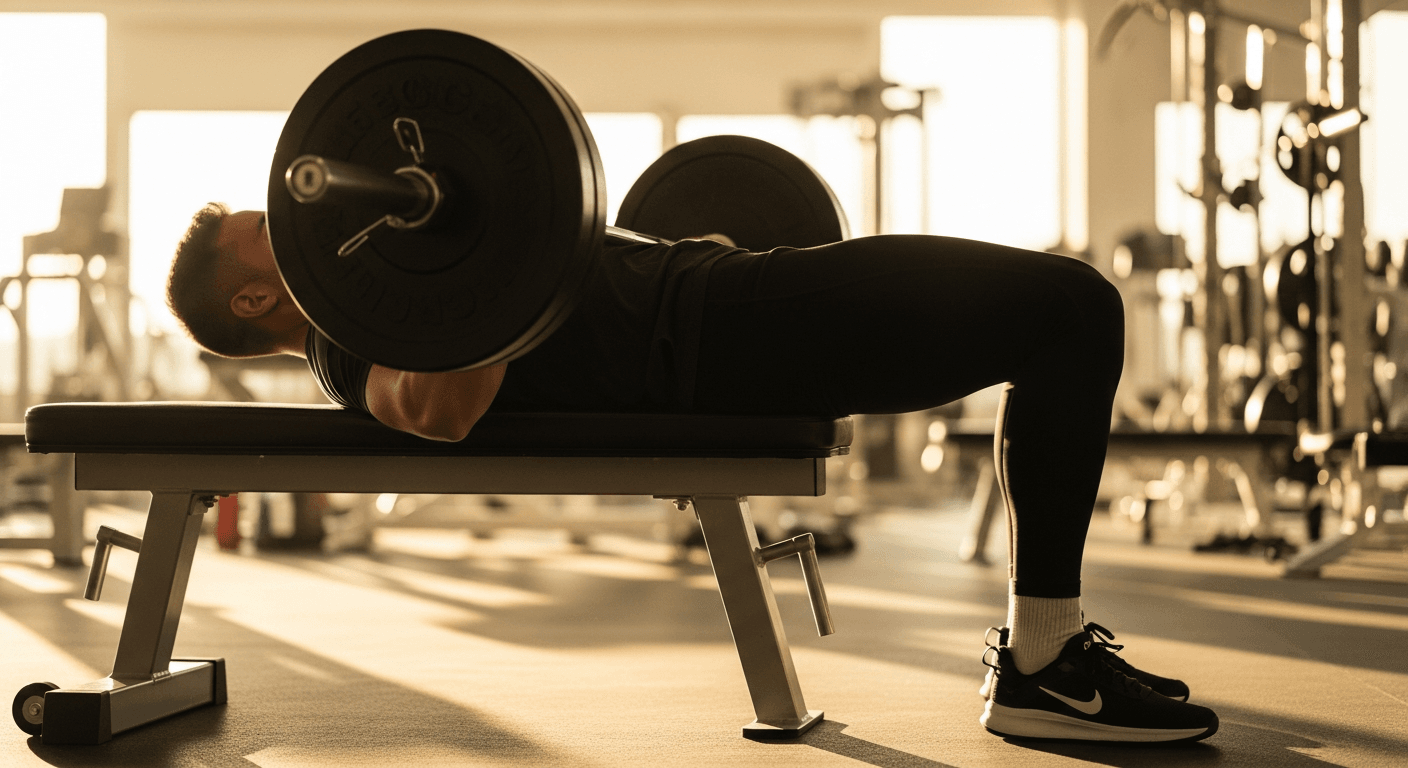
If you've been squatting and deadlifting and still feel like your glutes aren't responding the way you'd expect, you're not imagining it. Research consistently shows that the hip thrust produces significantly higher gluteus maximus muscle activation than either the back squat or the conventional deadlift. We're not talking about a marginal difference. EMG studies have measured glute activation during hip thrusts at levels roughly two to three times higher than what's recorded during squats. That makes it the most targeted glute-building exercise you can put in your program.
This guide covers everything you need to know: the science behind the exercise, how to set it up correctly, how to load it over time, which variations suit your level, and how to slot it into a weekly training schedule that actually produces results.
Why Hip Thrusts Outperform Squats and Deadlifts for Glute Development
The gluteus maximus is a hip extensor. Its primary job is to drive the hip from a flexed position into full extension. The hip thrust is built entirely around that movement pattern. At the top of the rep, your hips are fully extended and the glute is under peak tension. That's the sweet spot for muscle growth.
Squats and deadlifts are excellent compound movements, but neither loads the glute maximally at full hip extension. In a squat, the hardest part of the lift is out of the hole, where the glutes, quads, and lower back are all sharing the demand. In a deadlift, the glute fires hardest in the early phase of the pull, not at lockout. The hip thrust is unique because resistance peaks exactly where the glute is strongest and most active.
That mechanical advantage is why EMG data so consistently favors the hip thrust. It's not that squats and deadlifts don't work the glutes. They do. But if glute hypertrophy is your specific goal, the hip thrust deserves top billing in your training week, not a supporting role.
Setup: The Detail Most People Get Wrong
The hip thrust is one of those exercises that looks simple but punishes poor setup. Get the configuration wrong and you'll feel it in your lower back, your hamstrings, or your hip flexors. Get it right and the glute becomes almost impossible to avoid.
Here's what correct setup looks like:
- Bench height: The bench should sit just below your shoulder blades. When you lean back against it, the top edge of the bench should land at your mid-to-upper back, not at your neck or lower. If the bench is too high, your torso will be too vertical and your lower back will compensate. Most standard flat benches (around 16 to 18 inches) work well for most people.
- Foot position: Place your feet flat on the floor, roughly hip-width apart. Your shins should be close to vertical at the top of the movement. If your feet are too far forward, you'll overextend the lower back. Too close and the hamstrings take over. Dial it in by finding the position where you feel the most glute squeeze at the top.
- Bar placement: The barbell should sit directly over your hip crease, not on your lower abdomen or upper thighs. Use a barbell pad or a rolled-up mat to protect the hip bones. A bar that drifts even an inch or two out of position changes the leverage enough to shift load away from the glute entirely.
- Chin tuck and rib cage: At the top of each rep, tuck your chin slightly toward your chest and avoid flaring your ribs upward. This keeps your spine neutral and ensures the glute is doing the extension, not lumbar hyperextension mimicking hip drive.
Run through this checklist every session until it becomes automatic. Most people who report back pain or poor glute activation during hip thrusts trace the issue back to one of these four variables.
Progressive Overload: It Works Differently Here
If you apply the same progressive overload logic to hip thrusts that you use for squats or deadlifts, you'll likely stall out or start sacrificing form chasing heavier loads. The hip thrust follows a different strength curve, and that changes how you should program it.
Because the movement peaks in a shortened muscle position (glute is contracted at the top), heavier loads don't always produce better hypertrophy outcomes. Research on resistance training and muscle growth consistently shows that working through a full range of motion under tension drives adaptation more reliably than simply adding weight. For hip thrusts, that means higher rep ranges, typically 10 to 20 reps per set, often outperform the 3 to 6 rep ranges common in powerlifting-style lower body work.
Practical progression looks like this: start with a weight you can control for 12 clean reps. Add reps until you reach 15 to 20 with good form, then increase the load and cycle back down to 12. That's a straightforward double-progression model that keeps form intact while consistently increasing the training stimulus. You can also add workout variety without wrecking your progress by cycling in tempo variations or pause reps at the top without changing the load at all.
It's also worth knowing that going heavier than you can control with proper hip extension is counterproductive. Loading a hip thrust to the point where your lower back arches aggressively doesn't build a bigger glute. It builds a sore lumbar spine.
Variations for Every Level
The barbell hip thrust is the gold standard, but it's not where everyone starts, and it's not the only tool in the kit.
Bodyweight hip thrust: The right starting point if you've never done the movement before. Focus entirely on setup, range of motion, and feeling the glute contract at the top. Add a pause at the top of each rep for two to three seconds to reinforce the mind-muscle connection.
Banded hip thrust: A resistance band looped just above the knees adds abductor activation and increases tension throughout the range of motion. It's useful both as a beginner tool and as an intensity technique for experienced lifters looking to increase the training stimulus without adding more bar weight. Bands also force you to drive your knees out, which cues better glute engagement naturally.
Single-leg hip thrust: One foot on the floor, the other extended or resting on a surface. This variation dramatically increases the demand on the working leg and exposes any left-to-right imbalances. It's a smart addition for anyone who suspects one glute is lagging, and it's accessible without loading a barbell, which makes it useful for home training or gym-free sessions.
Dumbbell or machine hip thrust: If you're training in a commercial gym, hip thrust machines are increasingly common. They remove the setup complexity of the barbell version and often allow smoother loading. Dumbbells placed across the hips are a reasonable intermediate option, though balance above a certain weight becomes awkward.
How to Program Hip Thrusts Effectively
Two to three sessions per week is the evidence-supported sweet spot for most people targeting glute hypertrophy. Training the glute more frequently than that without adequate recovery doesn't accelerate growth. It just accumulates fatigue. This applies whether you're doing two lower-body days per week or running a higher-frequency program. There's a well-documented ceiling to how much additional volume continues to produce returns, and understanding where that ceiling sits will save you from overloading a program that's already working.
Placement within the session matters more than most people assume. Hip thrusts belong early in a lower-body workout, not at the end as a burnout finisher. When the glute is pre-fatigued by squats, leg press, or Romanian deadlifts, motor unit recruitment drops and you lose the high-activation stimulus that makes the exercise worth doing in the first place. Put hip thrusts first, or at most second after a compound warm-up movement, and you'll get significantly more out of every set.
A practical weekly structure might look like this:
- Session 1: Barbell hip thrust, 4 sets of 10 to 12 reps. Paired with Romanian deadlifts and walking lunges.
- Session 2: Banded hip thrust, 3 sets of 15 to 20 reps. Paired with step-ups and lateral band walks.
- Session 3 (optional): Single-leg hip thrust, 3 sets of 12 per side. Used as an accessory within a full-body or upper-lower session.
Rest periods of 90 to 120 seconds between sets are adequate. You don't need the longer rest windows typical of heavy compound work because the loads and rep ranges involved don't create the same systemic fatigue as a maximal squat or deadlift.
Supporting Your Training Outside the Gym
Muscle growth doesn't happen during the workout. It happens during recovery. Sleep quality and consistency have a direct impact on how effectively your body adapts to training stress. If you're not sleeping well, the signal from those hip thrust sessions gets partially lost. Sleep consistency, not just sleep duration, plays a significant role in how well your body recovers between sessions.
Stress management is equally underrated. Chronic psychological stress elevates cortisol, which blunts anabolic signaling. The same training effort produces fewer results in someone operating under sustained high stress. Practical tools for managing that load, including structured relaxation, using music intentionally for stress relief, and deliberate recovery practices, can meaningfully support what you're building in the weight room.
The Bottom Line
The hip thrust is the most direct path to gluteus maximus development available in resistance training. The research is clear, the mechanics make sense, and the movement is accessible enough for beginners while scalable enough to challenge experienced lifters for years. What stands between most people and results isn't the exercise itself. It's setup errors, poor programming placement, and applying squat-style loading logic to a movement that responds better to controlled, higher-rep work.
Fix those three things and the hip thrust becomes one of the most reliable tools in your training program.