
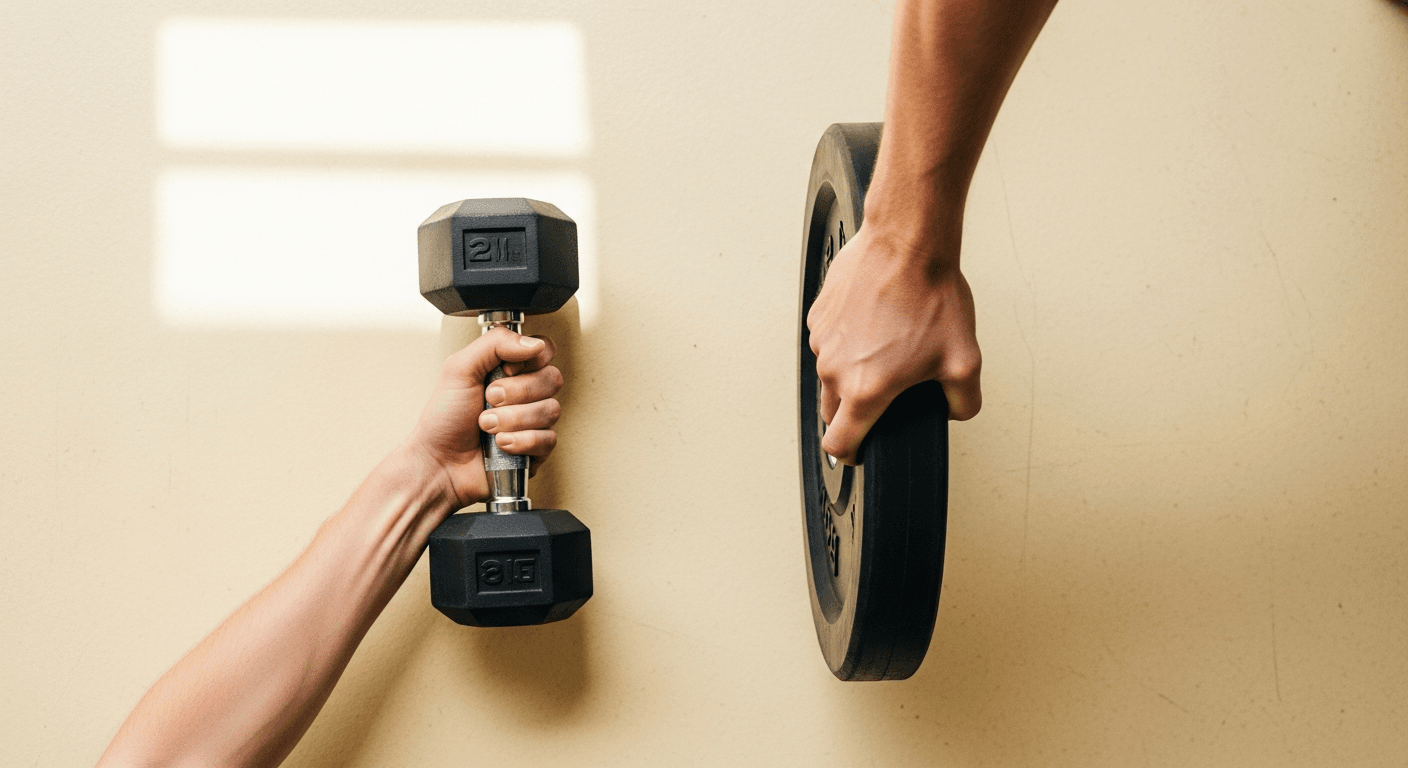
The gym debate that never dies
You've probably heard it both ways. Your trainer says go heavy. Someone on YouTube says lighter weights with higher reps build just as much muscle. Your friend swears by 5x5. Who's right?
A meta-analysis published in the Journal of Applied Physiology — pulling data from 14 studies on trained individuals — just gave us the clearest answer yet. And the short version is: it depends on what you're actually trying to achieve.
For muscle size, light loads work just as well
This is the finding that surprises most people. If your main goal is building muscle, gaining size, looking bigger — the weight on the bar matters a lot less than you think. What matters is effort.
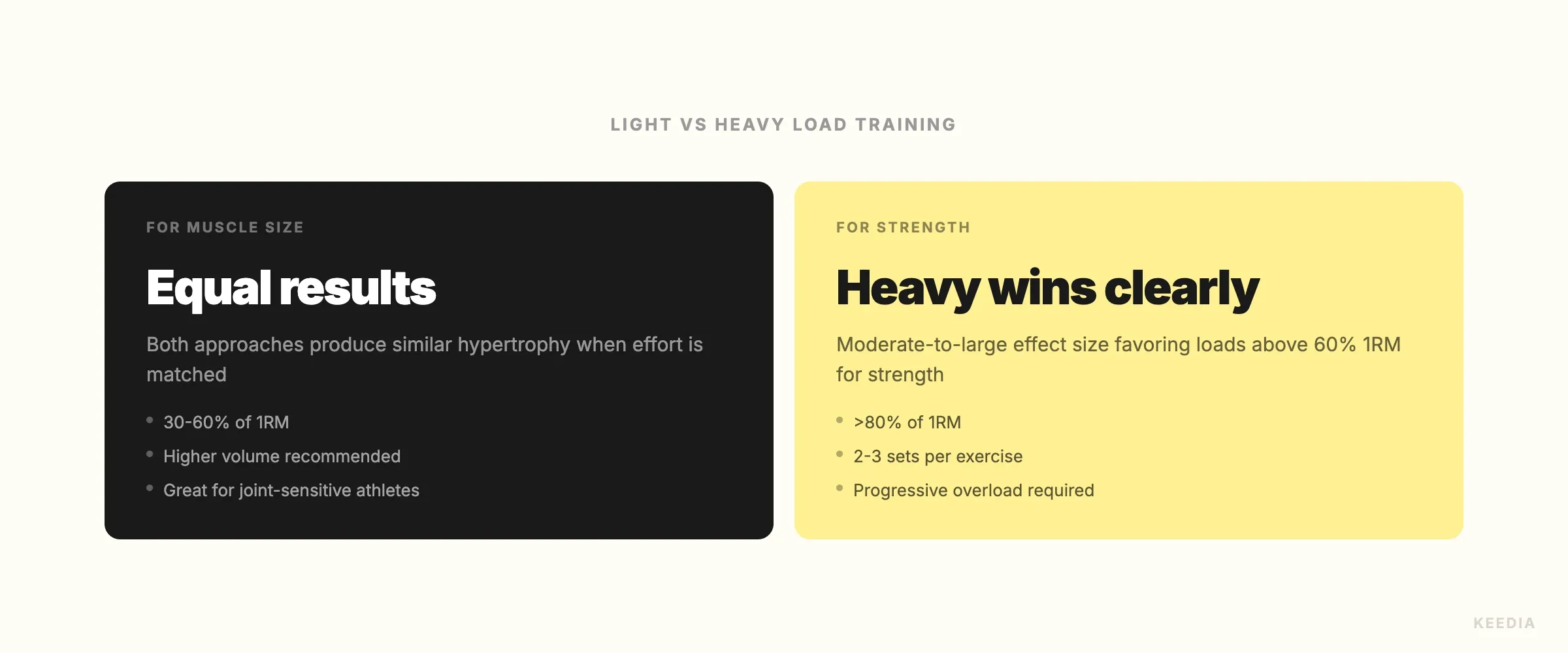
The research is clear: light loads (30-60% of your one-rep max) produce the same muscle hypertrophy as heavy loads (80%+), as long as you push close to muscular failure. Your muscles don't count the kilograms. They respond to tension and accumulated fatigue.
This is genuinely useful for anyone dealing with knee pain, shoulder issues, or wrist problems. You can work with lighter weights at higher rep ranges and get the same muscle-building stimulus — without the joint stress that comes with heavy loading.
For strength, heavy loads win — and it's not close
The picture changes completely when you're talking about maximal strength. Heavy loads win, and the data is unambiguous. The meta-analysis shows a moderate-to-large effect size favoring loads above 60% of 1RM for strength gains. The new 2026 ACSM guidelines back this up: to build strength, you need to train at around 80% of your max, for 2-3 sets per exercise.
The reason comes down to neuromuscular adaptation. Strength isn't just about how big your muscles are — it's about how efficiently your nervous system can recruit them. Training heavy teaches your brain to fire as many motor units as possible simultaneously, coordinating whole muscle groups under high load. That specific adaptation doesn't happen the same way with lighter weights, even when taken to failure.
What this actually means for your training
The question isn't light vs. heavy. The question is: what's your goal?
- Goal is muscle size, and you have joint limitations: work at 30-60% of your max, higher reps (15-20), higher weekly volume (10+ sets per muscle group per week). You're not leaving gains on the table.
- Goal is maximal strength or you compete in powerlifting, strongman, or any sport requiring force production: go heavy, 75-90% of max, low reps (3-6), consistent progressive overload.
- Goal is both: periodize. Run 4-6 week hypertrophy blocks with moderate loads, then 4-6 week strength blocks with heavier loads. Classic approach, still works.
The most common mistake? Running the same program for months without adjusting either load or volume. Your body adapts to a stimulus. Once it has, the stimulus needs to change.
The variable everyone ignores
There's one factor missing from most discussions of this research: proximity to failure. A light set done at 50% effort produces neither size nor strength gains. What triggers muscle growth is the last hard rep — whether that's rep 8 with a heavy bar or rep 20 with a lighter one. If you stop comfortably short of that point, no amount of careful load selection is going to help you.
Bottom line: for muscle, effort outweighs load. For strength, load is the driver. Understanding that distinction lets you build a program that periodizes effectively and actually matches your goals — and stop arguing about things that ultimately don't matter as much as showing up and working hard.