

Omega-3 and Muscle Recovery: What the New Nature Study Actually Shows
Most claims about omega-3 and recovery are vague enough to mean almost nothing. "It reduces inflammation." "It helps with soreness." Technically not wrong, but not particularly useful either. A new study published in Scientific Reports (part of the Nature portfolio) changes that. It gives you a specific protocol, a specific outcome measure, and a proposed mechanism that finally explains why the omega-3 literature has been so inconsistent for years.
Here's what the research actually shows, what it means for how you supplement, and how to apply it practically before your next hard training block.
What the Study Found
The study examined the effects of 8 weeks of omega-3 supplementation on muscle function recovery after eccentric exercise-induced damage. Participants supplemented daily with 2.5g DHA and 0.5g EPA. After the supplementation period, they performed a standardized eccentric exercise protocol designed to cause measurable muscle damage.
The key finding: those who supplemented with omega-3 showed significantly attenuated loss of peak voluntary muscle contraction strength following the eccentric bout. In practical terms, they held on to more functional strength in the days after hard muscle-damaging work.
Critically, the study didn't just measure soreness. It measured function. That distinction matters more than it might seem.
The Mechanism: Oxylipins and Inflammatory Resolution
The proposed explanation for the effect centers on oxylipins. These are bioactive lipid mediators derived from polyunsaturated fatty acids, and they play a direct role in resolving the inflammatory response that follows tissue damage.
After 8 weeks of supplementation, participants showed higher circulating oxylipin availability. This increased availability is thought to support the resolution phase of inflammation, the stage where the body actively clears pro-inflammatory signals and begins tissue repair. The key word is resolution, not suppression.
Omega-3s, in this context, are not acting as anti-inflammatory agents in the classic pharmaceutical sense. They're not blocking the initial inflammatory signal that triggers adaptation. Instead, they're supporting a faster, cleaner transition out of that inflammatory window. That's a functionally important difference, and it's one reason the common fear that omega-3 might blunt training adaptations is largely misplaced.
Why Previous Studies Showed Mixed Results
If you've followed the omega-3 research closely, you've probably noticed a lot of null findings scattered through the literature. Studies showing no effect on soreness, no effect on recovery markers, no measurable benefit. The new data helps explain why.
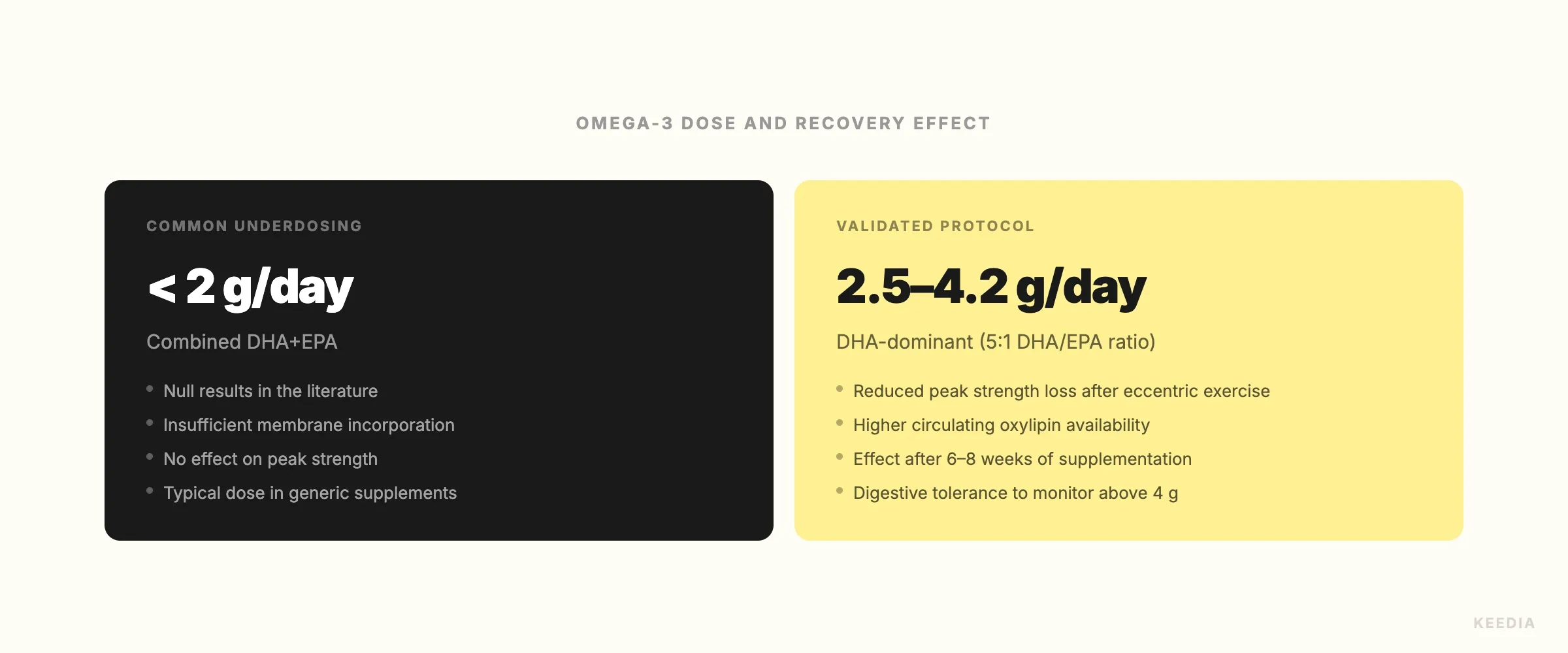
Two patterns stand out. First, many studies used doses below 2g of combined EPA and DHA per day. At that level, you likely don't accumulate enough omega-3-derived oxylipins to meaningfully shift the resolution pathway. Second, many studies measured soreness as the primary outcome. Soreness is a poor proxy for functional recovery. You can have reduced soreness and still show significant strength loss, or vice versa. Studies relying on subjective pain ratings were often measuring the wrong thing.
The Scientific Reports study addresses both issues: higher DHA-dominant dosing and a functional strength endpoint rather than a soreness scale.
What About Higher Doses?
One prior study is worth referencing here. Research using 6g of fish oil per day (providing approximately 4,200mg combined EPA and DHA) found it to be among the more effective protocols for reducing markers of muscle damage. The results were notable.
The practical problem is tolerability. Six grams of fish oil daily is a substantial amount. GI discomfort, fishy aftertaste, and simple compliance fatigue are real issues at that dose. For most people training at a high but non-elite level, the 2.5g DHA plus 0.5g EPA protocol used in the new study is a more realistic target. It's well within the range that most quality fish oil supplements can deliver across 2 to 3 softgels per day.
If you're already taking omega-3s but haven't been hitting at least 2g combined EPA and DHA daily, your current dose likely isn't doing much for recovery specifically, even if it has cardiovascular or cognitive benefits at lower amounts.

Resolution Versus Suppression: Why This Distinction Matters for Athletes
This point deserves its own space because it's where a lot of the practical confusion lives.
Some recovery strategies work by suppressing the inflammatory signal acutely. High-dose NSAIDs taken immediately after training fall into this category. There's genuine concern in the research that blunting early post-exercise inflammation too aggressively can interfere with the signaling processes that drive adaptation, particularly for strength and hypertrophy.
Omega-3s don't appear to work that way. The evidence suggests they support downstream resolution rather than blocking upstream signaling. The acute inflammatory response after training is not meaningfully diminished. What changes is how efficiently that response clears. The recovery window shortens. The signal isn't suppressed.
This is also why the timing finding matters. Omega-3 doesn't function as an acute pre-workout supplement. A single large dose the night before a hard session does nothing for the oxylipin pathway. The effect requires chronic accumulation in cell membranes, which is what 6 to 8 weeks of consistent supplementation actually achieves.
If you're interested in how other recovery modalities compare in terms of acute suppression versus adaptive interference, cold water vs contrast therapy: what the research actually says covers that tension in detail, particularly around cold exposure timing relative to strength training.
How to Time Omega-3 Supplementation Around Training Blocks
Given what the mechanism requires, the practical implication is straightforward: you need to load omega-3s before the hard work happens, not during or after.
If you're heading into a hypertrophy phase, a competition prep block, or a period of higher training volume, start supplementing 6 to 8 weeks before that block begins. By the time you're accumulating serious muscle damage across multiple sessions per week, your cell membrane EPA and DHA composition will reflect that chronic intake, and your oxylipin availability will be elevated accordingly.
This also connects to deload planning. If you're using structured deload weeks to manage accumulated fatigue, the omega-3 protocol should be running continuously through those periods, not started at the beginning of each block. Deload protocols: what the research actually says is worth reviewing if you haven't formalized that structure yet.
Practical Dose and Product Guidance
Based on the current evidence, here's how to translate the research into something actionable:
- Target dose: 2.5g DHA plus 0.5g EPA per day, reflecting the protocol used in the new study. This is a DHA-dominant ratio, which differs from many standard fish oil products that are EPA-dominant.
- Check your label: Most commercial fish oil products list total fish oil weight, not EPA and DHA content. A 1g softgel of fish oil typically contains only 180mg EPA and 120mg DHA. At that concentration, you'd need roughly 8 to 10 softgels daily to hit the study dose. Look for concentrated formulas.
- Duration before effect: Expect no meaningful functional recovery benefit until you've supplemented consistently for 6 to 8 weeks. This is a cellular composition change, not an acute pharmacological effect.
- Take with fat: Omega-3 absorption improves significantly when taken alongside a meal containing dietary fat. Don't take it on an empty stomach.
- Upper practical limit: 6g fish oil (approximately 4,200mg combined EPA and DHA) showed stronger results in prior research but comes with tolerability trade-offs. That's a ceiling worth knowing, not necessarily a daily target.
If you're also using other evidence-based supplements and trying to build a rational stack rather than a cluttered one, creatine forms: monohydrate vs HCl vs buffered is a useful comparison for another of the few supplements with genuine functional recovery evidence behind it.
Who Benefits Most From This Protocol
The research is most relevant to anyone training with high eccentric loads or high weekly volume. Think resistance training focused on hypertrophy, sport-specific work with significant deceleration demands, or any block where you're deliberately programming progressive overload across multiple muscle groups simultaneously.
It's also worth noting for athletes managing recovery across multiple modalities. If you're already using structured sleep support, for example, the omega-3 effect on inflammatory resolution may work in parallel with other recovery tools rather than competing with them. magnesium and sleep for athletes: which form, what dose, what results covers one of the more evidence-supported adjuncts in that space.
Athletes dealing with body composition changes, particularly those losing lean mass in a caloric deficit, may also find omega-3 supplementation relevant. Muscle preservation during periods of reduced intake is a related but distinct research area worth tracking alongside these findings, similar to what's emerging around GLP-1 and muscle loss: what training can and can't fix.
The Bottom Line
The new Scientific Reports study doesn't prove that omega-3 supplementation is a universal recovery solution. What it does is clarify the mechanism, specify a protocol that works, and explain why so much of the earlier research failed to find effects. The oxylipin pathway is the likely mechanism. Eight weeks of chronic supplementation at a DHA-dominant dose is the protocol. Functional strength preservation, not soreness reduction, is the meaningful outcome to track.
If you've been supplementing with omega-3 at low doses or inconsistently, this is a reasonable point to reconsider whether your current approach is actually capable of producing the effect you're looking for.