
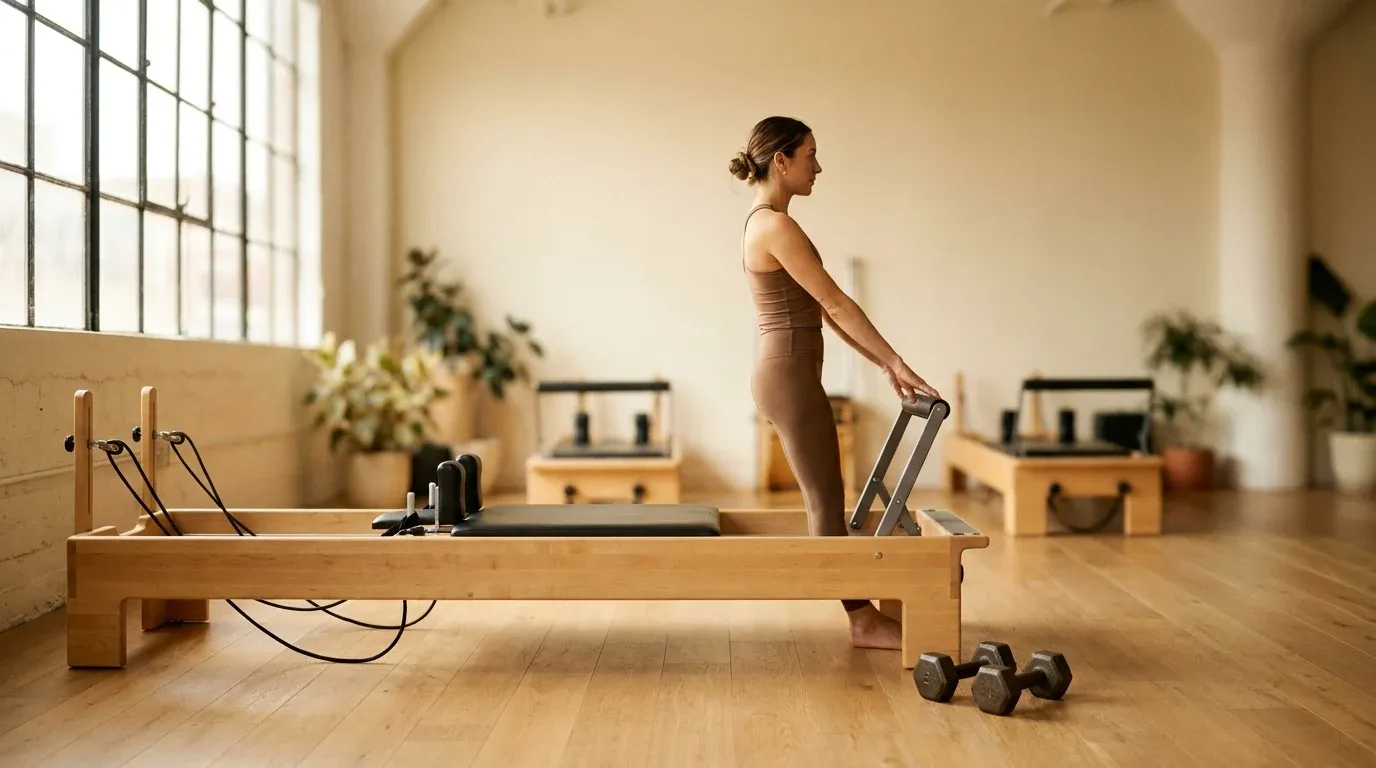
Something is shifting on gym floors in 2026. The reformer machines that once lived exclusively in boutique studios are showing up next to squat racks and cable stations. And the people using them aren't just yogis looking for a gentle stretch. They're powerlifters, CrossFitters, and serious gym-goers who've started treating Pilates as a performance tool rather than a recovery afterthought.
The latest signal: JetSet Pilates, one of the fastest-growing studio chains in the US, is rolling out new class formats in 2026 that weave strength training directly into traditional reformer sessions. It's a bold move, and it's not happening in isolation.
What JetSet Pilates Is Actually Building
JetSet Pilates has built its brand around high-energy, equipment-based classes. The new formats take that foundation and layer in resistance training, moving members between the reformer and free weights or resistance bands within a single session. The goal isn't to water down Pilates or turn it into a bootcamp. It's to create a format where mobility work and load-bearing exercise reinforce each other rather than compete for scheduling space.
Pricing for these hybrid formats is expected to sit in the same range as premium boutique fitness, roughly $35 to $45 per class or $180 to $250 per month for unlimited memberships, consistent with what the boutique fitness market currently charges for reformer-only sessions. That's a meaningful investment, which means the results need to justify the cost.
The studio isn't alone in this direction. Major gym chains and boutique operators across the US, UK, Canada, and Australia have been adding reformer equipment and experimenting with hybrid programming. As big gyms add reformer Pilates to their offerings, the question isn't whether this trend is real. It's whether the science backs it up.
What the Research Says About Combining Mobility and Strength Work
The case for hybrid training isn't built on aesthetics or studio marketing. There's a growing body of research showing that combining mobility-focused training with resistance work produces measurable gains that neither approach delivers as efficiently on its own.
Studies on concurrent training, which pairs flexibility and stability work with progressive overload, consistently show improvements in functional strength, injury resilience, and movement efficiency. One area where this shows up clearly is trunk stability. Pilates-based training activates deep core muscles, including the transversus abdominis and multifidus, that traditional lifting either ignores or under-recruits. When those muscles are trained alongside compound lifts, force transfer improves and injury risk drops.
Research published in sports medicine journals has found that individuals who incorporate Pilates-style stability training alongside resistance programs show reduced lower back pain, better hip mobility, and improved balance under load. These aren't marginal benefits for recreational athletes. For anyone lifting heavy multiple times a week, they're the difference between consistent training years and recurring setbacks.
There's also a cardiovascular angle worth noting. High-intensity training formats, even short ones, produce significant physiological responses. Research shows that brief, intense exercise can outperform longer moderate-effort sessions for certain health markers. Hybrid classes that push intensity in short bursts, alternating between reformer spring resistance and free weights, may hit that threshold more efficiently than people expect.
Why Lifters Should Pay Attention
If you're a serious lifter, the immediate reaction to "Pilates class" might be skepticism. That's fair. But here's what the hybrid format actually addresses: the gaps that conventional programming leaves open.
Traditional lifting is excellent at building strength in primary movers. It's less effective at developing the smaller stabilizing muscles and movement patterns that protect your joints under fatigue. Hip flexor tightness, weak rotator cuff engagement, limited thoracic rotation. these are common in people who lift consistently and stretch infrequently. They don't show up until something breaks down.
Reformer-based training puts your body through a full range of motion under spring resistance, which is fundamentally different from free weights or machines. The resistance is variable and length-dependent, meaning the challenge shifts as you move through a range. That creates neuromuscular demands that barbells simply don't replicate. For a lifter, that's not a replacement for squats. It's a complement that builds the tissue quality and motor control that makes squats safer and more effective.
The core work is the most immediately transferable element. Pilates-based core training doesn't just target rectus abdominis. It trains the full system of trunk stabilizers in positions that mirror real athletic demands. Planks and crunches aren't going away, but they don't prepare your spine for the lateral forces you encounter in a loaded deadlift or a heavy overhead press the way Pilates progressions can.
How the Trend Fits Into the Broader Shift in Fitness Culture
The hybrid Pilates-lifting format is part of a bigger cultural movement. Strength training has moved firmly into the mainstream in 2026, and with it has come a more sophisticated understanding of what "training" actually means. The old binary between cardio people and lifting people has collapsed. Athletes, weekend warriors, and recreational gym-goers are all looking for formats that do more than one thing.
Studios and gym chains have responded by designing classes that address strength, mobility, and stability simultaneously. The reformer machine has become a central tool in that shift because it's adaptable. You can use it for gentle rehabilitation work or high-resistance conditioning. The spring system means you can load movements that would otherwise be inaccessible to people with mobility limitations, which broadens the audience significantly.
For coaches building client programs, this trend has real practical implications. Clients who supplement their lifting with reformer-based work tend to recover better, move better, and stay more consistent. The format is also engaging enough that retention improves. A client who looks forward to their Tuesday hybrid class is more likely to stick with their Thursday strength session. Keeping clients accountable between sessions, whether through structured programming or tools like WhatsApp check-ins for client follow-up, becomes easier when the training itself is varied and enjoyable.
What to Look For in a Quality Hybrid Class
Not all hybrid formats are equal. As the trend grows, you'll see studios slapping "strength" on their reformer classes without meaningfully changing the programming. Here's what separates a well-designed hybrid session from a rebranded beginner Pilates class.
- Progressive overload is present. The strength component should increase in challenge over time, not stay static week to week. If there's no mechanism for progression, it's not a strength program.
- The transitions are intentional. Moving from reformer work to free weights should follow a logical sequence, not feel like two separate workouts stitched together. The best classes use each modality to prepare you for the next movement.
- Instructors have dual credentials. Look for coaches who hold both a recognized Pilates certification and a strength or personal training qualification. Hybrid programming requires understanding of both disciplines.
- Load is appropriate for your level. The strength component shouldn't be scaled down to the point of irrelevance for experienced lifters, but it also shouldn't be so heavy that it overwhelms someone new to resistance training.
- Recovery is factored in. A well-structured hybrid class should leave you challenged but not destroyed. If you're wrecked for three days after, the programming isn't calibrated correctly.
Should You Actually Add This to Your Program?
If you're already training four or five days a week with a structured lifting program, adding a weekly hybrid Pilates-strength class is likely a net positive. The mobility and stability work will address deficits that accumulate with heavy training, and the novel movement demands will challenge your neuromuscular system in ways your current program doesn't.
If you're newer to training and building a routine from scratch, a hybrid format is a genuinely smart entry point. You build strength and movement quality simultaneously, which sets a better foundation than starting with isolated machines or high-rep cardio classes.
Where it gets complicated is if you're in a competitive strength sport with specific peaking cycles. In that case, adding new movement patterns and unfamiliar loads during a competition phase carries some risk. Off-season or during general preparation phases, it's worth experimenting.
The honest answer is that most people aren't undertrained for Pilates. They're overtrained in one plane of motion and undertrained in everything else. A format that forces you to move differently, under load, through your full range, is going to expose that quickly. Whether that's uncomfortable or useful depends entirely on how you respond to it.
JetSet Pilates is betting that enough people will find it useful to build a business around it. Based on what the research shows and where gym culture is heading in 2026, that's not a bad bet.