
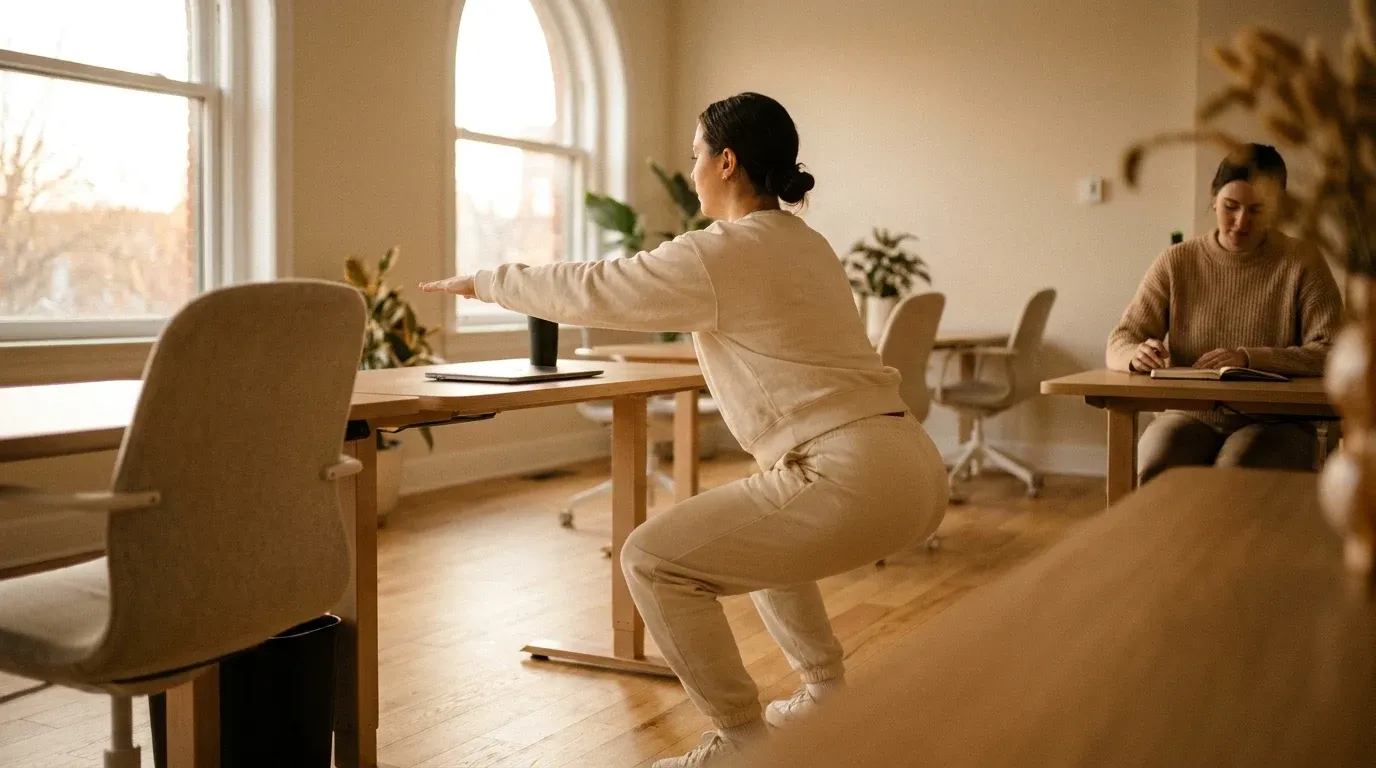
Squat snacking sounds like a gimmick. Break your squats into small sets scattered across the day, skip the gym session, and somehow still get stronger? A November 2024 study out of Tongji University suggests that's not far from the truth. Researchers found that distributing squat sets throughout the day produced strength gains comparable to completing them in a single continuous session. That's a meaningful result, and it changes how you can think about training on days when a proper workout isn't happening.
But the method only works if you structure it properly. Load, rep ranges, rest timing, and progression all behave differently when your sets are separated by hours instead of minutes. Here's how to make it work without losing your gains or clearing out your open-plan office.
What the Tongji University Study Actually Found
The November 2024 Tongji University study compared two groups: one performing squats in a single structured session, and another distributing the same total weekly volume across multiple short bouts spread throughout the day. After the study period, strength outcomes were statistically similar between groups.
The key variable was total volume, not session structure. As long as participants accumulated the same number of sets and reps at similar intensities, the body adapted. This aligns with the broader body of research showing that time-efficient training formats can produce real physiological results when volume and intensity are controlled.
What the study does not say: squat snacking is superior to traditional training, or that it replaces structured programming for advanced athletes. It says it's a viable option, particularly for people whose schedules don't allow a continuous workout window.
Setting Your Load and Rep Range for Distributed Sets
The biggest mistake people make with squat snacking is treating it like a movement break rather than actual training. Doing ten bodyweight squats every hour is fine for circulation, but it won't build meaningful strength. You need to be working at a load that challenges you.
For squat snacking to match gym-session outcomes, your mini-sets should sit between 60% and 80% of your one-rep max (1RM). That's the range where both strength and hypertrophy adaptations occur consistently. If you don't have access to a barbell at home or in the office, use the following proxies:
- Bodyweight with tempo: A 3-second descent and a 1-second pause at the bottom raises effective difficulty significantly. Use this if you're under 6 months of training experience.
- Resistance bands: A heavy-gauge band anchored underfoot adds enough resistance to challenge intermediate lifters without equipment.
- Goblet squat with a dumbbell or kettlebell: If you have a home office setup, a 24 kg (53 lb) kettlebell covers most intermediate lifters comfortably.
- Weighted backpack: Pack books or water bottles to approximate load. Crude, but functional if you're working from a hotel room or spare bedroom.
Aim for 3 to 5 reps per mini-set if you're lifting heavy, or 6 to 10 reps at moderate load. You should finish each set with 2 to 3 reps still in reserve. Grinding to failure in a 20-minute work break is impractical and unnecessary.
Rest Timing When Your Sets Are Hours Apart
In a standard session, you rest 90 seconds to 3 minutes between sets. With squat snacking, the gap between sets is measured in hours. That changes the physiology.
Your muscles will be fully recovered between mini-sets. That's actually an advantage for quality: every set is a fresh effort, not a fatigued one. But it also means you're not accumulating the metabolic stress that contributes to hypertrophy in a traditional session. Strength development still occurs, as the Tongji data shows, but maximal muscle growth is harder to achieve this way.
Practical timing guidelines:
- Space mini-sets at least 45 to 60 minutes apart to let any residual neuromuscular fatigue clear.
- Don't schedule a mini-set within 30 minutes of eating a full meal. Blood is redirected to digestion and performance dips.
- Try to anchor your sets to recurring daily events: morning coffee, a mid-morning call ending, lunch, an afternoon break, and end of day. Five sets across a workday accumulates real volume.
If you're managing energy and recovery carefully, it's also worth reading how to read your body's recovery signals before deciding whether today is a squat snacking day or a rest day.
Progressive Overload When Volume Is Scattered
Progressive overload is non-negotiable. If you're doing the same reps at the same load week after week, you're maintaining, not improving. The challenge with squat snacking is that your training log looks messier than a traditional program. Here's a system that works:
Track total daily volume, not sets. Calculate: sets x reps x load. If Monday's squat snacking session produces 5 sets of 6 reps at 60 kg, your daily volume is 1,800 kg. Next week, aim to beat that number by adding one rep per set, one additional set, or a small load increase.
Use a weekly progression model. Target a 5% to 10% increase in total weekly volume every 1 to 2 weeks. This mirrors standard linear progression rates and keeps you moving forward without burning out.
Log every mini-set immediately. Use a notes app, a fitness tracker, or a simple spreadsheet. Waiting until the end of the day to reconstruct what you did leads to inaccurate data and sloppy progression.
Understanding how hard you should actually be working matters here too. Squat snacking only produces results if each set is genuinely challenging, not just motion.
Sample Schedules for Home-Office, Hybrid, and Office Workers
Home-Office Schedule
You have the most flexibility and the least social friction. Use it.
- 8:00 AM: 4 x goblet squats at heavy load, pre-work warmup
- 10:00 AM: 5 x tempo bodyweight squats or banded squats between calls
- 12:30 PM: 4 x goblet squats post-lunch (wait 30 minutes after eating)
- 3:00 PM: 5 x heavy goblet or kettlebell squats
- 5:30 PM: 4 x squats as work winds down
Total: 22 to 25 quality reps across 5 mini-sets. Accumulate this 4 days per week and your weekly squat volume rivals many gym programs.
Hybrid Schedule (Office 2-3 Days Per Week)
- Office days: Use bodyweight with tempo or resistance bands in a private office, stairwell, or outdoor space. Keep sets to 3 to 5 reps to stay presentable. A bathroom break can discreetly fit in 2 mini-sets.
- Home days: Load heavier to compensate for lighter office-day sets.
- Weekly balancing: Track total weekly volume and ensure home days make up for any intensity gaps on office days.
Full Office Schedule
This is the most constrained scenario. You'll need to get practical about where and when without irritating coworkers or your manager.
- Use a standing desk area, empty meeting room, or outdoor break area.
- Aim for 2 to 3 mini-sets per day on office days. Focus on tempo and bodyweight difficulty rather than external load.
- Compensate on weekends with one or two proper loaded sessions if strength goals are a priority.
If you're new to structuring your own training, working with a coach even briefly can help you set starting loads correctly so you're progressing from day one rather than guessing.
When Squat Snacking Is Not the Right Tool
This method has real limitations. Be honest about whether it fits your current training phase.
Powerlifting peaking phases: The 4 to 8 weeks before a competition require heavy, specific loading under precise conditions. Distributed mini-sets can't replicate competition-depth singles or the neuromuscular demands of a peaking block. Stick to your coach's program.
Dedicated hypertrophy phases: Maximizing muscle growth benefits from metabolic stress, cell swelling, and accumulated fatigue within a session. These mechanisms are blunted when sets are separated by hours. If hypertrophy is your primary goal right now, squat snacking can supplement but shouldn't replace your sessions.
High training ages: Advanced lifters operating near their strength ceiling need progressive specificity that squat snacking rarely provides. It works well for intermediate and early-advanced athletes maintaining or building general strength.
Injury recovery: If you're working through a knee, hip, or lower-back issue, unsupervised mini-sets scattered through the day without proper warmup protocol can aggravate the problem. Get clearance first.
It's also worth remembering that training is one input among many. Recovery quality, including sleep consistency, affects how well you adapt to any format. Irregular sleep patterns carry real physiological consequences that show up in performance and recovery alike.
Making It a Real Training Habit
The biggest risk with squat snacking isn't the method. It's treating it as optional. When it's anchored to your calendar the same way meetings are, it happens. When it's left to spontaneous motivation, it doesn't.
Set phone reminders. Put a kettlebell next to your desk. Write your target sets and reps for the day on a sticky note. These small logistics decisions determine whether squat snacking produces results or just sounds like a good idea.
The Tongji University data gives you the scientific permission. What you do with that is up to you.