
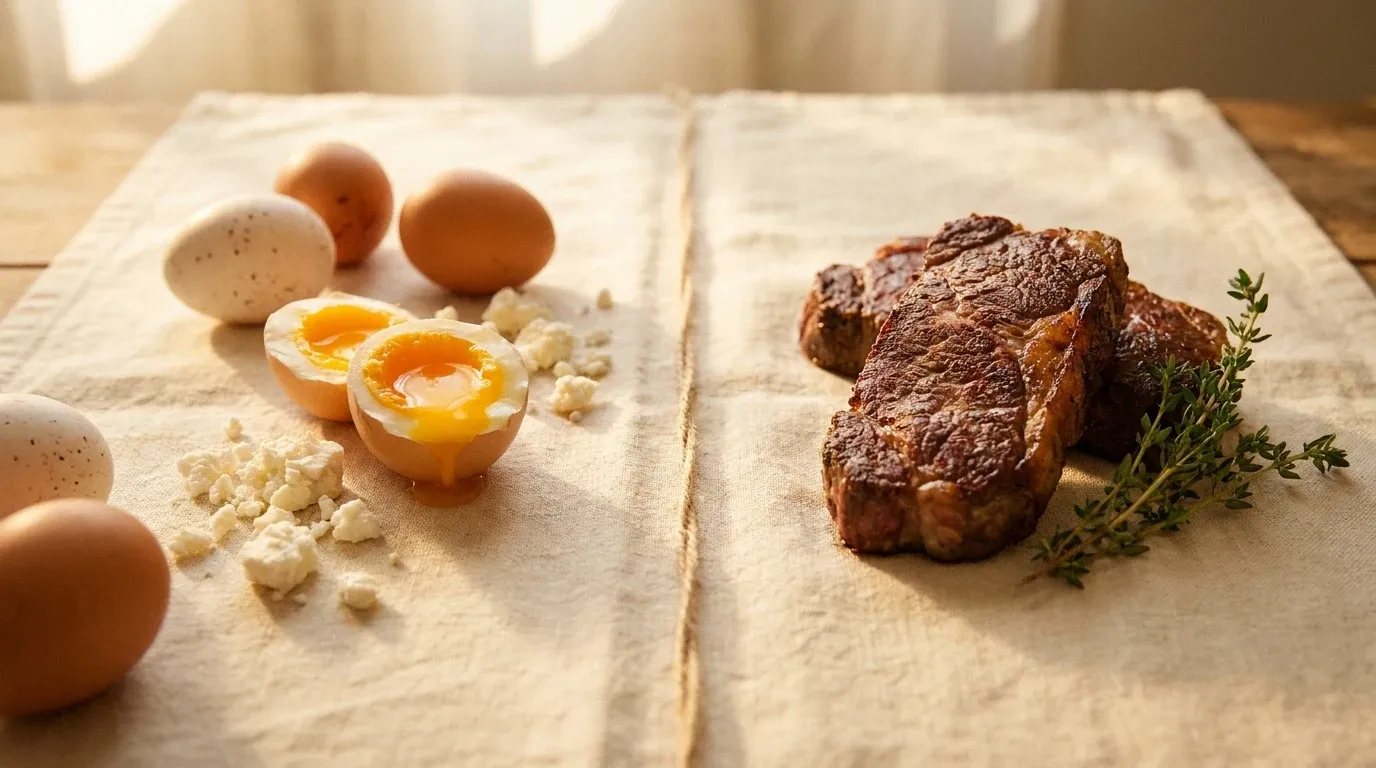
If you're over 55 and thinking about cutting meat from your diet, one question probably comes up fast: will you lose your gains? A recent study comparing lacto-ovo-vegetarian and omnivore diets in older adults finally puts some data behind what has mostly been gym-floor speculation. The short answer is that both diets can build muscle. But the full picture is more nuanced than that.
What the Study Actually Found
Researchers put two groups of adults over 55 through the same resistance training program, with one group following a lacto-ovo-vegetarian diet and the other eating a standard omnivore diet that included meat. Both groups trained consistently and had their protein intake monitored throughout the study period.
At the end of the trial, both groups showed meaningful gains in muscle mass. That alone is worth highlighting. The idea that older adults can't meaningfully respond to resistance training is still surprisingly common, and this study adds to a growing body of evidence that your body doesn't stop adapting after 55. It slows down. It doesn't stop.
The more specific finding, though, is where the conversation gets interesting. The omnivore group showed slightly greater gains in arm and leg muscle mass compared to the vegetarian group. These weren't dramatic differences, but they were measurable. When it came to strength tests, however, both groups improved at comparable rates. So the gap showed up in tissue-level changes, not necessarily in what you could lift.
Why Arm and Leg Mass Specifically?
It's worth pausing on why the differences appeared in arm and leg muscle mass rather than whole-body composition. These are the muscle groups most directly assessed through DEXA scans or similar imaging tools, and they're also the most functionally significant for older adults. Leg strength and muscle mass in particular are closely tied to fall risk, mobility, and independence as you age.
The modest edge for meat-eaters in these regions likely comes down to the amino acid profile of animal proteins. Animal-based proteins, including meat, tend to have a higher leucine content and a more complete essential amino acid profile than most plant proteins. Leucine is the primary driver of muscle protein synthesis, the biological process that actually builds new muscle tissue. Even when total protein intake looks similar on paper, the quality and digestibility of that protein can produce different outcomes at the cellular level.
Lacto-ovo-vegetarians do have access to eggs and dairy, both of which are high-quality protein sources. But if the vegetarian group in this study was leaning heavily on plant proteins like legumes and grains to hit their targets, they may have been working with a slightly less anabolic amino acid environment despite meeting overall protein targets.
For a deeper look at how protein quality affects muscle outcomes after 50, Protein for Muscle After 50: What Actually Works breaks down what the evidence says about sources, amounts, and timing.
Strength Gains Were Comparable. That Matters.
Here's the part that often gets buried in the coverage of studies like this: both groups got stronger at similar rates. Functional strength, the ability to push, pull, squat, and carry, improved regardless of whether participants were eating meat or not.
That's a meaningful finding for anyone over 55 who's debating whether to shift their diet. If your primary goal is to stay strong, move well, and maintain functional independence, a well-managed vegetarian diet doesn't appear to put you at a significant disadvantage. The edge for omnivores shows up at the tissue level, not necessarily in what your body can actually do.
This distinction matters because muscle mass and muscle function don't always move in lockstep. You can have more tissue without having proportionally more strength, and vice versa. For most older adults, functional strength is the priority. The slight hypertrophy advantage for meat-eaters may matter more for competitive athletes or bodybuilders than for someone focused on healthy aging.
The Protein Distribution Question
One variable that could explain some of the gap between groups is how protein was distributed across the day, not just the total amount. Research consistently shows that older adults benefit from spreading protein intake more evenly across meals rather than concentrating it in one or two sittings. This is because the muscle protein synthesis response to protein becomes less efficient with age, requiring a higher threshold dose per meal to trigger the same anabolic effect.
If vegetarian participants in this study were eating lower-protein breakfasts and lunches and trying to compensate at dinner, they may have left anabolic potential on the table even if daily totals looked fine. Protein Timing and Distribution: What Lifters Get Wrong covers exactly this problem and applies directly to the over-55 population.
Omnivore diets tend to make protein distribution easier simply because animal proteins are calorie-dense and satiating in smaller portions. A chicken breast or a portion of salmon at lunch gets you to 30 to 40 grams of high-quality protein without much effort. Hitting the same number from plant sources often requires more volume and more planning.
What This Means If You're Over 55 and Lifting
If you're currently eating meat and lifting consistently, this study doesn't give you a reason to change anything. The evidence suggests you're in a favorable position for building and maintaining muscle mass as you age.
If you're vegetarian or thinking about cutting meat for health, ethical, or environmental reasons, the picture is more encouraging than discouraging. Both groups built muscle. Both groups got stronger. The vegetarian group was not far behind on tissue gains, and they matched the omnivore group on the outcomes most relevant to daily life.
What the study does suggest is that vegetarians over 55 need to be more deliberate about their protein strategy. That means prioritizing high-quality sources like eggs and dairy, which the lacto-ovo framework already allows, spreading protein across at least three meals daily, and ensuring total intake is at the higher end of recommendations for older adults. Many researchers now suggest 1.6 to 2.2 grams of protein per kilogram of body weight per day for older adults engaged in resistance training, which is notably higher than general population guidelines.
Dairy, in particular, may deserve more attention in vegetarian strategies for older adults. Does Dairy Actually Help Aging Muscles? looks at the emerging evidence around dairy and muscle preservation, including some specific findings around fermented dairy sources.
Supplements: Can They Close the Gap?
Some vegetarians turn to supplementation to compensate for differences in protein quality, particularly creatine and leucine-enriched protein powders. Creatine is well-supported for older adults and doesn't require meat consumption to benefit from. Leucine supplementation or blended plant protein powders formulated to match the amino acid profile of whey may also help close the gap in muscle protein synthesis.
That said, supplements should fill gaps rather than replace a solid dietary foundation. If you're curious about what actually has strong evidence behind it, Sports Supplements in 2026: What the Science Says Now gives a current and sober assessment.
The Bigger Picture for Healthy Aging
Muscle mass after 55 isn't just about aesthetics or athletic performance. It's a core component of metabolic health, bone density, fall prevention, and overall resilience. Losing muscle in your later decades, a process called sarcopenia, is associated with frailty, reduced mobility, and higher mortality risk. Building and preserving muscle through training and adequate nutrition is one of the highest-leverage things you can do for long-term health.
The good news is that this study reinforces what exercise science has been showing for years: resistance training works for older adults, and it works across dietary patterns. You don't need a perfect diet to make progress. You need a consistent training program and enough protein, distributed intelligently across your day.
If you're newer to resistance training or returning after a break, it's also worth knowing that you don't need elaborate programs or long sessions to see real results. You Don't Need Hours in the Gym to Buy Years of Life covers how even modest training investments can produce significant outcomes for longevity and health.
The bottom line: meat-eaters had a slight edge in arm and leg muscle mass in this study, but vegetarians held their own on strength and weren't far behind on tissue gains. If you're over 55, the diet you can sustain and build consistent protein habits around is probably more important than whether it includes meat. Train hard, eat enough protein, and distribute it well. The rest is a matter of personal choice.