
VO2max and Muscle Strength Are the Two Real Markers of Longevity
Most longevity content reads the same way. Sleep eight hours. Manage stress. Eat more vegetables. These things matter, but they're not measurable, they don't give you a target, and they don't tell you where you actually stand. The research, when you look at it directly, keeps converging on two specific, quantifiable biomarkers: cardiorespiratory fitness measured as VO2max, and muscle strength measured by grip and lower-body performance. Everything else is context. These two are the signal.
VO2max: The Strongest Independent Predictor of All-Cause Mortality
VO2max measures how much oxygen your body can use during maximal effort, expressed in milliliters per kilogram of body weight per minute (mL/kg/min). It's not just a performance metric for athletes. Multiple large cohort studies, including analyses with sample sizes exceeding 120,000 patients, have confirmed that low cardiorespiratory fitness is a stronger independent predictor of all-cause mortality than BMI, elevated blood pressure, or abnormal cholesterol levels.
One landmark study found that men in the lowest fitness quintile had a mortality rate more than four times higher than those in the highest quintile, even after adjusting for age, smoking, and other risk factors. Moving from the bottom quintile to just the second-lowest cut risk substantially. You don't have to be an elite athlete. You just have to not be at the bottom.
What do the numbers actually mean for you? Here are approximate VO2max benchmarks for a 45-year-old male and female, based on established population norms:
- Below average (male 45): under 34 mL/kg/min
- Average: 34 to 40 mL/kg/min
- Good: 41 to 47 mL/kg/min
- Excellent: 48 to 53 mL/kg/min
- Elite: above 54 mL/kg/min
- Below average (female 45): under 27 mL/kg/min
- Average: 27 to 33 mL/kg/min
- Good: 34 to 39 mL/kg/min
- Excellent: 40 to 45 mL/kg/min
- Elite: above 46 mL/kg/min
Research suggests that reaching the "excellent" category at any age is associated with a markedly lower mortality hazard. Reaching elite is not required. Moving from below average to good may reduce all-cause mortality risk by 30 to 50 percent depending on the population studied.
The Decline Is Real, But It's Not Fixed
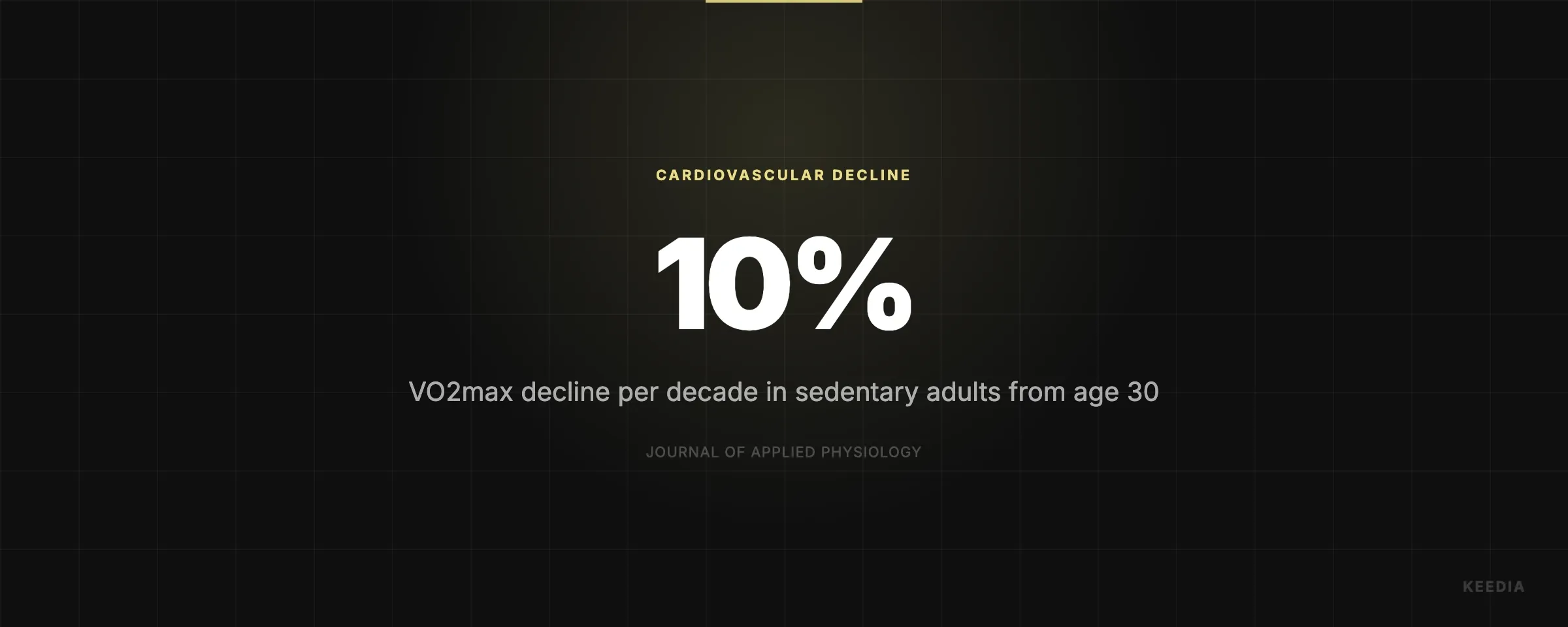
Here's the part most people don't know. VO2max begins declining from your early 30s in sedentary adults, at a rate of approximately 10 percent per decade. By your 60s, a sedentary person may have lost 30 to 40 percent of the cardiorespiratory capacity they had at 25. That's not aging. That's detraining masquerading as aging.
Consistently trained adults cut that decline rate roughly in half, losing around 5 percent per decade. Over 30 years, that's the difference between a 55-year-old who functions like a fit 35-year-old and one who struggles with basic exertion. The ceiling doesn't drop nearly as fast when you keep training it.
If you want to understand where to start and what protocols actually move the needle on VO2max, How to Improve Your VO2max: The Research-Backed Protocols breaks down the evidence on HIIT, zone 2, and hybrid approaches.
Zone 2 training specifically deserves mention here because it's been consistently underrated in popular fitness content. Long, low-intensity aerobic work builds mitochondrial density and cardiac output. If you're not sure where your zone 2 threshold actually sits without lab equipment, Zone 2 Without a Lab: Find Your Zone Accurately covers practical field methods that hold up against lab testing.
Grip Strength and Lower-Body Strength: The Structural Reserve
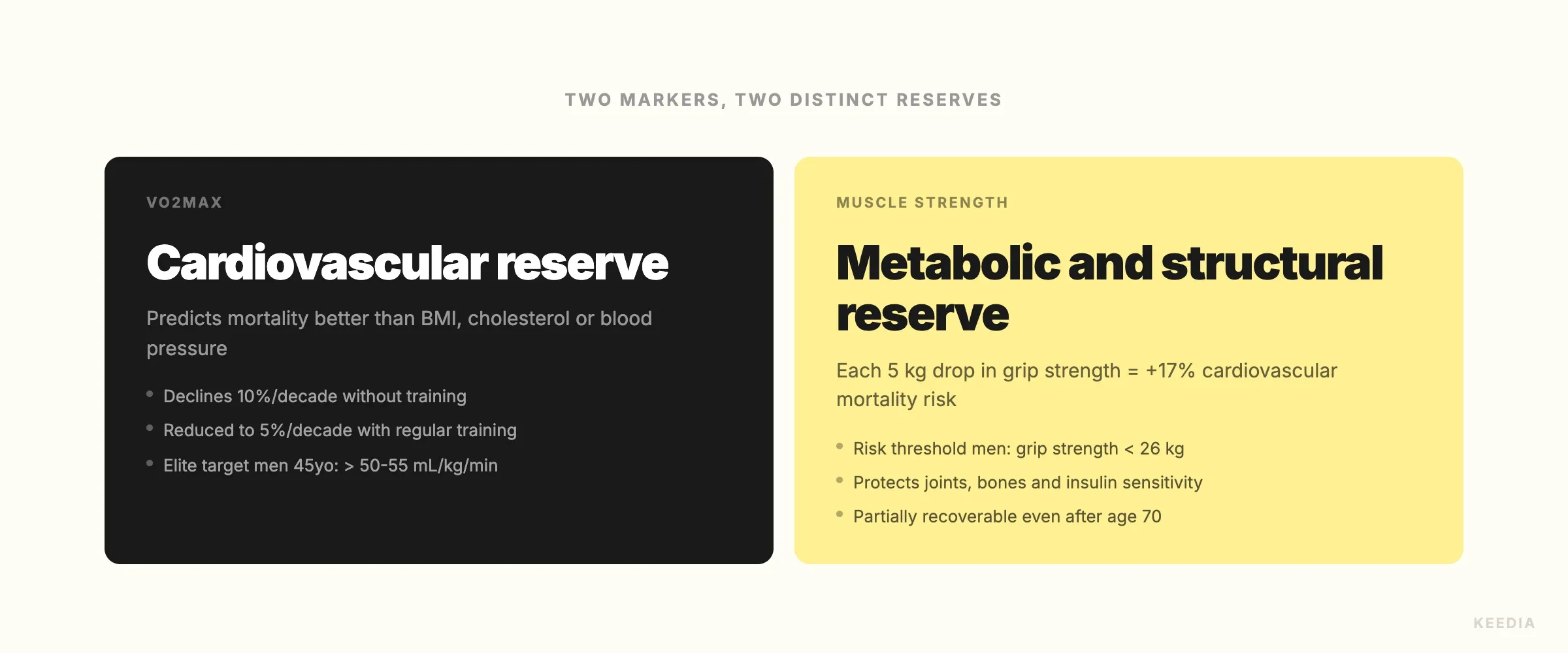
VO2max tells you how well your cardiovascular system delivers and uses oxygen. Muscle strength tells you something different: how well your body manages metabolic load, maintains structural integrity, and resists the functional decline that makes aging dangerous.
Grip strength has emerged as one of the most studied and reliable predictors of mortality in large epidemiological datasets. A major analysis published using UK Biobank data found that low grip strength in midlife was independently associated with increased all-cause and cardiovascular mortality over follow-up periods of 10 years or more. The association held after controlling for physical activity levels, meaning grip strength captures something grip strength training alone doesn't fully explain. It's a proxy for total systemic muscle quality.
What thresholds matter? General population data suggests:
- Men: grip strength below 26 kg is associated with elevated mortality risk; above 40 kg sits in the protective range for most age groups
- Women: below 16 kg indicates elevated risk; above 24 to 27 kg is associated with better outcomes
Lower-body strength matters just as much, and it's harder to proxy with a simple test. But research on leg press strength, chair stand speed, and walking speed all point in the same direction: people who maintain lower-body power into their 60s and 70s have significantly better survival profiles than those who don't.
Low muscle mass and strength are also increasingly relevant in the context of weight loss interventions. If you're working with patients or clients using GLP-1 medications, GLP-1 and Muscle Loss: What Training Can — and Can't — Fix addresses the specific risk of losing lean mass during rapid weight reduction and what resistance training and protein intake can do about it.
Two Metrics, Not One: Why Both Matter
It would be convenient if one biomarker predicted everything. It doesn't. VO2max and muscle strength are complementary and capture different systems.
High VO2max with low muscle mass leaves you with cardiovascular reserve but poor metabolic buffering. Muscle tissue is an endocrine organ. It secretes myokines that regulate inflammation, insulin sensitivity, and brain health. Losing it accelerates systemic aging regardless of your aerobic fitness.
Conversely, strong, well-muscled individuals with low VO2max show elevated cardiovascular mortality risk that strength alone doesn't offset. The heart is a muscle, but it responds to aerobic training in ways that resistance training doesn't fully replicate. Cardiac output, stroke volume, and peripheral oxygen extraction all require endurance training stimulus to develop and maintain.
You need both. Fortunately, training for both simultaneously is not only possible but well-studied.
Concurrent Training: Programming Both Without Sacrificing Either
Concurrent training, combining endurance and resistance work within a training program, was historically thought to produce an "interference effect" where aerobic work blunted strength gains. More recent research has clarified the picture significantly. The interference effect is real but context-dependent. When volume is managed, session order is considered, and recovery is adequate, trained adults can develop both VO2max and muscle strength without meaningful compromise to either adaptation.
Practical guidelines from the concurrent training literature:
- Separate strength and endurance sessions by at least six hours when possible to reduce acute interference
- On same-day training, prioritize the quality you're currently emphasizing (strength block or endurance block) by doing that modality first
- Keep endurance sessions during strength phases at lower volumes and moderate intensities. High-volume HIIT and heavy compound lifting in the same session on the same day repeatedly is where interference becomes significant
- Use periodization to alternate emphasis across training blocks rather than trying to maximize both simultaneously at all times
If you want to understand the programming architecture behind this, Periodization for natural athletes: block, undulating or linear? covers how different periodization models apply to non-pharmacologically-enhanced training, which is where most of this research is most relevant.
It's Never Too Late: Late-Onset Training Still Cuts Risk Substantially
A persistent and damaging myth in fitness culture is that starting in your 60s or 70s is too late to meaningfully change your trajectory. The evidence says otherwise, consistently and strongly.
Studies following previously sedentary adults who began exercise programs in their 60s and 70s show VO2max improvements of 15 to 25 percent over 12 to 24 weeks of structured training. Muscle cross-sectional area and strength respond to resistance training in older adults with gains comparable in relative terms to those seen in younger populations. One analysis found that older adults who became active later in life reduced all-cause mortality risk by approximately 35 percent compared to those who remained sedentary, even when the activity began after age 65.
The body doesn't stop adapting. The stimulus-response relationship persists into advanced age. What changes is recovery time, training volume tolerance, and the importance of programming quality. But the signal is still there, and it still works.
Sleep quality and recovery capacity also play a meaningful role in how effectively older adults respond to training. If recovery is a limiting factor in your programming, the evidence on specific sleep interventions is worth reviewing, including Sauna and Cardiovascular Health: What the Research Says in 2025, which covers passive cardiovascular adaptations that can complement structured training.
What This Means Practically
You don't need a $3,000 metabolic cart test or a laboratory to start improving these markers. Wearable-estimated VO2max from devices like Garmin and Apple Watch has been validated against lab measures with reasonable accuracy for population-level tracking. Grip strength dynamometers cost under $30. You can establish a baseline and track both metrics over time with minimal investment.
The training priority is clear: build and maintain aerobic capacity with consistent zone 2 and periodic high-intensity work. Build and maintain muscle strength with progressive resistance training emphasizing compound lower-body and upper-body movements. Manage volume and recovery to allow both adaptations to develop without chronic interference.
Longevity research doesn't resolve to a supplement stack or a morning routine. It resolves to two numbers. Find out where yours stand, then start moving them in the right direction.