
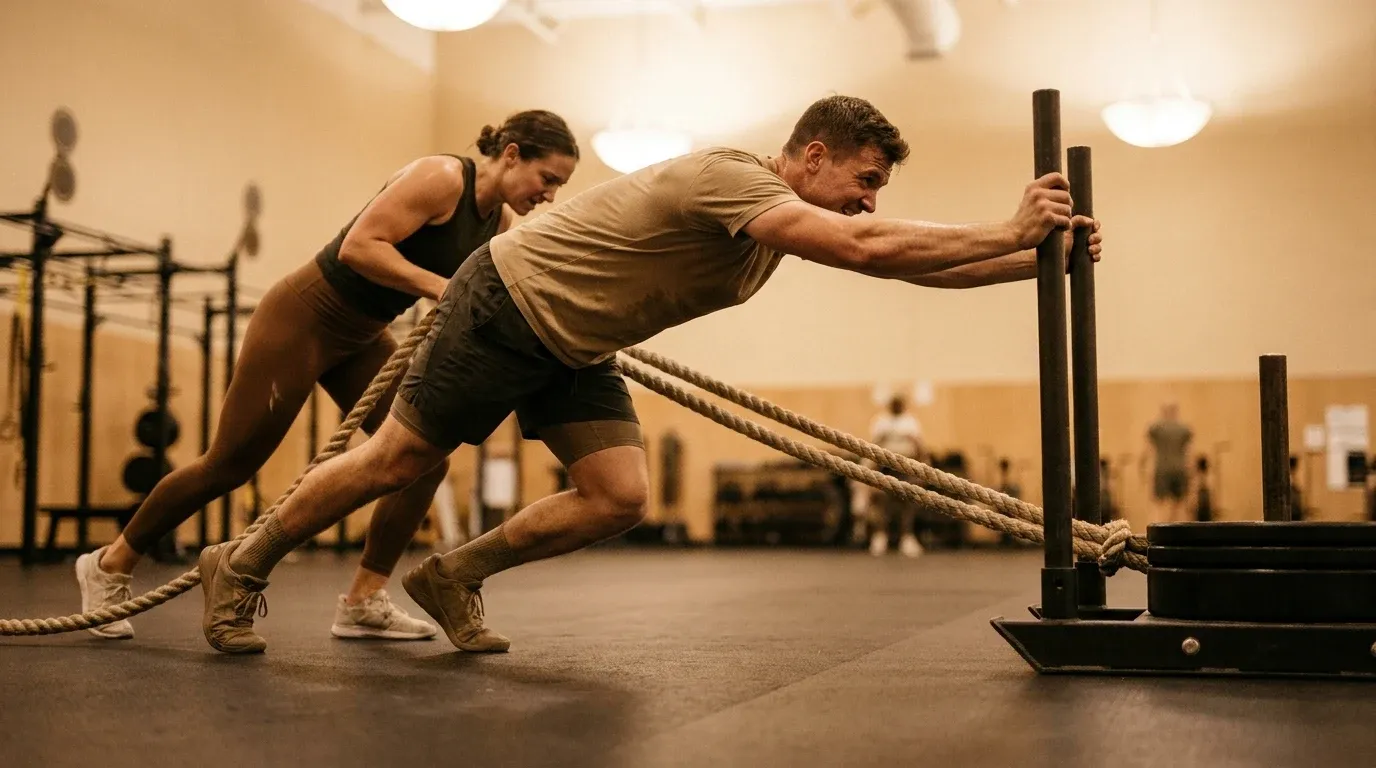
The Hamburg doubles results from Saturday told a familiar story to anyone paying close attention: the fastest pairs weren't always the most evenly matched. They were the smartest. Teams that had clearly mapped out who does what, when, and why crossed the finish line ahead of partnerships that simply split everything down the middle and hoped for the best.
Doubles racing is the most tactically rich format HYROX offers. You can split reps however you want across stations, you run together between them, and every decision you make in training either pays off or costs you on race day. Here's how competitive pairs should actually approach the split.
Why "Just Go 50/50" Is Usually Wrong
The instinct to divide everything equally feels fair. It isn't always fast. HYROX stations don't punish effort equally across all athletes. A 90kg athlete with a strong posterior chain will absorb the sled push and pull at a fraction of the metabolic cost it would take their lighter partner. Splitting those reps evenly wastes that advantage entirely.
The smarter approach is to audit each partner's relative strength ceiling versus their aerobic floor. If Partner A can move heavy loads without spiking their heart rate above threshold, they should dominate the sled work. If Partner B recovers faster between efforts and holds a lower lactate response to repeated short bursts, they should own the ski erg, the burpee broad jumps, and the wall balls, which reward rhythm over raw power.
This isn't guesswork. You need testing data. Run both partners through station-specific benchmark sets in training and track heart rate, recovery time, and rep quality at the back end of each set. The splits that emerge from that data will look different for almost every team.
Playing Asymmetric Strengths: What Hamburg Showed
Saturday's doubles results at Hamburg 2026 reinforced what coaches working with competitive pairs have been saying for two seasons. Teams with clearly asymmetric strength profiles, where one partner is noticeably stronger in one domain than the other, consistently outperformed pairs of near-identical fitness when those asymmetries were deliberately exploited.
For context on how the elite field was moving through the format, the HYROX Hamburg 2026 Friday Recap: Elite Results shows the kind of station splits and transition pacing the top athletes were executing even a day earlier in the individual category. The doubles field operates differently, but those benchmarks matter for calibrating your own targets.
The practical takeaway: if one of you is significantly better on the ski erg, they should take the first pull to set a controlled pace, then hand off only when the stronger partner's output would be wasted by staying on the machine. Don't rotate for the sake of rotating.
Station-by-Station Allocation Framework
Here's a working framework for how to think about each of the eight stations. Treat this as a starting point, not a prescription. Your training data should override any general recommendation.
- Ski Erg: Favor the partner with better upper body endurance and a lower rate of perceived exertion at high wattage. They should start. Handoff when output drops more than 10% from opening pace.
- Sled Push: Load-bearing leg strength wins here. The heavier, stronger partner typically leads. Consider having them complete 60-70% of the distance if the gap is significant.
- Sled Pull: Similar profile to the push, but grip endurance matters more. If one partner has grip fatigue from earlier stations, adjust accordingly. Don't assign this rigidly before the race.
- Burpee Broad Jumps: This is the great equalizer. It rewards aerobic efficiency and jump mechanics, not size. The partner who recovers faster between stations should expect to carry more load here.
- Rowing: The partner with a longer stroke and better rowing mechanics should anchor the majority of meters. Even a small technique advantage compounds across 1,000 meters.
- Farmers Carry: Grip and lat endurance. If one partner is already compromised from the sled pull, the other covers more distance here.
- Sandbag Lunges: Quad endurance under fatigue. Assign the partner who will be fresher at this point in the race, based on your projected fatigue curve going in.
- Wall Balls: The final station rewards shoulder endurance and squat stamina. If one partner has been protecting their legs through the middle stations, they take the larger share here.
Transition Timing: The Most Undertrained Element in Doubles
Most doubles teams train the stations. Almost none of them train the transitions between partners at those stations with the same rigor. That's a significant problem, because hesitation at handoff points is where races are quietly lost.
A poorly timed transition at the ski erg can cost four to eight seconds. Across eight stations, that's potentially a minute of pure time loss from nothing but indecision. At competitive level, a minute is enormous.
Effective transition training means building a verbal calling system. The partner currently working calls the switch before they need it, not when they're already at failure. That single habit changes the dynamic completely. The incoming partner is already moving, already positioning, and the machine or implement doesn't go cold between efforts.
Drill this in training until it's reflexive. Set specific rep targets where the switch call happens at rep N-minus-two, not at rep N. Your nervous system will learn the pattern faster than you think.
Running the 1km Segments as a Pair
The eight 1km runs are where doubles racing gets physiologically interesting. You're required to stay together, which means the faster runner is always running someone else's race. Done wrong, this tanks both partners by the halfway point.
The solution isn't matching pace by feel. It's establishing a shared lactate threshold benchmark before the race and building your run pace around that number. The slower partner's threshold becomes the ceiling for both of you on every run segment, without exception.
In practice, this means the stronger runner is running at 75-85% of their individual threshold effort. That's uncomfortable to accept in training. Accept it anyway. The energy they preserve comes back as output at the stations, and that's where doubles races are actually decided.
If you're building this kind of structured base for the season ahead, the HYROX 2026/27 Training Guide: Plan Your Season Right covers the periodization framework you need to develop both partners' aerobic capacity before introducing race-specific station work.
Communication Drills That Actually Transfer to Race Day
The gap between training communication and race-day communication is wider than most teams expect. Under hypoxic stress and noise, the clear verbal cues you used in the gym become muddy. You need to overtrain them.
Build three-word switch calls that are short, loud, and specific. "Your turn, ski." "Take the sled." These aren't elegant, but they work. The key is that the call happens early and the responding partner confirms with action, not words.
Practice at race-level heart rates. If you're drilling handoffs while barely breathing, you're not preparing for what race day actually feels like. Run partner-specific intervals at threshold, then immediately execute a station transition. That's the closest simulation to the real environment you can create in training.
This kind of high-intensity coordination work also has a recovery component worth taking seriously. Partners who are returning from a training gap or managing cumulative fatigue across a heavy prep block should build back deliberately. The Smartest Way to Return to Training After a Break outlines the evidence-based approach to rebuilding capacity without compromising the training block leading into a target race.
Building Your Doubles-Specific Prep Plan
Most doubles teams make the mistake of treating their prep like two individual programs running in parallel. They train together sometimes but don't build the systems that make them faster as a unit. The result is two fit athletes who aren't actually a team by race morning.
Real doubles prep has three non-negotiable components: individual strength and endurance work, joint station benchmarking to establish your split ratios, and full race simulations where you run every station and every transition at race effort. The last piece is where most teams underinvest.
One element that's often neglected in the recovery and preparation window between hard training weeks is nutritional support, particularly for training partners logging high combined volumes. If either partner is dealing with energy gaps or recovery deficits across a long prep block, it's worth reviewing whether basic micronutrient intake is covered. B Vitamins: Food First or Supplements? What to Actually Do is a useful reference for understanding which gaps are worth addressing through diet versus targeted supplementation.
The competitive doubles format rewards specificity more than almost any other racing format in functional fitness. The pairs who treat it as a chess match, mapping strengths, drilling transitions, setting shared run thresholds, and building real communication systems, are the ones whose names show up at the top of the results board. Hamburg proved that again on Saturday. Your preparation determines which side of that line you're on.