
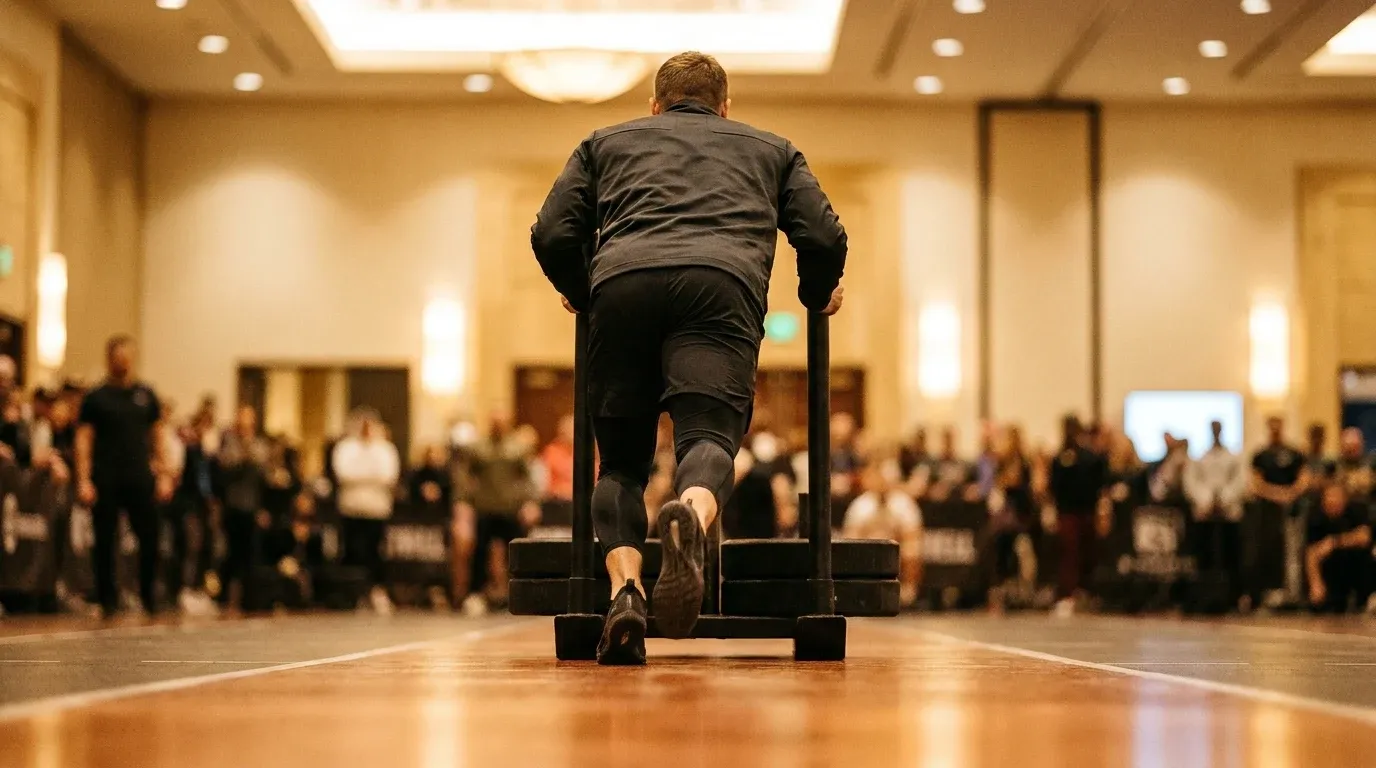
HYROX has never been quiet about its ambitions. The sport that turned ski erg intervals and sled pushes into a global competitive format now has its sights on the biggest stage in sport: the 2032 Brisbane Olympics. If you're competing in HYROX right now, that's not just a headline to scroll past. It's a signal that the rules of the game you're training for could look very different within a decade.
Here's what the bid actually means, what Olympic inclusion would require structurally, and whether the community-first culture that made HYROX popular survives the transition.
The Bid Is Real. The Timeline Is Tight.
HYROX formally announced its ambition to be included at the 2032 Brisbane Olympics, a move that followed its high-profile partnership with World Triathlon. That partnership is strategic. World Triathlon is already an IOC-recognized federation, and aligning with an established governing body gives HYROX a credibility ladder that sports like CrossFit have never had access to in the same way.
Brisbane 2032 is still years away, but Olympic program decisions happen well in advance. The IOC typically finalizes additional sports and disciplines years before an Games opens. For HYROX, that means the window to demonstrate global reach, athlete depth, governance maturity, and broadcast viability is not 2031. It's now.
The sport's growth numbers support the case. HYROX events now span more than 60 countries, with hundreds of thousands of registered athletes competing annually. That kind of geographic spread is exactly what the IOC looks for when evaluating new sports. But growth alone doesn't get you into the Olympic program.
What Olympic Inclusion Actually Demands
Getting into the Olympics isn't about being popular. It's about meeting a specific checklist of institutional requirements, and HYROX would need to clear all of them.
- WADA compliance: Every athlete competing at the Olympic level must fall under World Anti-Doping Agency protocols. That means registered testing pools, out-of-competition testing, therapeutic use exemptions, and sanctions that follow the WADA code. Right now, HYROX has its own anti-doping framework, but it would need to be fully harmonized with WADA standards, which is a significant operational lift.
- National Federation structure: The IOC requires that sports be governed through recognized National Olympic Committees in each participating country. For HYROX, that would likely mean establishing or affiliating with national federations across the US, UK, Canada, Australia, and dozens of other markets. This is slow, bureaucratic work that doesn't happen organically.
- Standardized athlete eligibility: Age minimums, nationality rules, and amateur status definitions would all need to be codified and enforced consistently. The current model, where registration is essentially open to anyone who meets entry criteria and pays the fee, would have to become far more formalized.
- Broadcast-ready format: The IOC cares about television. Any sport that makes it onto the Olympic program needs to work within the broadcast architecture of the Games, which means predictable timing, visual clarity, and commercial break compatibility.
The Format Problem
This is where things get complicated for the sport's identity. A standard HYROX race runs 60 to 90 minutes for elite athletes, combining 8 kilometers of running with eight functional fitness stations: ski erg, sled push, sled pull, burpee broad jumps, rowing, farmers carry, sandbag lunges, and wall balls. The format is deliberately exhausting. That's the point.
Olympic broadcast windows don't work around your race format. Your race format works around Olympic broadcast windows. Network deals, advertising slots, and scheduling logistics across multiple sports mean that a 90-minute individual event is a difficult sell. Compression is almost certain if HYROX makes it to Brisbane.
What could that look like? Shorter running segments between stations. Reduced station distances or repetitions. A restructured order designed for visual drama in the final minutes. None of these changes would necessarily make the sport less physically demanding, but they would change the nature of what you're training for. The athlete who has built a race strategy around pacing through 8 kilometers of cumulative running would need to recalibrate completely.
If you're already putting in serious structured training, understanding How Hard Should You Actually Train at the Gym? matters more in this context, because a compressed Olympic format would likely increase intensity demands and reduce the aerobic pacing window you currently have.
The Grassroots Problem
Ask any HYROX regular what they love about the sport and you'll hear the same thing: amateurs and pros race the same course. You might be warming up next to someone who finishes in 55 minutes. You might be in the heat after them. That proximity to elite performance is unusual in competitive sport, and it's a core part of HYROX's identity and commercial success.
Olympic sports don't typically work that way. The IOC framework is built around elite qualification, not mass participation. When a sport goes Olympic, the institutional pressure is to separate competitive tiers more formally, to establish qualification standards that gate entry, and to organize national trials that determine who represents a country. The open-registration model that lets a 42-year-old amateur from Austin race the same event as a sponsored pro is fundamentally at odds with how Olympic sport operates.
That doesn't mean HYROX would abandon its mass participation events. Triathlon is a useful comparison: the Olympic format exists alongside a thriving age-group and amateur circuit that runs independently. HYROX could realistically follow that model, keeping its open events while developing a parallel elite pathway for Olympic qualification. But the two would increasingly feel like different sports with shared equipment.
The physical toll of that elite pathway would also be significant. Athletes taking the Olympic route would face higher training volumes, more frequent competition, and the cumulative joint stress that comes with repeated high-load functional fitness work. That's worth taking seriously. HYROX Is Great for Fitness. It's Brutal on Your Joints. covers the orthopedic realities in detail, and they don't get easier to manage when you add the pressures of a qualification cycle.
Qualification: What Your Race History Might Already Be Building
Here's the part that matters most if you're a competitive athlete right now. If HYROX secures Olympic inclusion for 2032, qualification structures will almost certainly be built on documented competitive history. That's how most emerging Olympic sports have handled early qualification cycles. Athletes who can demonstrate a verifiable track record in sanctioned events get priority consideration.
Your finisher times from the past two or three years won't be irrelevant. They're the foundation of a competitive profile that could matter when national federations begin selecting and ranking athletes. This is not guaranteed, and the structure hasn't been announced because it doesn't exist yet. But the precedent across other sports is consistent: early adopters who built their competitive records before formal Olympic pathways existed have been rewarded in initial selection processes.
If you're competing seriously in HYROX now, document everything. Race times, placements, divisions, and event locations. Build the record while the sport is still defining what that record needs to look like.
Nutrition and Performance Standards Under WADA
Olympic-level drug testing has direct implications for how athletes approach supplementation and performance nutrition. The same pre-workout stack you're currently using may contain compounds that appear on WADA's prohibited list, often as undisclosed contaminants in products that don't advertise those ingredients. Athletes who transition into a WADA-registered testing pool face strict liability: a positive test is a positive test, regardless of whether you knew the substance was in what you took.
This applies to stimulants in particular. If you're using caffeine-containing supplements to push through training or race day, it's worth understanding the dosing and risk picture. Caffeine and Exercise: How Much Is Too Much? breaks down where performance benefits end and risk begins, and that calculation changes when you're operating under a formal anti-doping framework.
Third-party tested supplements and transparent ingredient sourcing would become non-negotiable for any athlete serious about an Olympic pathway.
What You Should Be Doing Now
The 2032 bid may succeed, may be delayed, or may not materialize in its current form. Olympic bids for emerging sports have failed before, often at late stages. But the trajectory of HYROX suggests that even a partial bid process will accelerate the sport's professionalization in ways that affect every competitive athlete.
The practical steps are straightforward:
- Keep racing and document your results. Build a verifiable competitive profile across multiple events and years.
- Start auditing your supplementation. Move toward products with Informed Sport or NSF certification, which independently verify that contents match labels and exclude prohibited substances.
- Train for format flexibility. If the race distance compresses, you'll want a higher power output at shorter intervals, not just aerobic endurance. No Time to Lift? What Science Says You Can Do Instead outlines high-efficiency training approaches that build that capacity without requiring unlimited gym hours.
- Watch the World Triathlon partnership closely. The governance decisions made within that relationship will define what the Olympic pathway actually looks like in terms of qualifying standards, federation structure, and athlete eligibility.
HYROX built its reputation by being the sport that didn't look like every other competitive format. The Olympic bid is a test of whether the people running it can preserve what made it worth fighting for while navigating the institutional machinery that Olympic inclusion demands. For athletes, the window between now and Brisbane is not waiting time. It's prep time.