

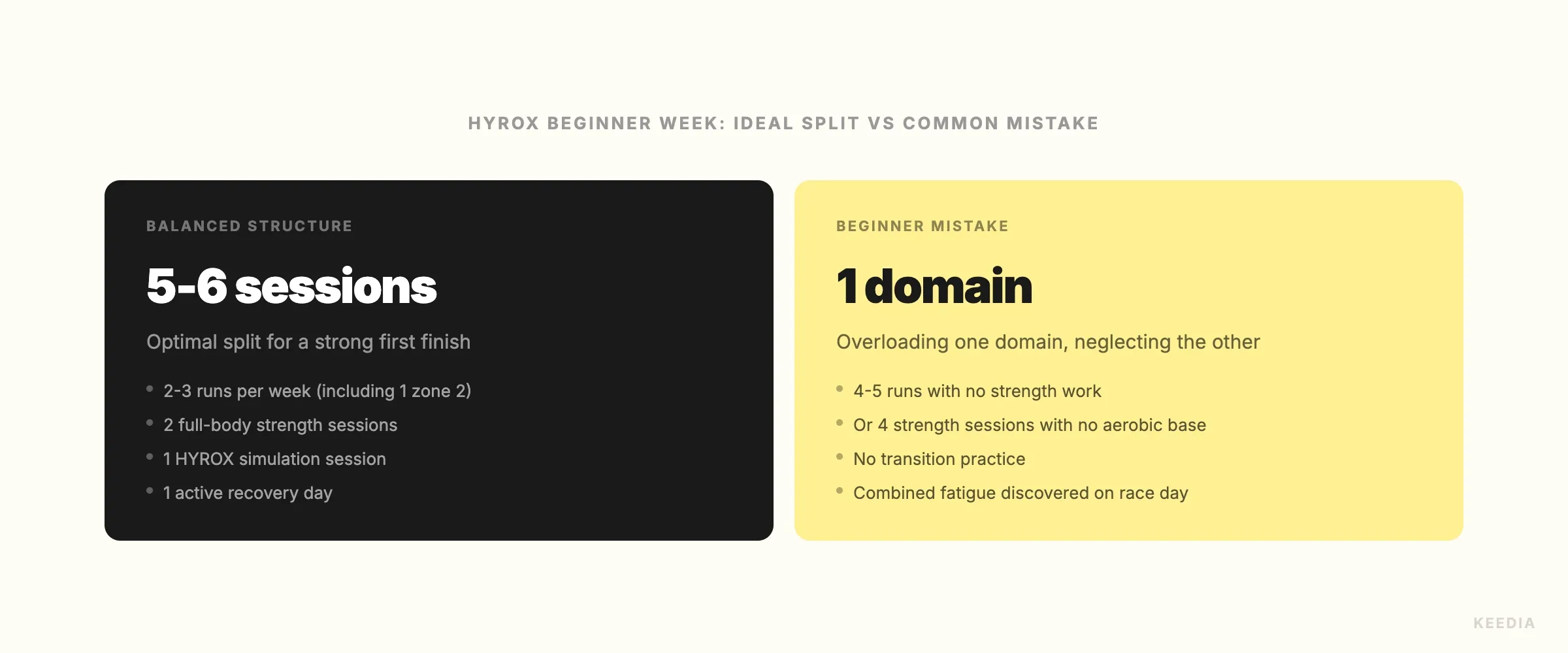
Most people show up to their first HYROX race having done one of two things: too much running and not enough strength work, or too much gym time with barely any sustained cardio. Either mistake will cost you. The race demands both, at the same time, and your training week needs to reflect that reality from day one.
Here's the good news. You don't need to train twice a day or sacrifice your social life to get ready for a strong first finish. What you need is a smart structure that builds your aerobic base, maintains functional strength under fatigue, and teaches your body to switch between the two without falling apart.
What HYROX Actually Demands From a Beginner
HYROX is an 8km run broken into eight 1km segments, with a functional fitness station between each. Stations include sled pushes, ski ergs, rowing, burpee broad jumps, sandbag lunges, and wall balls, among others. The work is not technically complex. The challenge is performing it when your legs are already burning and your heart rate is elevated.
For beginners, the most common failure point is not the stations themselves. It's arriving at each station already gassed from the run, then watching your form and output collapse. This is the specific problem your training week needs to solve.
The Recommended Weekly Structure
A well-balanced beginner HYROX training week includes three core elements: two to three runs, two full-body strength sessions, and one HYROX simulation session. That typically lands at five to six training days with at least one full rest day and one active recovery option.
Here's a practical template you can adjust to your schedule:
- Monday: Full-body strength session (45-60 minutes)
- Tuesday: Zone 2 run (30-45 minutes)
- Wednesday: Rest or light mobility work
- Thursday: Full-body strength session (45-60 minutes)
- Friday: Zone 2 run or tempo interval session (30-40 minutes)
- Saturday: HYROX simulation session (60-75 minutes)
- Sunday: Rest or easy walk
This structure gives you enough frequency to build fitness without accumulating the kind of fatigue that leads to injury or burnout. As race day approaches, you'll shift the balance slightly toward more simulation work and reduce training volume in the final one to two weeks.

Why Zone 2 Running Is Your Aerobic Foundation
Zone 2 running, where you're working at roughly 60 to 70 percent of your maximum heart rate and can hold a conversation, is the unglamorous cornerstone of HYROX prep. It builds your aerobic engine, improves fat oxidation, and trains your body to sustain pace without relying entirely on glycogen. Over 8km of racing, that matters enormously.
A common mistake is running every session too hard. Beginners often treat every run as a test, pushing into zone 3 or 4, which spikes fatigue without delivering the aerobic adaptations they need. Research consistently shows that athletes who keep 70 to 80 percent of their running volume in zone 2 develop better aerobic capacity over time than those who train at moderate-to-high intensity across the board.
If you're newer to running and looking to optimize your fuel strategy around your training sessions, Breakfast Before Running: What the 2026 Research Says is worth reading before you lock in your morning routine.
Your two to three weekly runs should be structured as follows. One longer Zone 2 effort of 40 to 50 minutes. One shorter Zone 2 run of 25 to 35 minutes to keep frequency up without adding stress. And, from week four or five onward, one session with brief tempo intervals to build your ability to push harder when it counts. That third session is optional early in your training block.
Structuring Your Strength Sessions for HYROX
HYROX is not a powerlifting competition. You don't need to back squat 300 pounds. What you need is muscular endurance: the ability to generate adequate force output repeatedly, over time, while your cardiovascular system is already working hard.
Your two weekly strength sessions should be full-body and built around movements that mirror the race demands. Think goblet squats, Romanian deadlifts, single-leg variations, bent-over rows, overhead pressing, and core stability work. Keep reps in the 10 to 20 range with moderate load and short-to-medium rest periods. This trains your muscles to work in a fatigued, slightly oxygen-deprived state, which is exactly what race day looks like.
One session per week can be slightly heavier (6 to 10 reps, longer rest) to preserve strength and prevent deconditioning. The other should lean into higher rep ranges and shorter rest to simulate the endurance demand. Research on minimum effective training volumes, covered in depth in Minimum Volume for Hypertrophy: What the Meta-Analyses Say, suggests that two sessions per week is sufficient to maintain and even build functional strength in most beginner-to-intermediate athletes when intensity and movement selection are appropriate.
Prioritize single-leg work. HYROX involves a lot of lunging and stepping, and unilateral strength is frequently undertrained. It's also one of the first things to fail when cumulative fatigue builds up across a race.
The Simulation Session: Where Beginners Learn the Most
The simulation session is the most important training unit of your week, and the one most beginners either skip or do incorrectly. This is where you practice the actual race format: running followed immediately by a station, then running again.
You don't need to replicate the full 8km and all eight stations in every session. That would be counterproductive early in training. Instead, build it progressively. In weeks one to four, practice two to three rounds of 400 to 500m run plus one to two stations. In weeks five to eight, increase to three to four rounds with more stations and closer to 800m to 1km run segments. In the final four to six weeks before race day, run a full or near-full simulation once every ten to fourteen days.
The specific skill you're developing here is transition: the ability to move from a running pace into a station immediately and execute with decent form. This sounds straightforward. It isn't. Most beginners either pause too long between the run and the station (losing time) or jump in too fast and blow up within the first few reps.
Practice arriving at your mock station and starting within five to ten seconds of stopping your run. Track your heart rate at that moment. Over time, you'll notice it drops faster as your aerobic fitness improves, giving you a cleaner entry into each station.
The Transition Problem: Most Beginners Miss This Entirely
If there's one thing that separates athletes who have a smooth first HYROX from those who struggle, it's transition practice. Yet most beginners spend zero time training it specifically.
Transition in HYROX means two things. First, the physical shift from running to a strength movement. Second, the mental shift, where you stop thinking about maintaining pace and start thinking about form and output on the station. Both require practice under genuine fatigue.
The fix is simple: never practice station movements fresh. Whenever you train a HYROX-specific exercise in your simulation sessions, always precede it with at least a short run. Even 200 to 400 meters is enough to elevate heart rate and give you a realistic feel for what the station will demand mid-race.
Fueling Your Training Week
Training for HYROX is a significant energy output. You're running, lifting, and doing high-intensity simulation work across five to six days. Nutrition matters more than most beginners expect, particularly protein intake to support muscle recovery.
Current recommendations for athletes in endurance-strength hybrid sports generally sit around 1.6 to 2.0 grams of protein per kilogram of bodyweight per day. For context on how those numbers are evolving and why they matter, The 2026 Protein Trend: Numbers and Recommendations gives a solid breakdown of the latest guidance.
Carbohydrate timing matters too. Your simulation session and your harder run days both benefit from adequate carbohydrate availability beforehand. Don't show up to your simulation session in a fasted or depleted state and expect quality output. Save restrictive eating experiments for rest days if you're curious about them at all. For a practical look at how different dietary approaches interact with training performance, Intermittent Fasting vs Standard Dieting: The 2026 Verdict is a useful reference.
How to Know When Your Week Is Working
Progress in HYROX training is not always obvious. You won't hit a PR every week. But there are signals worth tracking. Your Zone 2 pace should improve at the same heart rate over four to six weeks. Your station output, the number of reps completed or time taken, should be more consistent across rounds. And transitions should feel less chaotic as your body adapts to the run-to-station rhythm.
If you're consistently arriving at stations with your heart rate above 180 beats per minute, your running pace is too aggressive. Slow down. The goal in training is to practice control, not to replicate race-day suffering every session. Save that for the race itself.
Stick to the structure, build progressively, and don't let either running or strength sessions dominate your week at the expense of the other. HYROX rewards balance. So does the training that gets you there.