
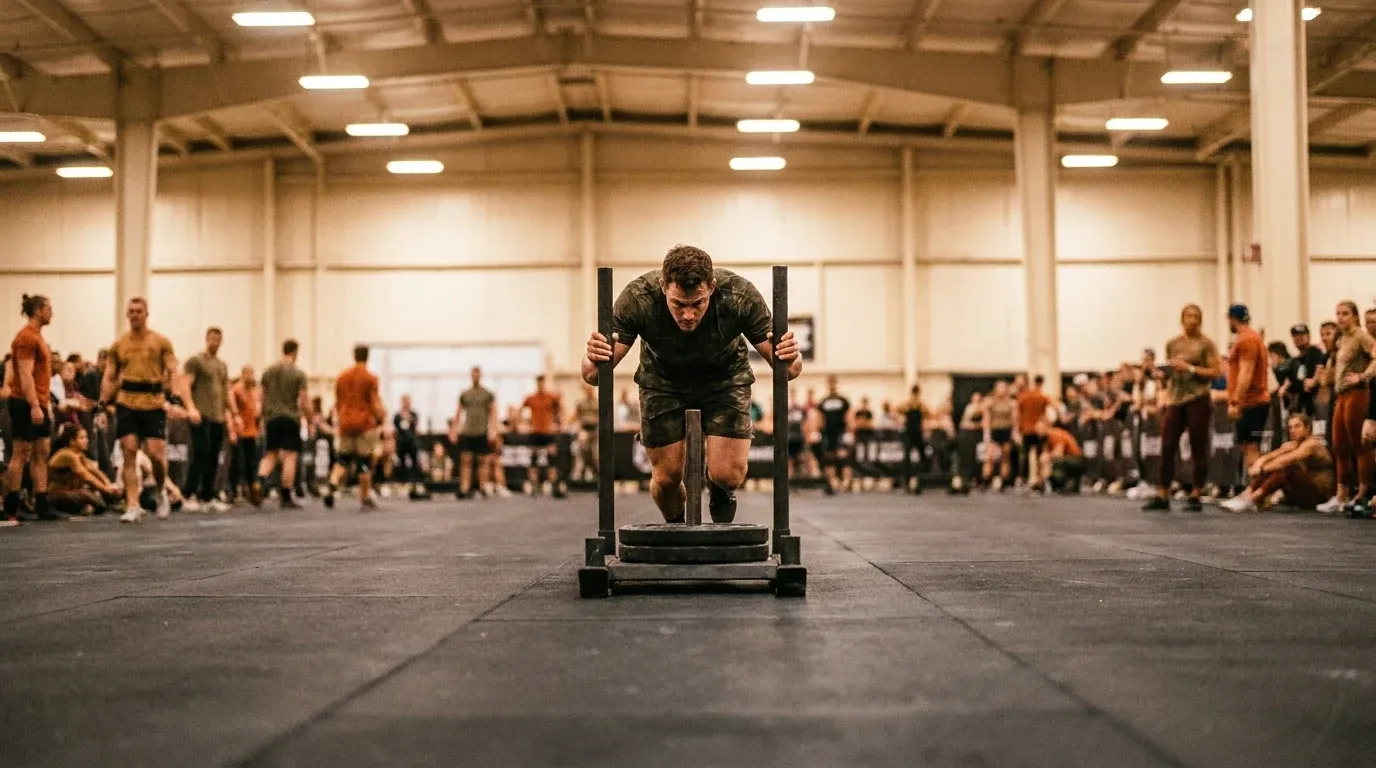
Four race days. Thousands of athletes. One of the most demanding indoor fitness racing formats in the world, staged in a city that already knows something about competitive suffering. HYROX Boston 2026 delivered on every front, and the split data it left behind tells a story worth reading carefully if you plan to toe the line anywhere in North America this year.
Scale and Turnout: Boston Cements Its Place on the Calendar
HYROX Boston 2026 ran across four consecutive race days, drawing one of the largest fields of any North American event to date. Athlete counts across all divisions, including Open, Pro, and the doubles categories, pushed well into the thousands, confirming that this stop has moved firmly into must-attend territory for serious competitors and first-timers alike.
That kind of turnout doesn't happen by accident. Boston sits at a crossroads of endurance culture and strength culture in a way few American cities can match. The infrastructure around event day, from athlete check-in logistics to spectator flow, handled the volume better than many earlier HYROX North American events managed at comparable scale.
If you're mapping out your season, the HYROX North America Fall 2026: The Full Race Schedule is worth bookmarking now. Slots at events of this size fill faster than most athletes expect.
Overall Results: Who Won Boston 2026
In the Men's Open division, the podium was decided by margins tighter than one minute across the top three finishers, with the winning time landing just under the 58-minute mark. That's a benchmark that would have been exceptional at most North American events two years ago. It's now a requirement just to lead the field.
The Women's Open top finisher posted a time in the low 1:06 range, with the second and third place athletes within 90 seconds. The density at the top of the women's field in Boston was noticeably tighter than comparable 2025 events, which reflects genuine improvements in training specificity among female competitors.
In the Pro divisions, both men and women showed the kind of consistent split management that separates athletes who train HYROX-specifically from those who arrive with raw fitness. The Pro men's winner came in under 55 minutes. The Pro women's winner broke 1:03, a competitive marker that continues to drop year over year.
Doubles and Mixed Doubles categories saw strong depth as well, with multiple teams finishing within two minutes of each other across the top five in each division.
Split Breakdown: Where Boston Athletes Lost the Most Time
This is where the data becomes genuinely useful. HYROX publishes full split data for every finisher, and the Boston 2026 results reveal clear patterns across age groups and divisions.
Ski Erg: Consistently one of the cleaner stations across age groups. Athletes who had trained it specifically posted splits in the 3:30 to 4:15 range for the 1,000m distance, while those who hadn't tended to drift past 5 minutes. The gap here wasn't dramatic, but it compounded downstream.
Sled Push: The Boston venue floor surface was reported as moderately resistant, which made sled push splits lean harder than athletes projected. Across Open men 35-44, average sled push splits ran approximately 25 to 30 seconds longer than Boston 2025 comparable data, suggesting either heavier load management issues or insufficient sport-specific training volume.
Burpee Broad Jumps: The station that separated the prepared from the unprepared, across every single division. In the Open women's 30-39 age group, the spread between top-quartile and bottom-quartile finishers on burpee broad jumps alone exceeded three and a half minutes. That's not a fitness gap. That's a training specificity gap. Athletes who don't practice this movement under fatigue pay for it every single time.
Wall Balls: Consistently a graveyard for athletes who arrive with good aerobic capacity but limited overhead endurance. Across Open men's divisions, wall ball splits showed the widest variance of any station. Top performers stayed under 4 minutes. The bottom quartile averaged over 6:30. If you're trying to find the single station to prioritize in training, Boston 2026 data points directly at wall balls.
Rowing (1,000m): Splits here were tighter than at most stations, likely because rowing is the most commonly trained of the HYROX ergometer movements. The outliers were athletes who clearly went too hard on the ski erg or sled push earlier, arriving at the rower already in oxygen debt.
Sandbag Lunges: A consistent time-sink in the 50-plus age groups particularly. The 24kg load for women and 32kg for men over 50 created meaningful split disparities compared to younger divisions, not because of strength alone but because of the accumulated fatigue effect arriving at that station in the back half of the race.
Running Splits: The Connective Tissue of Every HYROX Race
One of the underappreciated elements of HYROX performance is the quality of the 1km runs between stations. Boston 2026 was no different. The athletes who maintained consistent run splits throughout the eight laps were overwhelmingly the athletes who finished at the top of their divisions. The correlation is almost mechanical at this point.
Across the Open men's field, athletes finishing in the top 20 percent maintained average 1km run splits within 8 to 12 seconds of each other across all eight runs. Athletes finishing in the bottom 40 percent showed average run split degradation of 30 to 50 seconds from the first run to the eighth. That's the race being won and lost on the track, not just at the stations.
Running capacity under fatigue is a specific adaptation. It doesn't come from standard 5k or half marathon training alone. It requires deliberately stacking running with station work in training blocks, conditioning your system to produce pace when you're already glycolytically stressed. The same principles behind building that kind of durability are also why research into strength training as a fat-loss tool has drawn attention from endurance athletes. 7 Strength Sessions Start Shrinking Your Fat Cells covers some of that underlying physiology in a way that's directly applicable to HYROX training architecture.
What the Age Group Data Tells Us
Boston 2026 fielded competitive depth across every age category, and a few patterns in the age group data deserve attention.
- Athletes 25-34: The most competitive bracket by volume. The top finishers in this group would have placed respectably in Pro at many 2024 events. The ceiling for Open 25-34 is rising fast.
- Athletes 40-49: This group showed the strongest year-over-year improvement in average finishing times compared to Boston 2025, suggesting that masters athletes are now training with far more HYROX-specific programming than they were two years ago.
- Athletes 50-59: Sled drag and sandbag lunges remained the primary time-loss stations. The split gaps here between trained and undertrained athletes were significant, often exceeding four minutes across those two stations alone.
- Athletes 60+: Participation numbers in this bracket grew at Boston compared to prior years, which mirrors a broader trend in functional fitness events. The 60-plus field is no longer a footnote. It's a competitive category.
North American HYROX Is Maturing Fast
Boston 2026 isn't an isolated data point. It's a confirmation of a trajectory that has been building for two years. The depth of North American HYROX fields is increasing at a pace that most observers didn't predict when the format first gained traction on this side of the Atlantic.
Median finishing times across Open divisions are dropping. The gap between the 50th percentile finisher and the top 10 percent is compressing. Podium times that would have been exceptional in 2023 are now just competitive in 2025 and 2026. That's what a maturing sport looks like, and Boston 2026 is one of the clearest expressions of it yet.
For context on how this kind of competitive growth compares to other endurance disciplines, Chicago 2026: What the Results Tell Us About Road Running tracks similar field-depth trends in marathon racing, and the parallels in participation growth and performance compression are worth reading together.
If you're on the fence about entering a fall event, don't wait. Fields are filling at a rate that reflects genuine demand, and the events with the most competitive energy tend to sell out months in advance. Check the HYROX North America Fall 2026: The Full Race Schedule and register before your target event closes.
Key Takeaways for Your Next Race
Boston 2026 is done. Here's what the data says you should be doing before your next start line.
- Train burpee broad jumps under fatigue. Not fresh. Under fatigue. That's the only way to close the split gap that's costing you three to four minutes at this station.
- Wall balls need to be a staple, not an afterthought. The variance data from Boston is unambiguous. Athletes who train them consistently show dramatically tighter splits.
- Protect your run splits. Deliberate run-station-run blocks in training are non-negotiable if you want to stop bleeding time in the back half of the race.
- If you're competing in the 40-plus categories, the field is getting faster. The athletes who trained for 2023 HYROX conditions are now getting outpaced by athletes training with 2026 specificity.
- Sled work matters more than most training plans reflect. Boston's floor conditions punished athletes who hadn't put in real sled-specific volume. Address it before your next event.
Boston 2026 was a marker of how far North American HYROX has come. It was also a clear signal of what you need to bring to stay competitive as the field keeps rising. The data's there. The question is what you do with it.