
HYROX Cape Town 2026: Results and What the Times Reveal
HYROX Cape Town wrapped on April 5 after three days of racing at the Cape Town International Convention Centre. Full results are now live on HYRESULT and TrainRox, and if you haven't gone through them yet, you should. Not just to see who won, but to understand where time was actually made and lost across divisions.
With HYROX Brisbane APAC Regional Championships scheduled for April 11-12, athletes have a narrow window to extract useful data from Cape Town and act on it. Here's what the numbers actually show.
The Race at a Glance
The Cape Town event featured the full division slate: Pro Men, Pro Women, Open Men, Open Women, Doubles Men, Doubles Women, Mixed Doubles, and the Corporate Challenge. Racing ran across all three days, with Pro divisions typically drawing the deepest fields and the most compressed finishing times at the top.
Cape Town has established itself as one of the key Southern Hemisphere tune-up races on the calendar. For athletes targeting Brisbane, it offers a recent benchmark under race conditions. For those already looking ahead, it also feeds into the broader qualification picture for HYROX World Championships 2026 in Stockholm, where the fields will be significantly more competitive.
The CTICC venue, like most indoor HYROX setups, places athletes on a consistent flat course. That means finishing times from Cape Town translate cleanly to Brisbane without major environmental adjustments needed beyond heat and humidity management.
Where Most Races Are Won and Lost: SkiErg and Sled Push
Pull the raw splits from any HYROX result database and a pattern emerges consistently across events. The SkiErg and Sled Push stations generate the widest time differentials between athletes at all levels. These two stations don't reward just fitness. They reward specific preparation.
In the Open Men division at Cape Town, the gap between top-quartile and median finishers on the SkiErg alone typically runs 45 to 90 seconds over the 1,000-meter distance. That's not a small margin. Over a full race that might separate podium from mid-pack, it's the equivalent of poor pacing on two running segments.
The Sled Push tells a similar story, and often a more dramatic one. Weight is fixed at 102 kg for Open Men (62 kg for Open Women), but technique variability is enormous. Athletes who haven't trained the push mechanics specifically tend to slow down disproportionately in the final 25 meters of each 25-meter length, which is where the real time bleeds out. Cape Town splits confirmed this pattern again.
For Pro divisions, the differentials compress but don't disappear. The top Pro Men finishers at Cape Town separated themselves primarily through sustained SkiErg pace and cleaner Sled Push transitions, not through running splits, which tend to be remarkably uniform among elite athletes at this level.

Benchmark Times by Station: What Fast Looks Like
If you're targeting a competitive finish at Brisbane, here's a working reference based on top-quartile performance across Cape Town divisions. These aren't world-record benchmarks. They're the times you need to be capable of producing under race fatigue.
- SkiErg (1,000m): Under 3:45 for competitive Open Men, under 4:20 for competitive Open Women. Pro Men are executing closer to 3:20-3:30.
- Sled Push (50m): Under 1:30 for Open Men, under 2:00 for Open Women. Anything above 2:30 in Open Men represents significant ground lost.
- Sled Pull (50m): Under 1:45 for Open Men, under 2:10 for Open Women. This station tends to be more uniform than the push.
- Burpee Broad Jumps (80m): Under 2:30 for Open Men, under 2:50 for Open Women. Pacing discipline here matters more than raw speed.
- Rowing (1,000m): Under 3:50 for Open Men, under 4:15 for Open Women. Technique fatigue becomes visible here after heavy sled work.
- Farmers Carry (200m): Under 1:45 for Open Men, under 2:15 for Open Women. Grip fatigue is the limiting factor late in race.
- Sandbag Lunges (100m): Under 2:45 for Open Men, under 3:15 for Open Women. Hip flexor fatigue accumulates from prior stations.
- Wall Balls (100 reps): Under 4:00 for Open Men (9 kg), under 4:30 for Open Women (6 kg). Unbroken sets are achievable at this benchmark.
These aren't arbitrary numbers. They reflect the performance band where finishing times start to become genuinely competitive across HYROX regional events. If you're consistently hitting these in training, you're in the window. If two or three stations are significantly above these marks, that's where your Brisbane prep should concentrate.
Doubles Division: The Pacing Calculation Is Different
The Doubles results from Cape Town reveal something that solo athletes often underestimate. The work split strategy between partners has an outsized effect on total time, and teams that default to equal splits frequently underperform relative to teams that assign based on individual strengths.
In Mixed Doubles in particular, the weight adjustments across stations mean that smarter allocation. letting the stronger partner absorb more of the Sled Push and SkiErg while the other recovers. can produce meaningful time savings. Cape Town Doubles results showed top teams finishing 3 to 5 minutes ahead of similarly fit teams that weren't optimizing their splits. Understanding work splits and pacing strategy in HYROX Doubles is worth reviewing in detail if you're competing in Brisbane as a pair.
One data point worth noting from Cape Town: Doubles teams that took slightly longer transition pauses between partner switches at the Sled Push actually posted faster overall station times than teams rushing transitions. A 10-second reset is worth it if it means your partner enters the push with posture and drive angle intact.
The Running Segments: Underestimated by Most, Critical to All
Eight running kilometers split across the race don't sound like much. But the compounding effect of running pace on station performance is consistently underrated by athletes who train their functional stations heavily and their running lightly.
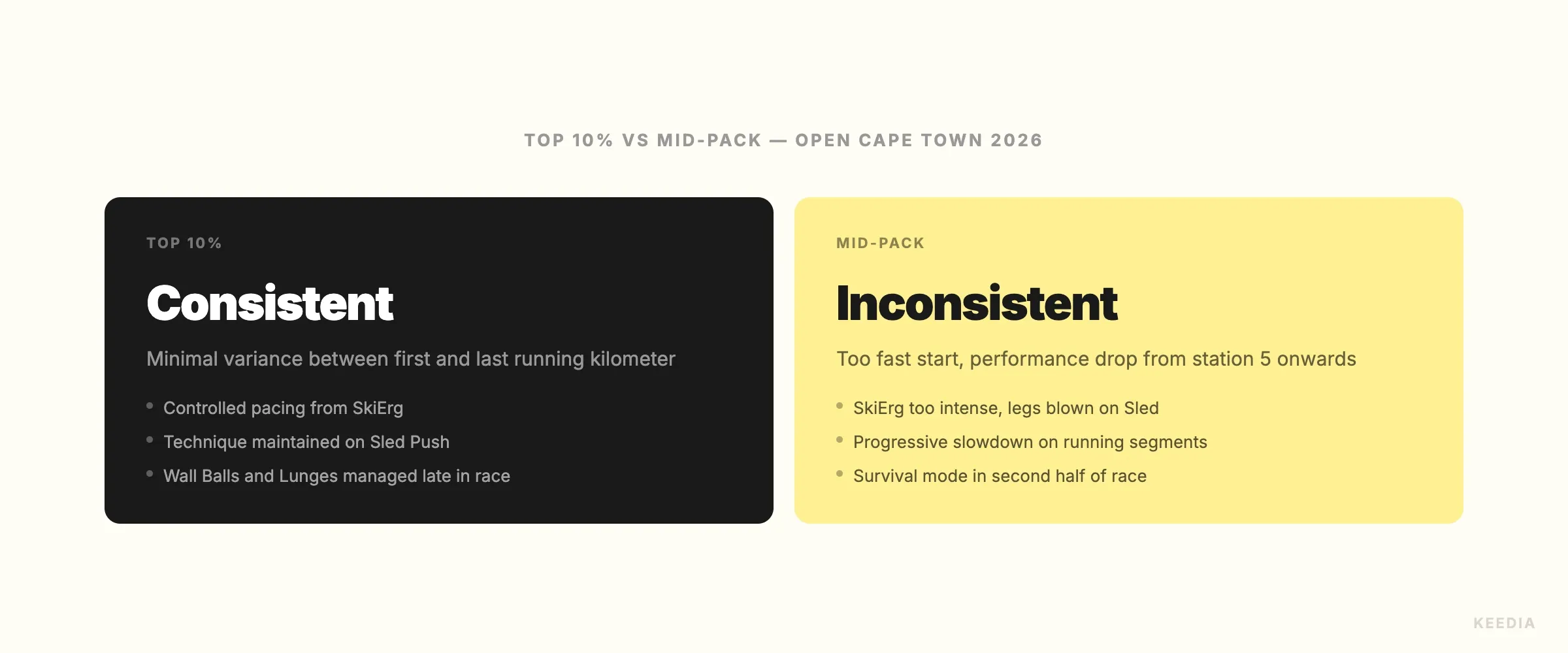
Cape Town data shows that athletes finishing in the top quartile of Open divisions were running their 1 km splits at 4:20 to 4:50 per kilometer under race fatigue. Most mid-pack athletes were running 5:30 to 6:00 per kilometer, often because they'd over-paced early stations and were managing the debt by slowing down on runs. That's a recoverable pattern if you catch it before Brisbane.
If you've been racing in warmer conditions and want to understand the adaptation angle, heat training protocols for runners are relevant reading. Brisbane in April can introduce humidity variables that Cape Town's indoor setup didn't replicate.
Recovery in a Two-Week Window
If you raced Cape Town and you're heading to Brisbane, the next two weeks aren't for building fitness. They're for recovering completely, sharpening a few weak points, and arriving fresh enough to perform.
Most athletes should be looking at a structured deload in the first week post-Cape Town. Research consistently shows that training volume reduction of 40 to 60 percent over 5 to 7 days does not result in fitness loss and measurably improves neuromuscular readiness. The evidence on deload protocols is worth understanding precisely so you don't talk yourself into doing more than you should.
Sleep quality during this window matters more than most athletes account for. Functional station performance, particularly on high-skill stations like SkiErg and Wall Balls, degrades meaningfully with accumulated sleep debt. If you're running low on recovery, the tools available to support sleep architecture are worth using deliberately in this two-week period. The research on magnesium supplementation and sleep quality for athletes outlines the forms and doses with actual evidence behind them.
Beyond sleep, joint recovery from a full HYROX race effort is real. The Sled Push and Lunges in particular load the knees and hips under fatigue conditions. Don't ignore any persistent soreness or stiffness that's localized rather than general. General muscle soreness resolves. Specific joint irritation sometimes needs attention before you add race intensity again.
What to Prioritize in the Final 10 Days Before Brisbane
Based on what Cape Town times revealed, here's a practical sequence for athletes with Brisbane on the calendar:
- Days 1-5 post-Cape Town: Reduce volume sharply. Maintain movement quality with two to three low-intensity sessions. Prioritize sleep and nutrition. Don't race the recovery.
- Days 6-9: One race-pace SkiErg session targeting your benchmark split. One Sled-specific session focusing on drive mechanics and staying low through the full 50 meters. One tempo run at race-pace effort.
- Day 10 (2 days before race): Short activation only. No fatigue accumulation. Confirm your nutrition and caffeine protocol for race day.
Caffeine timing and dosing under race conditions is worth getting right. If your tolerance has drifted high from training periods where you're using caffeine daily, you'll get less performance benefit from it on race day. Managing that in the two weeks post-Cape Town is a legitimate prep detail, not a marginal one.
Cape Town provided the data. Brisbane is where you use it. Pull your splits, identify your two biggest time-loss stations, and spend the next 10 days making those stations marginally better. That's where the result moves.