
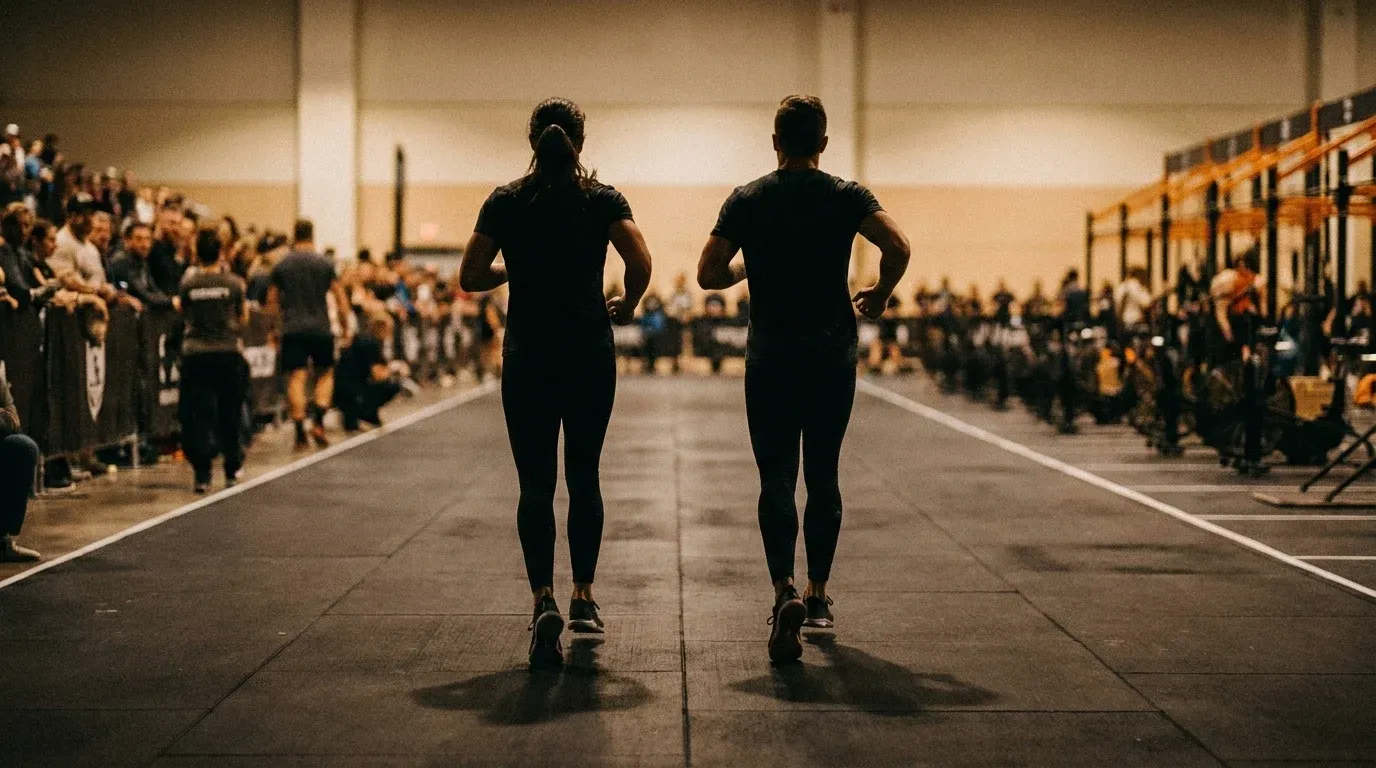
They had shared exactly one training session together before race day. No synchronized workouts, no months of building chemistry, no shared suffering through back-to-back ski erg intervals. Just a single meetup, a conversation about pacing strategy, and an agreement to trust each other under pressure. They won their age division anyway.
The story of Marcus Webb and Daniel Osei, who topped the Men's 40-44 doubles category at a regional HYROX event in Austin, Texas, is the kind of result that makes you rethink what doubles competition actually demands. It's not about shared mileage or years of friendship. It's about something more specific and, it turns out, more learnable.
One Session. One Plan. One Win.
Webb, a former collegiate rower who now trains primarily for recreational fitness, and Osei, a CrossFit regular with a strong engine but limited running background, were connected through a mutual friend three weeks before the event. They met once at a local turf gym, ran a 5K together on the track, and worked through a few of the HYROX stations to get a read on each other's output.
That single session produced the only data they needed: they were aerobically close enough to pace together without either athlete blowing up or waiting around. From there, they divided responsibilities. Osei would lead the ski erg and sled push based on his strength profile. Webb would set the pace on the running legs and manage the wall balls. Every station had an agreed-upon tempo before they arrived at the start line.
"We weren't trying to go fast," Webb said after the race. "We were trying to go even. That's a different thing entirely."
Their finish time placed them nearly four minutes ahead of the second-place pair in their age category. The margin wasn't built on exceptional fitness. It was built on not making expensive mistakes.
Why Aerobic Compatibility Is the Real Selection Criteria
Most athletes approaching HYROX doubles for the first time focus on the wrong variables. They want a partner who's strong at the stations they find hardest, or someone they know and trust socially. Both instincts are understandable, but neither addresses the actual bottleneck in doubles performance.
The format requires both athletes to complete each functional station together before moving on. That means if your aerobic capacity is significantly higher than your partner's, you'll be waiting at stations, breaking rhythm, and losing the steady-state momentum that makes HYROX doubles fast. The penalty for mismatched aerobic engines isn't just slow transitions. It's complete disruption of pacing structure across eight stations and eight running legs.
The most effective way to assess compatibility before committing to a pairing is a simple shared run test. Run a 5K or 10K together at a pace that feels genuinely uncomfortable for both athletes. If you're both struggling at the same intensity, you're compatible. If one of you is coasting while the other is grinding, that gap will compound over a 60-to-90-minute race.
This matters even more for athletes in the 40-plus age categories, where recovery capacity between high-intensity efforts begins to differentiate more sharply between athletes of seemingly similar fitness levels. For those training in that age range, understanding your actual aerobic ceiling, not just your lifting numbers, becomes the foundation of any race plan. The principles covered in Strength Training After 40: The Minimum Dose That Works are directly relevant here: maintaining a high aerobic output with controlled volume is the engine doubles athletes need.
Station Strategy Before Race Day
Webb and Osei's pre-race conversation covered something most casual doubles pairs skip entirely: station-by-station pacing agreements. This isn't about deciding who does more reps. In HYROX doubles, both athletes complete all work together. The agreement is about tempo, rest behavior, and communication cues.
Here's what a functional pre-race plan looks like for doubles:
- Ski erg: Agree on a stroke rate and hold it. Going too hard early here destroys the legs before the sled push.
- Sled push and pull: Designate a leader for transitions so you're not losing seconds to confusion at the lane change.
- Burpee broad jumps: Set a cadence and stick to it together. Rushing here while your partner struggles creates a split that's hard to close.
- Rowing: Match your stroke rate to your partner's. One athlete rowing at 28 strokes per minute while the other pulls at 22 is a sign of misalignment that should have been caught in training.
- Wall balls and sandbag lunges: Agree on rest intervals before you start. "We'll do 20, rest 10 seconds, then go again" is a conversation that takes 30 seconds before the race and saves two minutes during it.
The running legs are where most doubles pairs lose unnecessary time. The temptation is to use the 1km runs as recovery, walking sections or letting pace collapse. Webb and Osei held a disciplined trot between every station. It wasn't fast, but it was consistent, and consistency compounds over eight laps.
For athletes who want to understand how to train the running component specifically for HYROX, the approach outlined in Compromised Running: The HYROX Training Edge is worth building into your preparation. Running efficiently on fatigued legs is a skill, and it's one you can develop well before race day.
Trust Under Pressure Is Trainable
The psychological element of doubles HYROX is real, and it's underestimated. When you're 45 minutes into a race and your legs are failing on the sled pull, the temptation is to look sideways at your partner and recalibrate your effort based on theirs. If you don't have a pre-established agreement about how to handle that moment, you'll make a reactive decision instead of a strategic one.
Webb and Osei had discussed this explicitly. Their rule was simple: if one person signals they need 10 seconds at a station, the other acknowledges and waits without comment. No encouragement, no pressure, no visible frustration. Just a reset and a return to the plan.
That kind of communication protocol sounds obvious until you're in it. Most doubles pairs haven't talked about it at all. And when things get hard, silence from a partner you don't know well can feel like judgment. Having named the behavior in advance removes that ambiguity entirely.
This is why one good session before race day can actually be sufficient. You don't need months of shared training to build functional trust in a HYROX context. You need one honest conversation about what you'll do when it gets hard.
What This Means for Athletes Considering Doubles
HYROX doubles has grown sharply in participation over the past three years, partly because it lowers the barrier to entry for athletes who find the solo format intimidating, and partly because the format is genuinely fun. Sharing the work and the suffering with another person changes the psychological texture of the event entirely.
But the growth has also produced a common misconception: that doubles is easier than solo HYROX, and therefore requires less preparation. That's wrong. Doubles is a different kind of hard. The fitness demands are slightly reduced per athlete, but the strategic demands are higher. You're managing two aerobic systems, two emotional states, and two sets of fatigue signals simultaneously.
The good news is that the preparation gap between "total beginner" and "competitive doubles athlete" is smaller than most people assume. If you're already running consistently and have a baseline of functional strength, you can be competitive in a regional age category doubles event within eight to twelve weeks of focused preparation. You don't need to be elite. You need to be matched and strategic.
Finding that partner, by the way, is easier than you think. HYROX has an official partner-matching feature in its app, and most local gyms that host HYROX training sessions informally connect athletes looking for doubles partners. If you're over 40 and considering your first doubles entry, the athlete community around HYROX tends to be collaborative rather than territorial. Ask around.
For athletes building running fitness as part of their preparation, the guidance in How to Keep Your Running Fitness All the Way Through Fall translates directly. Maintaining aerobic base across changing seasons is exactly the kind of low-drama consistency that HYROX doubles rewards.
The Bigger Picture
What Webb and Osei actually demonstrated isn't that preparation doesn't matter. It's that the right kind of preparation doesn't require the most time. A single focused assessment session, a clear station-by-station plan, and one direct conversation about how to behave under pressure. That's the minimum effective dose for doubles HYROX success, and they proved it holds up at a competitive level.
Their win also points to something the broader fitness community tends to overlook: structured events with clear formats reward strategic thinking as much as raw fitness. You don't win by being the fittest pair on the floor. You win by being the least chaotic pair at every station, across every running lap, for the full duration of the race.
If you're considering HYROX doubles, the question worth asking isn't "am I fit enough?" It's "do I have a plan, and does my partner know what it is?" Based on everything Webb and Osei showed, that's the question that actually decides the result.