
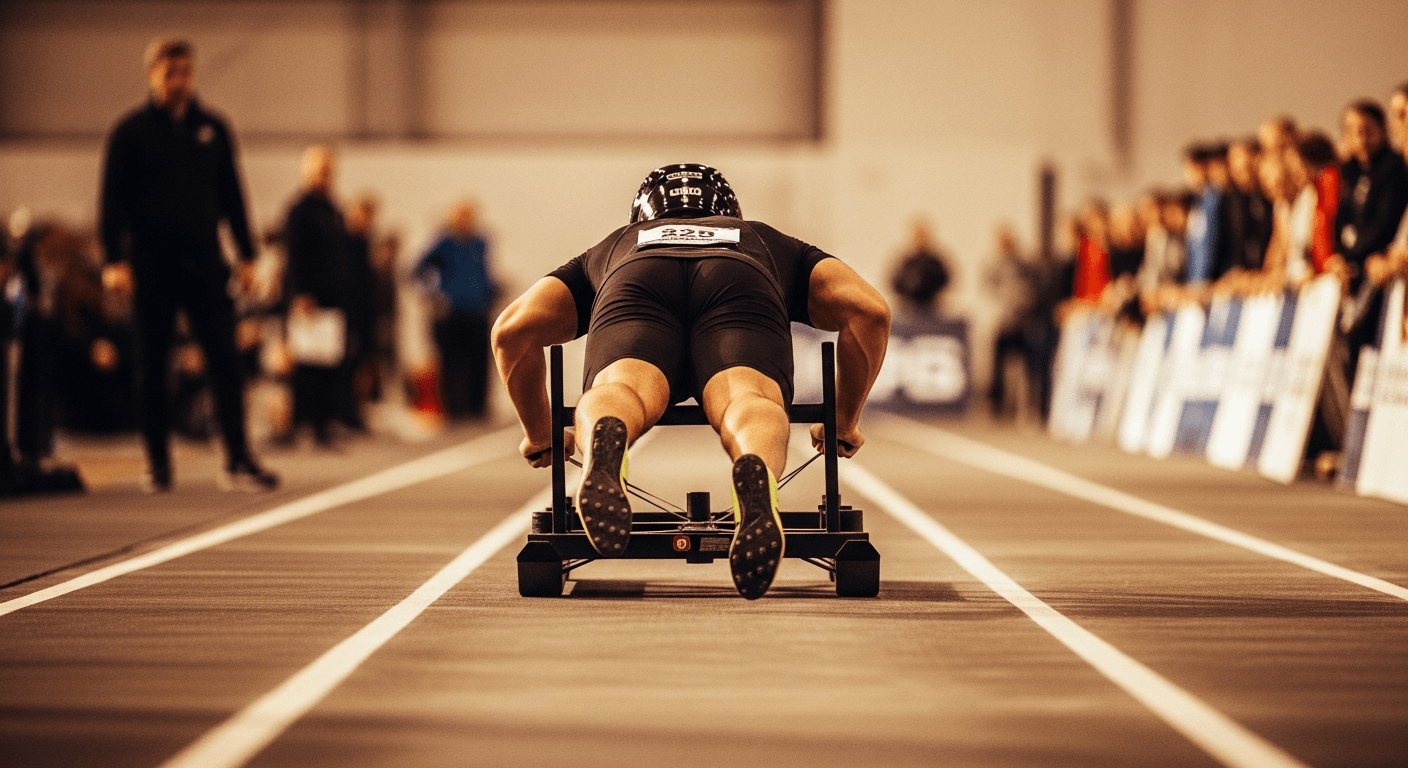
Something unusual is happening across HYROX finish lines. Athletes who ran competitive times two seasons ago are now placing mid-pack. Age-group podiums that once required a 1:15 are now demanding sub-1:10. And at the elite level, the clock is being reset in ways that felt impossible when the sport launched in 2017. The improvement isn't incremental. It's structural, and it's accelerating.
The Numbers Tell a Clear Story
Across the 2025-2026 season, finish times in elite and age-group divisions have fallen by several minutes compared to equivalent stages in previous years. That's not a rounding error or a course anomaly. It reflects a sport that's maturing rapidly, with athletes arriving better prepared, better coached, and better equipped than any previous generation of HYROX competitors.
The benchmark that crystallizes this shift is Lukas Wietrzyk's world record of 54:25. When HYROX held its first major events, finishing under 60 minutes was considered elite territory for a small handful of specialists. That Wietrzyk is now nearly six minutes inside that threshold speaks to how dramatically the performance ceiling has been raised. His time isn't just a personal achievement. It's a signal of where the sport's upper limit now sits, and how much further it may still travel.
For context, early HYROX winners were often endurance athletes transitioning from running or triathlon, treating the functional stations as obstacles to survive rather than elements to optimize. That mindset is now essentially obsolete at any competitive level.
Training Has Gotten Smarter, Not Just Harder
The most significant driver behind falling times isn't raw fitness. It's specificity. Athletes across all divisions are now following structured hybrid training blocks that treat running and functional work as genuinely integrated disciplines, not parallel tracks that occasionally intersect.
A well-designed HYROX training block today typically includes dedicated sled push and pull sessions at race-weight loads, ski erg intervals calibrated to sustainable watts, and running workouts that specifically replicate the cardiovascular demand of transitioning from high-effort station work back to 1km laps. Coaches working in this space have increasingly refined the sequencing of these elements, building sessions where athletes train the exact fatigue pattern the race produces.
This mirrors a broader shift happening across fitness culture, where AI is building personalized workout programs in 2026 that can identify training gaps and optimize load distribution with a precision that generic programs simply can't match. HYROX athletes, particularly at the elite and competitive amateur level, are early adopters of these tools.
The result is that athletes arrive at race day having already experienced the metabolic stress of the full event, multiple times, in controlled training environments. That familiarity with suffering is itself a performance advantage.
Pacing Strategy Has Become a Discipline of Its Own
Early HYROX races were, for most athletes, exercises in controlled panic. The competitive field was small, race data was limited, and most competitors had little reference for how hard to push at each station relative to their capacity over the full distance. Many athletes blew up on the sled push or the burpee broad jumps and spent the final two kilometers running on empty.
That's changed substantially. The growth of HYROX-specific coaching, the proliferation of race-day data from wearables, and the sheer volume of competitive experience across the global athlete base have produced a far more sophisticated collective understanding of how to distribute effort across the eight stations and eight running laps.
Top performers now enter races with precise target watts for the ski erg, target paces for each running segment, and pre-planned modifications for stations like the wall balls and rowing that allow them to manage heart rate without sacrificing time. The race is increasingly treated like a structured time trial rather than a test of who can endure the most discomfort. That mental shift translates directly to the clock.
Interestingly, research on exercise timing and chronotype suggests that when athletes compete at times aligned with their individual biological peak performance windows, output metrics improve meaningfully. For athletes who have multiple races per season, this kind of marginal optimization is now part of the conversation.
Equipment and Recovery Have Closed the Gap
Gear matters more in HYROX than it did three years ago. Not because the sport has become equipment-dependent, but because athletes at every level are now more deliberate about selecting footwear, training tools, and recovery protocols that are genuinely suited to the demands of the race.
Running shoe selection for HYROX presents a genuine tradeoff. You need something responsive enough for 8km of running but stable enough for loaded stations. The category of hybrid and multi-sport shoes has grown to address exactly this need, and athletes who've optimized their footwear choices are reporting tangible differences in both station performance and running economy late in the race.
On the partnership side, the sport's infrastructure is also maturing. HYROX's three-year global partnership with Amazfit signals the degree to which wearable data has become embedded in how serious competitors approach training and race-day execution. Real-time heart rate, power output, and recovery tracking are no longer optional for athletes chasing podium finishes.
Recovery protocols have similarly evolved. Athletes competing across multiple HYROX events per season now approach inter-race recovery with the same rigor applied to marathon runners managing high training loads. Sleep optimization, nutrition periodization, and active recovery strategies have moved from the margins into standard practice for competitive amateurs.
A Bigger Field Means a Faster Field
Perhaps the most underappreciated driver of faster times is the simplest one. There are more athletes competing, and more competition makes everyone faster.
HYROX has expanded aggressively across North America, Europe, Australia, and Asia-Pacific over the past three years. Entry numbers at major events have grown substantially, and the depth of competitive fields at every age group has increased correspondingly. When you're racing in a category with 400 athletes rather than 40, the performance curve sharpens. Athletes who would have finished on the podium in a thinner field now finish outside the top ten, which drives training intensity upward across the board.
This dynamic is consistent with what's been observed in other endurance sports experiencing rapid growth. Research on participation trends in trail running growth and race entry data in 2026 shows that as sports scale, competitive density at mid-field increases first, then filters upward to compress times at the elite level. HYROX appears to be following exactly this trajectory.
The age-group divisions illustrate this particularly well. The 35-39 and 40-44 categories, historically among the deepest in HYROX, have seen some of the most pronounced time drops over the past two seasons. These are athletes with the resources to invest in quality coaching, the experience to train intelligently, and the motivation of a category that genuinely rewards consistent preparation.
What This Means for You in 2026
If you're a current HYROX athlete, the implication is direct. The standard that qualified as competitive two seasons ago probably doesn't anymore. If your goal is a podium finish or a top-ten age-group result, you need to train with greater specificity than general fitness work will produce.
That means structured hybrid blocks. It means practicing stations under fatigue, not just as standalone exercises. It means developing a pacing plan based on your actual tested capacity across all eight stations, not your best-case scenario.
If you're new to the sport, the data is both motivating and clarifying. HYROX rewards disciplined preparation more than raw athletic talent. Athletes who come from running backgrounds often underestimate the functional demands. Athletes from strength backgrounds often underestimate the cardiovascular tax. The sport is genuinely hybrid, and training for it effectively requires honoring both sides of that equation.
The times will keep falling. The athletes setting them aren't superhuman. They're just preparing smarter, pacing more precisely, and racing in a field that's raising everyone's ceiling by demanding more from the bottom up.