
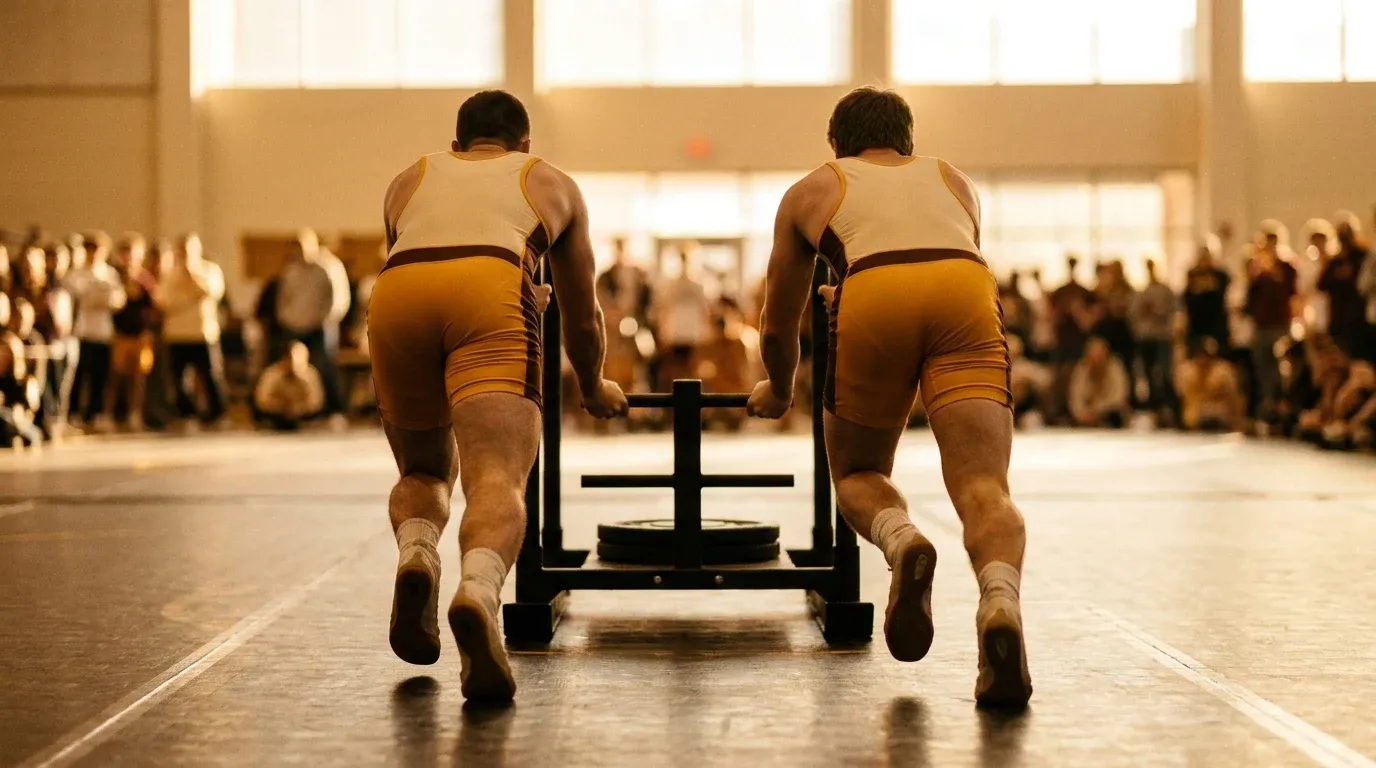
If Friday belonged to the singles athletes pushing their limits across Hamburg's iconic race floor, Saturday shifted the dynamic entirely. The doubles format arrived with its own brand of pressure, strategy, and raw spectacle. Emile Mattheeuws and Louis Osselaer took center stage in the Men's Challenger Doubles, while the Women's Elite 15 Doubles delivered one of the tightest finishes the Hamburg event has seen in recent memory.
For context on what set the tone heading into Saturday, the HYROX Hamburg 2026 Friday Recap: Elite Results covers the singles action that had the crowd buzzing from the opening gun. Saturday built directly on that energy.
Mattheeuws and Osselaer Claim Men's Challenger Doubles
Emile Mattheeuws and Louis Osselaer came into Hamburg with a clear plan, and they executed it with the kind of discipline that separates well-prepared teams from those who find out mid-race that their pacing strategy was built on optimism.
The Belgian duo moved efficiently through the running segments, keeping splits conservative enough in the early laps to have something left when the sled pushes and wall balls arrived. Their transitions between partner exchanges were sharp. In doubles, even a few sloppy handoffs compound over eight stations, and Mattheeuws and Osselaer didn't leave points on the floor.
They held their position through the SkiErg and Sled Push, extended their lead during the Burpee Broad Jumps, and closed out the race with enough runway to cross the finish line comfortably ahead of the field. It was a controlled, confident performance from start to finish.
Women's Elite 15 Doubles: A Station-by-Station Battle
The Women's Elite 15 Doubles told a different story. Teams Weeks and Tafuto versus Archer and Millard produced the kind of head-to-head racing that makes doubles competition genuinely compelling to watch.
The gap between these two teams shifted multiple times across the course. Weeks and Tafuto edged ahead through the early running laps and maintained a slim margin at the SkiErg. Archer and Millard responded on the Sled Push, where their coordination on partner exchanges was noticeably sharper, pulling them level and briefly ahead.
The Rowing stations became a critical equalizer. Both teams are strong on the erg, and neither gave ground willingly. By the time they reached the Wall Balls, the split between them was close enough that the outcome genuinely wasn't decided. Weeks and Tafuto fought hard through the final station, and the crowd inside Hamburg's venue had enough information to track the tension in real time.
Results from events like this one reinforce why doubles racing at the Elite 15 level demands a different kind of preparation than singles. You're not just managing your own output. You're reading your partner's fatigue, adjusting your share of each station's workload on the fly, and maintaining communication under conditions that make clear thinking difficult.
Why Doubles Racing Is Its Own Discipline
It's tempting to treat doubles as simply two singles athletes racing side by side. That framing misses most of what actually matters. The fundamental challenge in doubles is coordination under load, and that's something you can't shortcut.
Partner exchanges during station work, decisions about who handles the heaviest portion of a shared sled, pacing conversations during running laps where both athletes are already operating near threshold. These are skill sets that require deliberate training. Athletes who have spent months refining their individual HYROX fitness sometimes arrive at their first doubles race underprepared for exactly this dimension.
If you're building toward a doubles event, the HYROX 2026/27 Training Guide: Plan Your Season Right walks through how to structure a full season with both race formats in mind, including how to layer partner-specific sessions into a training block without sacrificing your individual conditioning base.
The physical demands themselves are also worth taking seriously in isolation. Both athletes are running the full 8km across the laps, and the combined station workload, while split between partners, still requires that each individual arrives at each functional station with enough capacity to contribute meaningfully. Fitness deficits don't disappear just because you have a partner absorbing some of the work.
Hamburg as a Flagship European Stop
Hamburg has earned its place as one of HYROX's marquee European events. The venue draws top-tier elite athletes and competitive age-groupers across both days, and the production quality reflects the race's stature in the global HYROX calendar.
The crowd inside the hall on Saturday was loud and engaged throughout the doubles races. That atmosphere is part of what makes Hamburg different from a regional qualifier. Athletes who perform well here do so in front of genuinely knowledgeable spectators who understand the sport, which adds a layer of pressure that doesn't exist in smaller events.
For international athletes traveling to Hamburg specifically for the doubles format, the city also provides logistically sound conditions. The venue is accessible, the race organization is tight, and the competition field draws from across Europe and beyond. If you're planning your HYROX season around the European events, Hamburg warrants a slot on the calendar.
What Saturday's Results Tell You About Doubles Strategy
Looking at both the men's and women's results together, a few patterns emerge that are worth sitting with if you're preparing for a doubles event of your own.
- Early pacing discipline matters more, not less, in doubles. Teams that go out hard in the opening running laps often pay for it during the later stations, when partner communication breaks down under fatigue.
- Station transitions are a genuine performance variable. Clean exchanges don't happen automatically. They require practice, and the teams that finish well almost always have smoother transitions than the teams that don't.
- Identify your team's weak stations early in training. Weeks and Tafuto versus Archer and Millard showed that small advantages at specific stations can swing an entire race. Know where your team is vulnerable and build a plan around it.
- Running fitness is still the foundation. The station work gets the attention, but both athletes cover the full running distance. If either partner is significantly undertrained on the running side, that gap becomes very visible very quickly.
Athletes who are returning to training after time off and considering doubles competition should be realistic about where their fitness is before committing to a race timeline. The Smartest Way to Return to Training After a Break offers a structured framework for rebuilding capacity without rushing the process and risking injury before you've even reached the start line.
The Broader HYROX Weekend Picture
Taken together, Friday and Saturday in Hamburg painted a picture of a sport that continues to grow in competitive depth. The singles fields on Friday were stacked, and Saturday's doubles results showed that the format is drawing athletes who are taking it as seriously as any other race category.
That competitive maturity is worth noting. In the early years of HYROX's growth, doubles was sometimes treated as the more social or accessible version of the race. The performances at Hamburg 2026 don't support that characterization. The elite doubles athletes are training specifically for the format, and it shows in how they race.
For athletes at every level, watching how top teams handle the strategic dimensions of doubles racing is genuinely instructive. You don't have to be chasing Elite 15 results to benefit from thinking carefully about pacing, transitions, and partner-specific preparation. The principles scale down to age-group and open division competition just as cleanly.
Hamburg 2026 delivered across both days. If you're already thinking about next year's race calendar, this weekend gave you a clear benchmark for what serious doubles competition looks like at the top of the sport.