
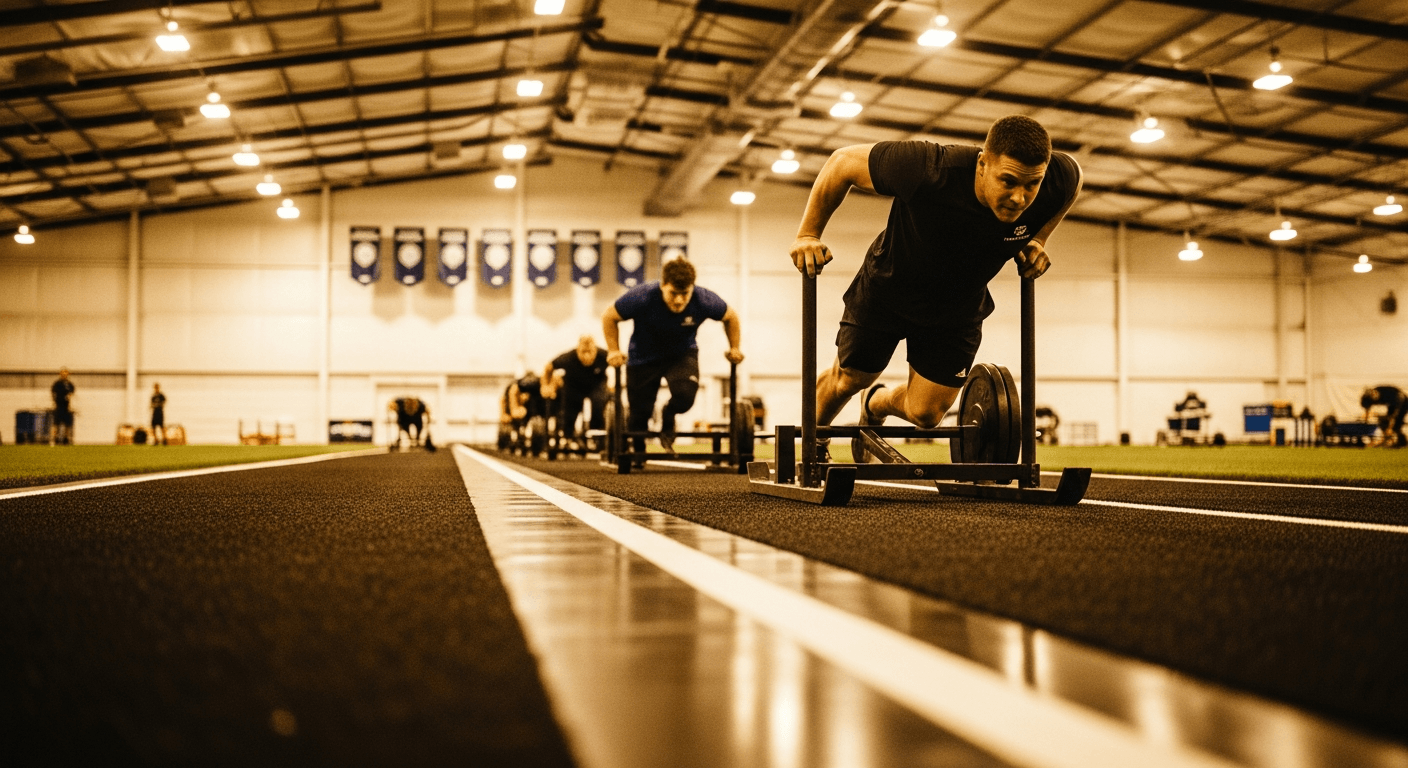
Lisboa 2026 wasn't just another stop on the HYROX circuit. As one of the final major qualifier races before the Stockholm World Championships, it drew a deep field of competitors who knew exactly what was at stake. The results didn't just crown podium finishers. They told a more complicated story about who's ready for Stockholm and who still has work to do.
If you're targeting a personal best or a World Championships qualification, the data from Lisboa deserves more than a quick scroll through the leaderboard. Here's what the numbers actually reveal.
The Stockholm Stakes Made Lisboa Different
With Stockholm World Championships approaching as the season's defining event, the field at Lisboa carried unusual weight. Many athletes treated this race as a final dress rehearsal, which means pacing decisions, equipment choices, and race-day strategy were more deliberate than at earlier qualifiers.
That deliberateness shows up in the splits. The spread between the top finishers and the mid-pack was notably wider at Lisboa than at several earlier 2025-26 season races. That's not a coincidence. When athletes race with a championship mindset, small errors compound. The Lisboa results document exactly where those errors happened.
Qualification windows for Stockholm are tightening, and for many athletes currently sitting just outside the top cut-off spots, Lisboa represented a critical points opportunity. The pressure filtered into the pacing data in ways that are genuinely instructive.
Where the Podium Was Actually Won and Lost
Strip away the finishing times and look at the station splits, and a clear picture emerges. The workout stations doing the most damage to mid-pack finishers weren't the ones most athletes fear. Sled pushes and sled pulls consistently separated the top five from positions six through twenty across both the men's and women's open divisions at Lisboa.
The gap wasn't primarily about strength. Athletes who finished in the top five showed a measurably tighter sled split variance, meaning they maintained more consistent effort across all sled repetitions rather than going hard on the first few and fading. Mid-pack athletes tended to attack the sled early, which looked good in the first pass but cost them on later stations.
Rowing was the other major differentiator. In the women's open division, the top three finishers were separated by less than 40 seconds across all running legs combined. But on the rowing stations, that gap expanded to over 90 seconds. Rowing endurance, specifically the ability to sustain output after fatigued running, proved to be a genuine separator at Lisboa in a way that pre-race rankings didn't predict.
Wall balls and burpee broad jumps showed smaller gaps between podium finishers and mid-pack athletes, which suggests these stations are increasingly well-trained across the competitive field. If you're trying to find time at Stockholm, the data points toward sled efficiency and rowing capacity as the higher-return investments right now.
Masters Athletes Are Closing the Gap Faster Than Expected
One of the most striking storylines from Lisboa 2026 doesn't involve the open division at all. The masters age groups, particularly the 40-44 and 45-49 brackets, posted times that would have placed solidly within the open division top half as recently as two seasons ago.
This is happening faster than most analysts expected. Masters athletes have historically closed the gap gradually, but Lisboa showed something closer to acceleration. Several masters competitors in the 45-49 bracket finished within 8 percent of the open division winning time, a margin that was closer to 14 percent at comparable events two years ago.
The reasons aren't mysterious. Masters athletes competing at this level now tend to have longer training histories, more sophisticated periodization, and a more disciplined approach to recovery and nutrition. There's also a selection effect: the athletes still competing seriously in their mid-40s are, by definition, resilient and experienced.
Nutrition quality plays a real role here. Research consistently shows that protein intake and food quality have outsized effects on muscle preservation and power output as athletes age. If you're a masters competitor and haven't audited your daily intake recently, the real impact of ultra-processed food on muscle strength is worth understanding before Stockholm.
For open division athletes, the masters data carries a different message: the competitive field at World Championships events is expanding from the bottom up. Depth is increasing across all age groups, which changes how qualification margins work.
The Front-Loading Trap: Why Early Running Pace Backfires
The most consistent pattern in the Lisboa pacing data is also the most predictable, and yet athletes keep falling into it. Competitors who ran the first two running segments at or above their theoretical maximum sustainable pace showed a statistically reliable fade pattern on the sled and rowing stations that followed.
This isn't surprising in isolation. But the magnitude of the fade at Lisboa was larger than expected. Athletes who front-loaded their running pace by more than 6-7 percent above their race-appropriate threshold didn't just slow down slightly on sleds. They lost an average of 90 to 120 seconds across the back half of the race compared to athletes who ran the opening segments at a controlled, sustainable effort.
The sled was where the damage showed up first. A fatigued posterior chain and elevated heart rate from aggressive early running made the sled push feel exponentially harder, and athletes responded by either slowing dramatically or taking unplanned rest breaks. Either way, time was lost.
The practical lesson for Stockholm: your running fitness might genuinely allow a faster opening split, but the question isn't what you can run in isolation. It's what pace leaves you functional for the sled, the row, and everything else that follows. Lisboa produced clear evidence that the athletes who prioritized functional pacing over impressive early splits finished better.
If your running base still needs work before Stockholm, understanding how to build heat-adapted aerobic capacity efficiently is worthwhile. The principles behind using summer heat to build faster running fitness apply directly to HYROX athletes managing training blocks in warm conditions.
What Lisboa Signals for Your Stockholm Preparation
The Lisboa data produces four actionable signals for athletes who are still in their Stockholm preparation window.
- Train your sled consistency, not just your sled max. The athletes who won at Lisboa weren't necessarily stronger on the sled than mid-pack finishers. They were more consistent across repetitions. Training yourself to hold a steady effort under accumulated fatigue is a different stimulus than going heavy in a fresh state.
- Prioritize rowing under fatigue. Isolated rowing fitness is table stakes at this level. What Lisboa revealed is that rowing after significant running volume is a specific and trainable skill. If your training doesn't regularly include rowing after running, you're preparing for a different race than the one you'll actually do.
- Anchor your pacing strategy to your worst-case sled performance. Work backward from what you need to deliver on sleds and rows, then set your running pace accordingly. That discipline, uncomfortable as it feels on race day, is what the Lisboa data rewards.
- Don't underestimate the masters field. If you're an open division athlete who assumes masters competitors aren't direct competition, the Lisboa results should update that assumption. The gap is narrowing, and at World Championships depth, it matters.
Recovery and adaptation quality between now and Stockholm will determine how much of your training actually converts. Immune function and systemic recovery are easy to overlook during a hard training block. Emerging research on micronutrient support, including work on vitamin B3 and immune cell activity, is worth reviewing if you're managing a high training load heading into a championship.
The Bigger Picture for the HYROX Season
Lisboa 2026 confirms a few things that have been quietly building across this season. The competitive field is deepening, not just at the top, but through the mid-pack and across age groups. Station-specific gaps, particularly on sleds and rowing, are becoming more decisive as running fitness across the field becomes more uniform.
Athletes who arrive at Stockholm with genuinely well-rounded capacity, not just strong running legs or a single dominant station, are the ones the Lisboa results suggest will perform. The sport is maturing, and the data from this season's qualifiers reflects that.
For women specifically competing at Stockholm, the Lisboa splits highlight that upper-body endurance and rowing output are significant leverage points. If your training nutrition hasn't kept pace with your training volume, understanding your actual protein needs as a female athlete is a practical place to close the gap before race day.
The numbers from Lisboa don't predict Stockholm outcomes. But they do describe the shape of what winning requires. That's exactly the kind of signal worth paying attention to when the championship is weeks away.