

HYROX Miami and Bologna 2026: Weekend Results Recap
Two continents. Two race venues. One weekend. HYROX wrapped simultaneous events at Miami Beach Convention Center (April 3–5) and Bologna (April 4–6), giving Season 8 athletes on both sides of the Atlantic a critical shot at qualification points before the Stockholm World Championships. Here's what happened, what the results mean, and where the Elite 15 standings now sit.
Miami Beach: North America's Premier Spring Race
Miami's Convention Center returned as one of the marquee North American stops on the Season 8 calendar. The venue draws a deep field every year, and 2026 was no different. With full spectator access, multiple competitive waves across three days, and a post-race atmosphere that has become a signature of HYROX's premium venue strategy, Miami delivered the kind of production that the sport's growth depends on.
Results posted live on hyresult.com/event/s8-2026-miami and the official results.hyrox.com platform throughout Saturday and Sunday. If you raced, your splits are already up. Check your sled push and ski erg times against the field averages. That station-by-station data is where most athletes find their biggest gaps.
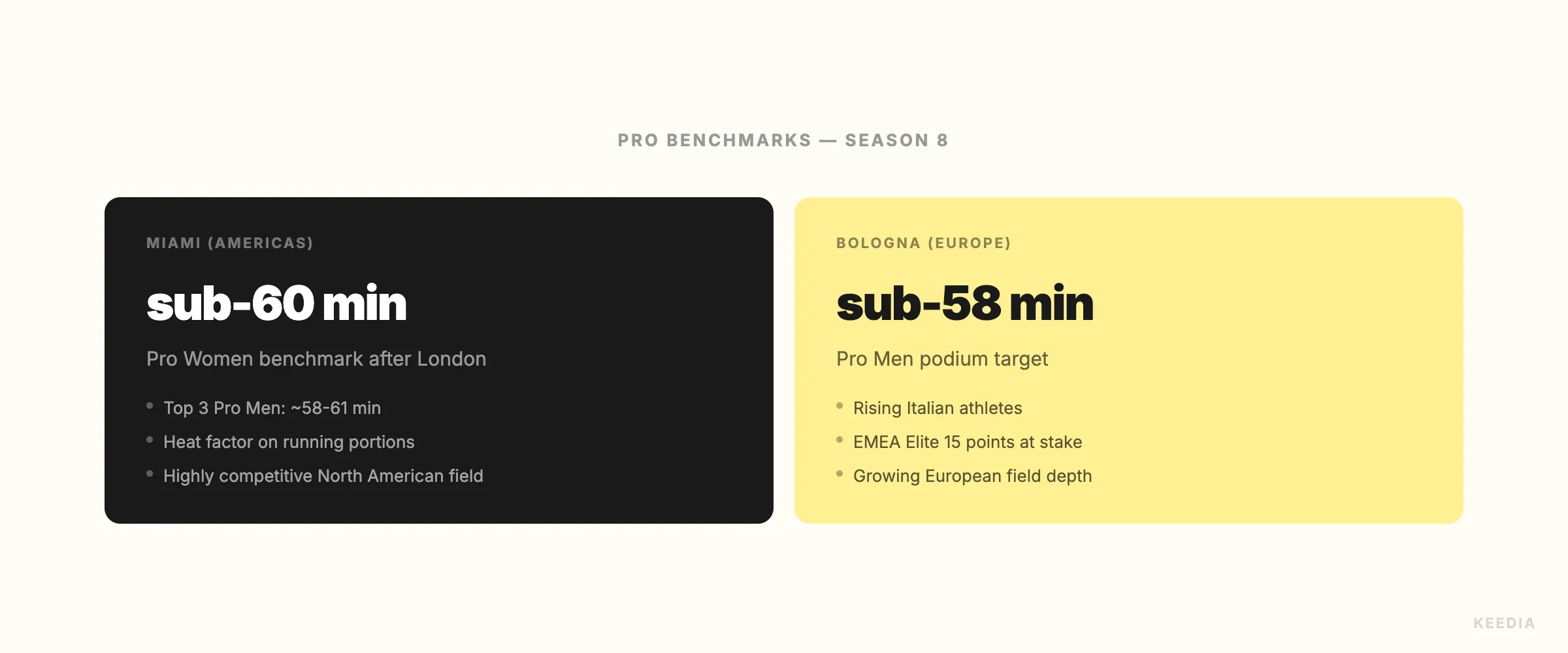
The Men's Pro division in Miami featured strong North American depth, with the top finishers pushing into the 58-to-62-minute range depending on heat conditions. Miami in April is warm, and that matters. Athletes who underestimated the cumulative heat load, particularly in the later running laps, paid for it in the final two stations. The protocol for heat-adapted running performance is one of the more underused tools in HYROX prep, and Miami is exactly the race where that investment shows up in the results.
On the Women's Pro side, the benchmark to watch was 58:04. That's Sinead Bent's time from the London EMEA race. Miami's top women didn't match it on aggregate, which isn't surprising given the heat differential, but several athletes pushed into sub-62-minute territory. Those times carry real qualification weight heading into the final weeks of the season.
Bologna: Italy's Home Race and Southern Europe's Season Highlight
Bologna is a different race in feel and field composition. The Italian HYROX community has grown fast, and this event draws heavily from Italian and southern European athletes who don't necessarily travel to the major EMEA hubs like London or Frankfurt. For many of them, Bologna is the season race. The podium pressure is local, and the crowd energy reflects that.
Italian athletes have been consistently improving across divisions over Season 7 and into Season 8. The Men's Pro field in Bologna is competitive enough to push top finishers into the high-50-minute and low-60-minute brackets, with station-level execution, particularly on the wall balls and burpee broad jumps, separating the podium from the field.
The Women's Pro Bologna results showed the same pattern seen across European races this season. Athletes from Italy, Spain, and France are closing the gap on the northern European-dominated podiums that characterized earlier seasons. That's not just a depth story. It reflects better coaching infrastructure and more race-specific preparation at the club level across southern Europe.
Results for Bologna are available on results.hyrox.com. If you raced Bologna and want a European benchmark comparison, cross-reference your splits against the London EMEA published results from two weekends prior.
Season 8 Elite 15: What Miami and Bologna Change
The Elite 15 qualification cutoff is the structural narrative running through the back half of Season 8. Athletes accumulate ranking points across their best results, and the top 15 in each division earn automatic entry into the Stockholm World Championships. Miami and Bologna both count toward that ranking, and with the race calendar tightening, this weekend's results will reshuffle positions for athletes sitting on the bubble.
For the full picture of what Stockholm qualification involves and what the World Championships format looks like, the complete guide to the 2026 Stockholm World Championships covers everything from the divisional structure to the venue details and what to expect on race day.
A few key implications from this weekend:
- Athletes in positions 10 through 18 in the Elite 15 standings are the ones most affected. A strong Miami or Bologna finish can push a borderline qualifier over the threshold. A missed opportunity at one of these late-season races with only a few events left is hard to recover from.
- Doubles divisions had strong fields in both cities. The pacing dynamics in Doubles are distinct enough from solo racing that station-by-station work splits require a different analytical lens. Understanding how to structure work splits and pacing in HYROX Doubles is particularly relevant for teams still optimizing their approach before Stockholm.
- Age group divisions in Miami and Bologna feed their own qualification pathways. If you're competing in a Masters or Age Group category, your divisional standings update independently of the Pro field. Check your specific division on the results platform.

How to Use the Results as a Benchmark Tool
Whether you raced this weekend or not, the Miami and Bologna results are a useful calibration tool for the rest of your season. Here's how to approach the data.
Pull up your hyresult.com profile and compare your station times against the top 10 percent, the top 25 percent, and the median in your division. Most athletes are not losing races in the running laps. They're losing them at specific stations where their preparation hasn't matched the demands, typically the ski erg, the sled push in heavier conditions, or the wall balls when cumulative fatigue has already accumulated.
If your running splits look solid but your station times are dragging your overall time into a lower bracket, that's a programming issue, not a fitness ceiling. It's worth reviewing your periodization structure to see whether your training blocks are actually building the station-specific strength your results need.
On the recovery side, if you raced Miami this weekend, you're now dealing with post-race inflammation and accumulated fatigue on top of a compressed training schedule if Stockholm is your target. That means recovery quality matters more than volume right now. Athletes who underinvest in sleep quality during taper and post-race windows consistently underperform in subsequent events. The research on magnesium supplementation and sleep quality for athletes is worth reviewing if you're managing a tight race-to-race recovery window.
Venue Strategy and HYROX's Expansion Playbook
The fact that Miami and Bologna ran simultaneously is not coincidental. HYROX's Season 8 calendar reflects a deliberate expansion strategy built around premium convention center venues that can run multi-wave formats over three days without compromising the spectator experience. Miami Beach Convention Center and Bologna's venue both fit that template.
This approach serves two purposes. First, it increases total participant capacity while maintaining consistent course standards across global events. Second, it builds regional identity. Miami is a North American race. Bologna is a southern European race. Athletes in those regions are more likely to travel to a race that feels like their event rather than a generic stop on a global circuit. That's smart audience development, and it's why the sport's growth has held up across multiple seasons without the quality dilution that often follows rapid expansion.
The dual-weekend format also creates a global results conversation. Within 48 hours of Bologna finishing, athletes in Miami and Bologna are comparing times across continents, benchmarking against the same season-wide standards. That cross-event conversation is one of the more underappreciated parts of what makes HYROX's community engagement unusually sticky compared to other competitive fitness formats.
What Comes Next
With Miami and Bologna now in the books, the Season 8 calendar moves toward its final stretch before Stockholm. Athletes still chasing Elite 15 qualification have a narrowing window. If you're within range, your next priority is identifying which remaining events you can realistically target and what a peak performance at those events requires.
For athletes who raced this weekend and are already looking ahead, the next phase of preparation needs to account for cumulative fatigue without sacrificing the training quality that's gotten you this far. That balance is where most athletes make their biggest mistakes in the final four to six weeks before a target race. Recovery, specificity, and race-day execution are the variables left to optimize. The fitness base is already built. Don't add unnecessary volume trying to make up for a result that didn't go your way this weekend. Adapt and focus forward.
Full results for both Miami and Bologna remain live on results.hyrox.com and hyresult.com. Check your splits, note the gaps, and plan accordingly.