
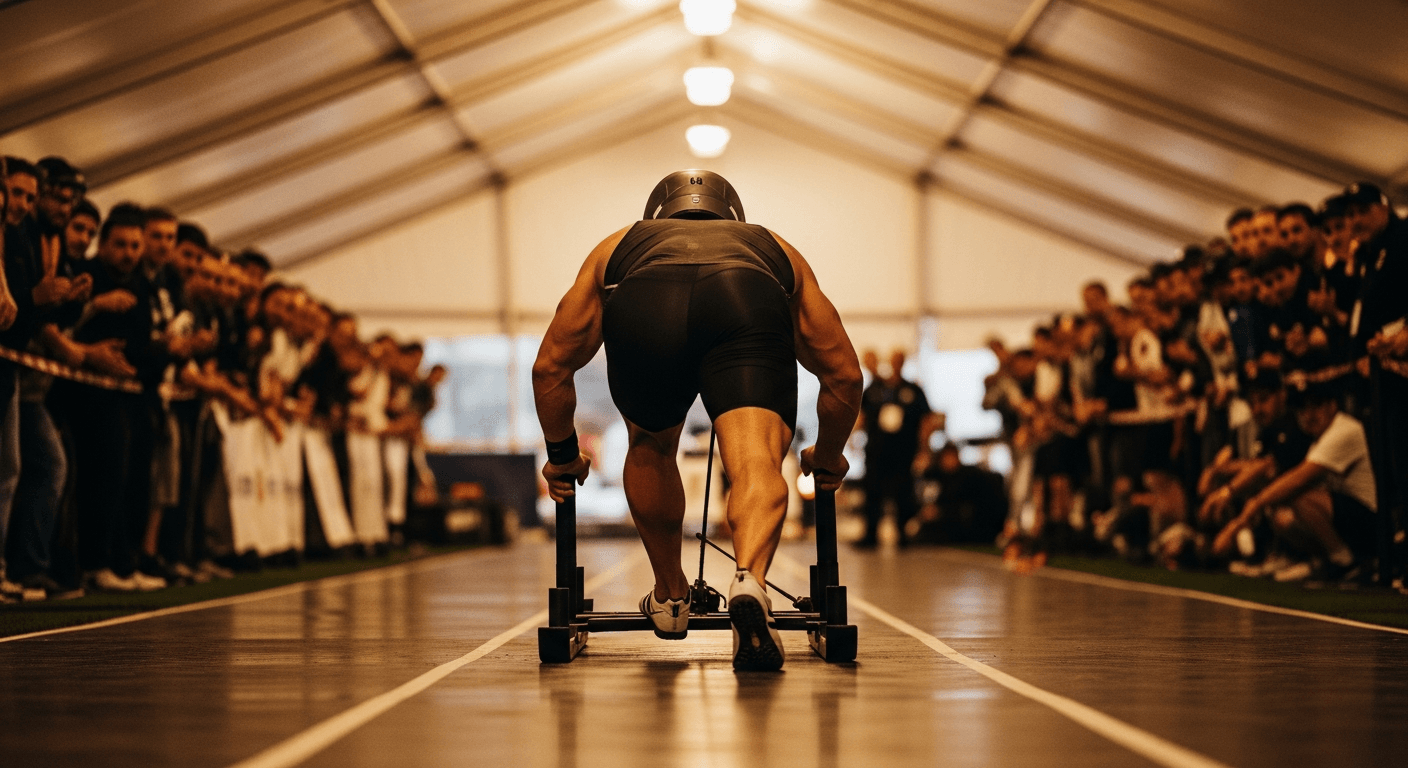
Every HYROX guide you've read covers station order, split targets, and sled push strategy. What they skip is the part that actually derails most first-timers: the moment you step inside the venue and everything you trained for starts to feel completely different. The tent environment, the noise, the crowd, the logistics. These aren't minor inconveniences. They're variables with real consequences on your time.
Here's what experienced athletes wish someone had told them before their first race.
The Tent Is Its Own Training Variable
HYROX events are typically held in large indoor arenas or temporary tent structures. Both share the same core problem: heat accumulation. When you pack thousands of athletes, spectators, lighting rigs, and sound systems into an enclosed space, ambient temperature climbs fast. Depending on the venue and time of year, temperatures inside can run 5 to 12 degrees Fahrenheit higher than outside air.
That gap matters more than it sounds. Research on exercise in elevated ambient temperatures consistently shows that perceived effort increases before actual performance declines. You'll feel like you're working harder at the same pace, which triggers premature pacing adjustments that compound across eight workout stations.
The noise compounds this. HYROX venues run music at competition volume for the duration of the event. Live commentary, crowd noise, and station announcements layer on top. For athletes who train in quiet gyms or with headphones at controlled volume, this sensory load is genuinely disorienting during the first twenty minutes. Your brain is processing more, and that costs energy you didn't budget for.
The practical fix is simple but rarely followed: arrive early enough to walk the floor before your wave. Absorb the environment before you're competing in it. Let your nervous system acclimate. Athletes who spend even ten minutes inside the venue before their warm-up report significantly less adrenaline dysregulation at the start line.
Transition Zones Are Where Races Are Lost
On paper, HYROX is eight workout stations separated by one-kilometer runs. In practice, it's eight stations separated by one-kilometer runs plus eight transitions that nobody practices and everybody underestimates.
The transition zone is the gap between finishing a run lap and beginning your next station. In training, this gap doesn't exist. You walk to the next movement, set up your equipment, catch your breath, and go. At a HYROX event, this gap involves navigating a marked floor with other athletes moving at different speeds, locating your assigned station lane, waiting if a lane is occupied, and mentally switching from running mode to the specific motor pattern of the next exercise.
Most athletes lose between 30 and 90 seconds per transition. Across eight stations, that's a potential four to twelve minutes of time that never shows up in any split analysis because it's invisible. It's not your run pace. It's not your station time. It's the space between.
The athletes who manage this best have two habits. First, they've memorized the station order so thoroughly that they're already mentally transitioning during the final 200 meters of each run. Second, they've practiced moving immediately into position without a standing recovery pause. That second habit is harder to train for than any individual workout station.
Logistics Require a Plan, Not an Assumption
Most HYROX preparation guides get into wave seeding and nutrition timing. Very few cover the 90 minutes before your wave starts, which is where a surprising amount of race-day stress originates.
Bag drop at major HYROX events can involve queues of 20 to 40 minutes during peak morning waves. If you've factored in 30 minutes for warm-up and 15 minutes for athlete check-in, a 40-minute bag drop queue collapses your entire pre-race window. This isn't hypothetical. It's a consistent complaint from athletes at high-attendance events in major cities.
Warm-up space is similarly limited. HYROX venues designate warm-up areas, but these fill up quickly before popular waves. Athletes who arrive expecting open floor space often find themselves jogging in place near the entrance or doing dynamic work in a corridor. Neither is ideal preparation for a race that opens with a one-kilometer run at target pace.
Wave seeding is the third variable that catches people off guard. HYROX uses self-seeded waves for most open categories. Athletes who seed themselves too optimistically end up in faster waves, get passed constantly from the first station, and pace off the wrong reference group. Athletes who seed conservatively end up stuck behind slower competitors in transition zones, which costs time differently but just as definitively. Being honest about your expected finish time when registering is one of the highest-return decisions you can make before race day.
For context on what realistic finish times look like across different athlete profiles, HYROX Age Group Times: What They Really Reveal breaks down what competitive and recreational benchmarks actually mean in practice.
Adrenaline Is Not Your Friend at the Start Line
This is the point that experienced HYROX athletes discuss most among themselves and that almost never makes it into beginner guides.
The start of a HYROX race feels electric. The music is loud, the crowd is energized, the announcer is hyping your wave, and every athlete around you is bouncing on their toes. Your heart rate is already elevated before you've moved a meter. That adrenaline spike is real, physiological, and extremely dangerous to your pacing strategy.
Athletes who go out at perceived effort instead of target pace during the first run consistently blow their splits. The first kilometer feels easy because adrenaline is masking the actual effort. By station three or four, the mask comes off, and there's no recovering the deficit. You're not running faster because you're fitter. You're running faster because your nervous system is flooded, and you're mistaking that signal for capacity.
Experienced HYROX competitors deliberately reduce their target pace by 5 to 10 percent on first attempts specifically to account for adrenaline mismanagement. That's not sandbagging. That's accurate self-knowledge applied under novel conditions. If you've run every training kilometer at 5:30 per kilometer, your race-day target on a first attempt should probably open closer to 5:50 to 6:00. The athletes who do this finish stronger, suffer less in the back half, and almost always post times they're more satisfied with.
The mental discipline required here is underappreciated. You have to actively override a strong physiological signal to slow down when everything in your body is saying go. That's a trainable skill, but it requires conscious preparation, not just fitness.
What Elite Performances Actually Teach You
Watching elite HYROX performance offers a useful recalibration. The athletes at the front of the field aren't immune to the tent environment or the adrenaline spike. They've just accumulated enough race-specific experience to work with those variables rather than against them.
At high-level events, the margin between a well-executed race and an imploded one is often not fitness. It's pacing discipline in the first two stations and transition efficiency across the back half. Those are tactical skills. They develop through race experience, not gym volume.
For a look at how elite athletes execute under competitive pressure, HYROX Paris 2026: Results and Race Highlights provides useful context on how top performers structured their efforts across the full field.
It's also worth noting that elite HYROX athletes treat running as a primary performance lever, not just a connector between stations. HYROX Women's World Record Holder Runs Sub-3 Marathon illustrates the level of running development that separates recreational and elite performance in this sport.
Nutrition and Hydration Inside the Venue
The heat inside a HYROX tent accelerates sweat rate and dehydration more than most athletes plan for. Arriving to your wave already in a hydration deficit, which is easy to do after a two-hour logistics window with no deliberate fluid intake, compounds everything else on this list.
Hydration strategy for race day starts the morning of the event, not at the water stations inside the course. Athletes racing at 90 minutes or more should consider both sodium intake and carbohydrate timing in their pre-race window. For a practical framework on when and how to fuel around competition, Sports Nutrition Timing: The 2026 Practical Guide covers the evidence-based approach in detail.
Keep your pre-race nutrition simple and familiar. Race day is not the time to test a new gel, a new electrolyte product, or a different breakfast. If it didn't work in training, it won't work better under a hot tent with 3,000 people watching.
The Real Race Starts After Station Four
There's a consistent pattern across HYROX finisher data: athletes who feel strong through the first four stations often struggle disproportionately in the back half. Athletes who feel slightly restrained through the first four stations tend to close well.
The race reveals itself in the second half. That's where heat accumulation, adrenaline depletion, and cumulative fatigue from imperfect transitions compound into a final two or three stations that feel nothing like training. Preparing for that feeling specifically, not just building fitness, is what separates a HYROX race you're proud of from one you spend months trying to explain.
Go in knowing the tent is loud, the transitions are invisible on paper, the logistics will stress-test your pre-race window, and the start will feel faster than it should. Adjust for all of it. Then race.