

You've done the training. Your sled push numbers are solid, your ski erg pacing is dialed, and your run splits are where they need to be. But if you've ever crossed a HYROX finish line wondering where the last three stations went sideways, the answer probably isn't physical. It's mental. And it's fixable before race day.
With the World Championships approaching, most athletes are deep in taper mode, obsessing over logistics. What they're not doing is building the specific cognitive framework that separates athletes who hold together in the back half from those who unravel between stations six and eight. This guide is for the second group.
Why HYROX Is Different: The Cognitive Load Problem
Most endurance events ask your brain to do one thing for a long time. Run. Pace. Breathe. HYROX asks your brain to do eight different things, in a fixed sequence, separated by running intervals that are just long enough to let doubt creep in but not long enough to fully recover.
That distinction matters more than most athletes realize. Research on dual-task fatigue consistently shows that switching between distinct motor patterns accelerates cognitive depletion faster than sustained single-mode effort. Each station in a HYROX race is a full mental reset. You're not just loading your muscles. You're re-recruiting your attention, recalibrating your effort perception, and making real-time decisions about pacing under progressive stress.
By the time you reach the wall balls or the rowing station in the back half, you're not just physically tired. Your prefrontal cortex. the region governing effort regulation and decision-making. is running on fumes. That's when conservative pacing choices collapse, transitions get sloppy, and athletes leave minutes on the course that no amount of fitness can explain.
The solution isn't more fitness. It's training your brain to reset faster and more cleanly between stations, starting in race week.
Station-by-Station Visualization: The Technique Elite Athletes Actually Use
Athletes who visualize their races typically focus on run splits and overall time targets. That's useful, but it's incomplete for HYROX. The athletes consistently performing at the front of their age groups aren't just seeing their finish time in their heads. They're mentally rehearsing each station as a discrete event with its own entry cue, execution feel, and exit strategy.
This is called segmented visualization, and the research behind it is well-established in applied sport psychology. When you mentally rehearse a specific sequence with sensory detail. the weight of the sandbag lunge, the sound of the sled scraping, the burn in your quads on the ski erg. you reduce the novelty load on your nervous system when that moment arrives in competition. The brain has already been there. It knows what to do.
Here's the structure that works for HYROX specifically:
- Run into station: Visualize your breathing as you arrive, your pace dropping slightly, your hands releasing from their run position.
- Station setup: See yourself setting up correctly without hesitation. No fumbling. No recalculating.
- Execution feel: Don't just see yourself completing reps. Feel the resistance, the fatigue, the point where your technique wants to break down. Rehearse holding form through that point.
- Exit cue: Visualize your first three steps back into the run with intention, not relief. This is where most athletes lose 10 to 15 seconds per transition.
In race week, dedicate 15 minutes each morning to a full mental walkthrough of all eight stations in sequence. Do it lying down, eyes closed, before you check your phone. Consistency matters more than duration here.

The Emotional Volatility Trap: Sled Push and Ski Erg
Ask any experienced HYROX athlete which stations cost them the most unplanned time and the sled push and ski erg come up repeatedly. Not because athletes are undertrained on those movements, but because of when they appear in the race and what they demand emotionally.
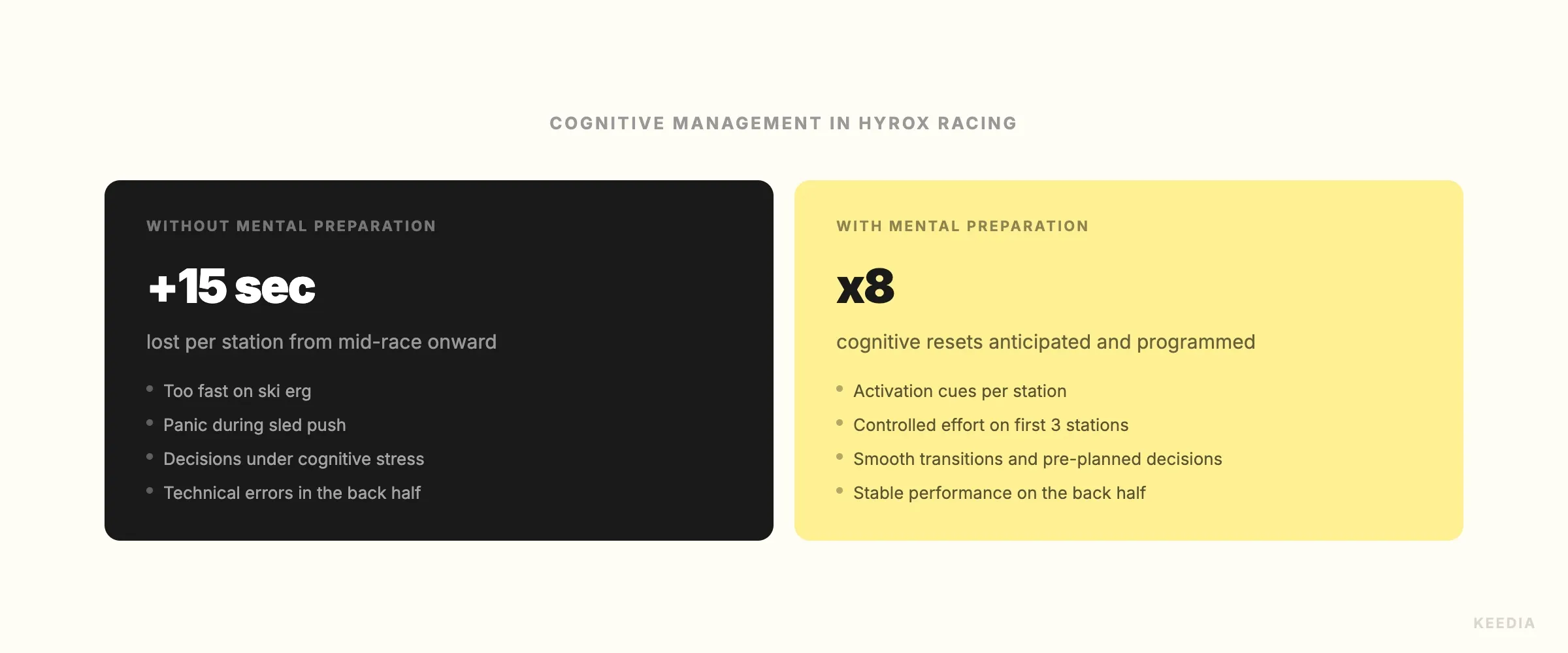
The ski erg opens the workout. You're fresh but also anxious, and the machine's resistance creates an immediate mismatch between effort and expected output. Athletes go out too hard trying to prove something, spike their heart rate, and spend the next two to three kilometers paying interest on that decision.
The sled push arrives later, when your legs already have accumulated fatigue, and it's uniquely brutal in its feedback loop. There is almost no movement that more directly converts your current strength and mental state into raw difficulty. When the sled slows mid-push, the psychological response. frustration, panic, the urge to stop. is disproportionate to the actual performance loss. That emotional spike is where age-group athletes bleed the most time.
The fix isn't to become emotionally numb. It's to have a pre-committed response to the moment when the sled slows or the ski erg hurts more than expected. Sport psychology research on pre-commitment planning shows that athletes who decide in advance how they'll respond to adversity outperform those who rely on in-the-moment willpower by a significant margin.
Write it down this week. Literally. One sentence for the ski erg: what you'll say to yourself in the first 30 seconds when the burn starts. One sentence for the sled push: what you'll do when your pace drops. Keep both anchored to process cues, not outcome goals. "Drive through the heel" beats "don't slow down" every time.
The Race-Week Routine That Reduces Perceived Effort
Perceived effort is not a soft metric. It's one of the strongest predictors of endurance performance, and it's highly sensitive to sleep quality, nutrition timing, and mental state in the 72 hours before competition. You can't change your fitness this week. You can absolutely change how hard the race feels.
Sleep: The research on pre-competition sleep is clear. A single night of poor sleep before a race has minimal performance impact. Two consecutive nights of poor sleep does not. Protect Thursday and Friday nights above everything else. Keep your bedroom cool, avoid screens for 60 minutes before bed, and if you wake early on race morning, stay horizontal. Passive rest still reduces perceived fatigue.
Nutrition timing: You're not loading for a marathon here, but you do want stable blood glucose and well-stocked muscle glycogen. In the 48 hours before the race, shift your carbohydrate intake earlier in the day and keep meals consistent in size. Erratic eating patterns increase cortisol variability, which directly affects your emotional regulation during the race. Getting your protein intake right also matters for recovery during this taper period. For a detailed breakdown of how to structure that, Protein for Women: The No-BS Practical Guide covers the fundamentals that apply across the taper window regardless of training gender.
Avoid heavy reliance on ultra-processed convenience foods in the days leading up to the event, even if your diet is otherwise clean. The research is increasingly specific about how these foods affect muscle function under fatigue. Ultra-Processed Food and Muscle: The Real Impact on Strength unpacks exactly what the current evidence shows.
Mental rehearsal timing: Structure your mental preparation sessions at the same time each day so they become a consistent anchor rather than another item on your pre-race anxiety list. Morning is generally better because cortisol is naturally elevated and attentional focus is sharper. Keep the sessions brief and specific. This is not meditation. It's deliberate mental practice with a clear object: your race, your stations, your responses.
The Back-Half Strategy Most Athletes Don't Have
Here's the pattern that kills otherwise well-prepared HYROX athletes: they race the first four stations by feel, then try to survive the last four. That's backwards. The back half of a HYROX race is where your preparation either holds or collapses, and it deserves a strategy of its own.
Going into stations five through eight, your primary mental job is not to push harder. It's to maintain your technique anchors under fatigue. Pick one technical cue per station for the back half and write it on your wrist. Keep it to three words maximum. "Hips tall" for lunges. "Pull don't yank" for rowing. "Breathe then push" for the final sled. When your brain is cognitively depleted, simple explicit cues outperform any motivational strategy you can manufacture in the moment.
The athletes who run clean back halves aren't working harder than you. They've made fewer decisions per station, because they made those decisions in advance.
One Week, One Edge
HYROX rewards athletes who train intelligently, but the gap between athletes of similar fitness at World Championships level often comes down to who prepared their mind as specifically as their body. You've built the engine. Race week is when you tune the cockpit.
Run your visualization sessions every morning. Write your adversity responses before Wednesday. Protect your sleep Thursday and Friday. Eat consistently and avoid erratic choices that spike your stress hormones. And on race morning, trust the sequence you've already run a hundred times in your head.
The race isn't new. Your brain has already been there.