
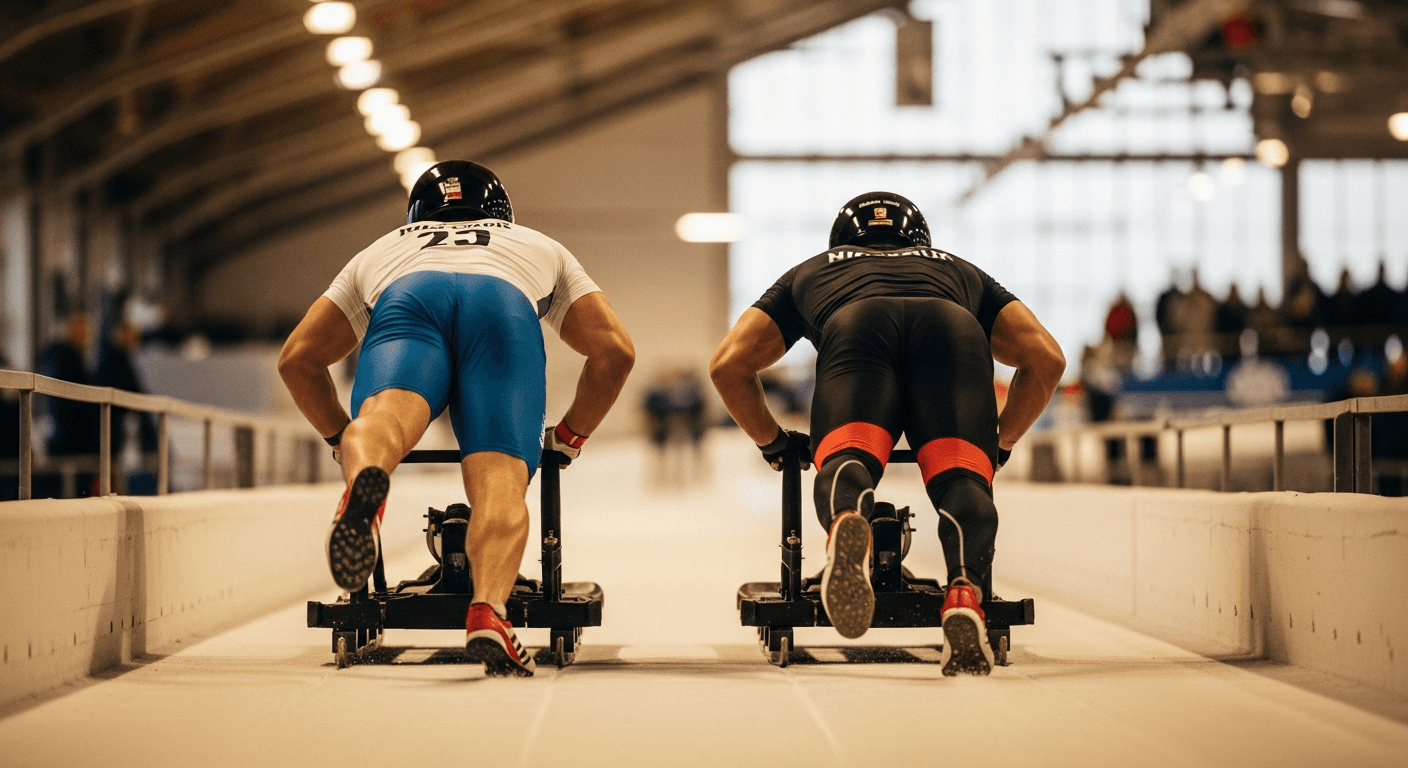
Two HYROX races. One weekend. Different cities, different fields, and a combined data set that doesn't come around often. Rotterdam and Cologne both hosted HYROX events across the same April 2026 weekend, and the numbers they produced together tell a more complete story than either race could alone.
If you're preparing for Stockholm in June, this is the form guide you need to read carefully.
Why a Dual-City Weekend Matters for the Data
HYROX events generate detailed split data by design. Every station, every transition, every running kilometer is tracked. But when two major European races run simultaneously, you get something rarer: a side-by-side snapshot of field depth and performance trends at the same point in the season.
Rotterdam drew a characteristically deep open field with strong representation from Northern European athletes. Cologne, historically one of the busiest stops on the HYROX calendar, pulled a similarly competitive lineup with notable Central European presence. Together, the two events logged thousands of finishers across all divisions, with the Pro division results carrying the most weight for Stockholm qualification discussions.
The combined field gives analysts and athletes alike a broader sample to work from. Single-event data can be skewed by local weather, course setup, or an unusually strong regional turnout. Dual-city data smooths those variables out.
What the Competitive Splits Reveal
Looking across both Pro Men and Pro Women fields, a few patterns stand out clearly from the April weekend results.
In the Pro Men division, the top finishers in both cities clustered within a tight band at the front. The gap between first and tenth place across both events was narrower than comparable results from earlier in the 2025-26 season. That compression at the top signals a field that is getting faster and more evenly matched as the championship approaches.
Station times showed particular movement at the Ski Erg and Burpee Broad Jumps. Across Rotterdam and Cologne, the fastest Pro Men were holding sub-4:00 Ski Erg splits more consistently than in autumn events, suggesting either better pacing discipline or genuine aerobic improvements heading into the back half of the season.
In the Pro Women division, the Wall Balls station continued to act as a significant differentiator. Athletes who kept their Wall Balls below 5:30 in both cities finished overwhelmingly in the top 15% of the Pro Women field. Those drifting past 6:30 tended to lose multiple positions in the final running kilometer, where accumulated fatigue makes recovery nearly impossible.
Sandbag Lunges also showed meaningful variance. Rotterdam's Pro Women field averaged roughly 15-20 seconds slower at that station compared to Cologne, a gap that likely reflects different pacing strategies rather than fitness differences. It's a reminder that even within the same competitive tier, execution choices carry real time costs.
Field Depth: The Numbers Behind the Headline
Beyond the Pro results, the open divisions across both cities painted a picture of a sport that continues to grow in competitive density. The percentage of finishers completing the full race under 90 minutes in the Mixed Open category increased compared to the same calendar window in 2025. That's not a marginal shift. It reflects a maturing athlete base that has trained more specifically for the HYROX format.
For context, the average finish time across all divisions at major HYROX European stops has trended downward by approximately 3-4% year-over-year since 2023. The April 2026 dual-city results are consistent with that trajectory.
Field depth also matters for Stockholm because the qualification cutoffs are determined in part by performances across the season's results. A deeper, faster open field means the boundary between qualifying and non-qualifying finishes shifts. If you were on the edge of the top 0.5% heading into April, this weekend either confirmed your position or gave you a clear target to chase before the June deadline.
Stockholm Implications: What This Weekend Confirmed
The World Championships run June 18-21 at Strawberry Arena in Stockholm. That's a short runway from April. The results from Rotterdam and Cologne function as the last major European form guide before athletes either commit to their preparation or adjust it.
A few things the April data confirmed for Stockholm contenders:
- Running economy matters more than ever. The top 10 finishers in Pro Men across both cities averaged sub-4:30 per kilometer on all eight running segments. If your running splits are slower than that, you're giving back time you can't fully recover at the stations.
- Station fatigue accumulation is the decisive variable. The athletes who fell out of podium contention typically lost it across stations 5 through 8, not at the start. Pacing the early stations conservatively is not a weakness. It's the strategy the data supports.
- Pro Women field depth is closing on Pro Men. The proportional gap between the top 10 and top 50 in the Pro Women division was smaller at both April events than in the equivalent 2025 races. Stockholm will feature one of the most competitive Pro Women fields the event has seen.
For athletes targeting a Stockholm qualifier, the April results also serve as a direct benchmark. If your current finish time is within 5% of the cutoff times posted in Rotterdam and Cologne, you're in range. If it's outside that window, the next six weeks need a sharper focus on your limiting stations rather than general volume.
How to Use This Data for Your Own Benchmarking
You don't need to be chasing a Pro qualification to use the April data productively. The station splits from Rotterdam and Cologne cover every division, and comparing your own times against a field of thousands gives you a realistic picture of where you actually stand.
Start with your two weakest stations from your last event. Check where those times sit relative to the median finisher in your division from the April events. If you're at or below median on both, you have a specific problem to solve. If you're significantly above median on everything except one station, that station is probably costing you a meaningful number of places.
The running segments deserve the same scrutiny. Many athletes focus heavily on station performance and underestimate how much time is lost or gained across 8 kilometers of total running. The April data consistently shows that athletes who pace their first two running kilometers conservatively maintain better station quality through the second half of the race.
Nutrition plays into late-race performance in ways that show up clearly in the splits data. Athletes who fade at stations 6 through 8 are often dealing with glycogen depletion as much as muscular fatigue. If you're training hard for Stockholm and not hitting your protein targets, the station data is likely reflecting that. The guidance in Protein for Women: The No-BS Practical Guide is directly applicable here, and the principles extend to male athletes managing recovery load as well.
There's also accumulating evidence that diet quality outside your training windows affects the muscular endurance that HYROX demands across a full race. Research summarized in Ultra-Processed Food and Muscle: The Real Impact on Strength is worth reviewing if your station times are declining in the second half of your races despite solid training blocks.
The Broader Calendar Context
April 2026 sits at an interesting point on the HYROX calendar. The season's major European qualifiers are largely complete, and athletes are now managing fitness peaks rather than building them from scratch. The dual-city weekend at Rotterdam and Cologne effectively closed the primary qualification window for most of the field.
Stockholm is the destination, but the preparation period between now and June 18 is where races are typically won or lost. Athletes who treat this block as maintenance risk arriving underprepared. Those who push volume without recovery risk arriving injured or overtrained. The April results give you the benchmarks. The next six weeks are about executing against them.
The training discipline required to peak at a HYROX World Championships has parallels in other endurance formats. The principles behind building heat resilience and aerobic capacity that drive performance in events like marathons apply here too. The approach outlined in How to Run Better in Summer Heat Starting Now has crossover value for HYROX athletes managing June training in warming European conditions.
Rotterdam and Cologne gave the field a mirror. What you do with that reflection between now and Strawberry Arena is the only question that matters.