
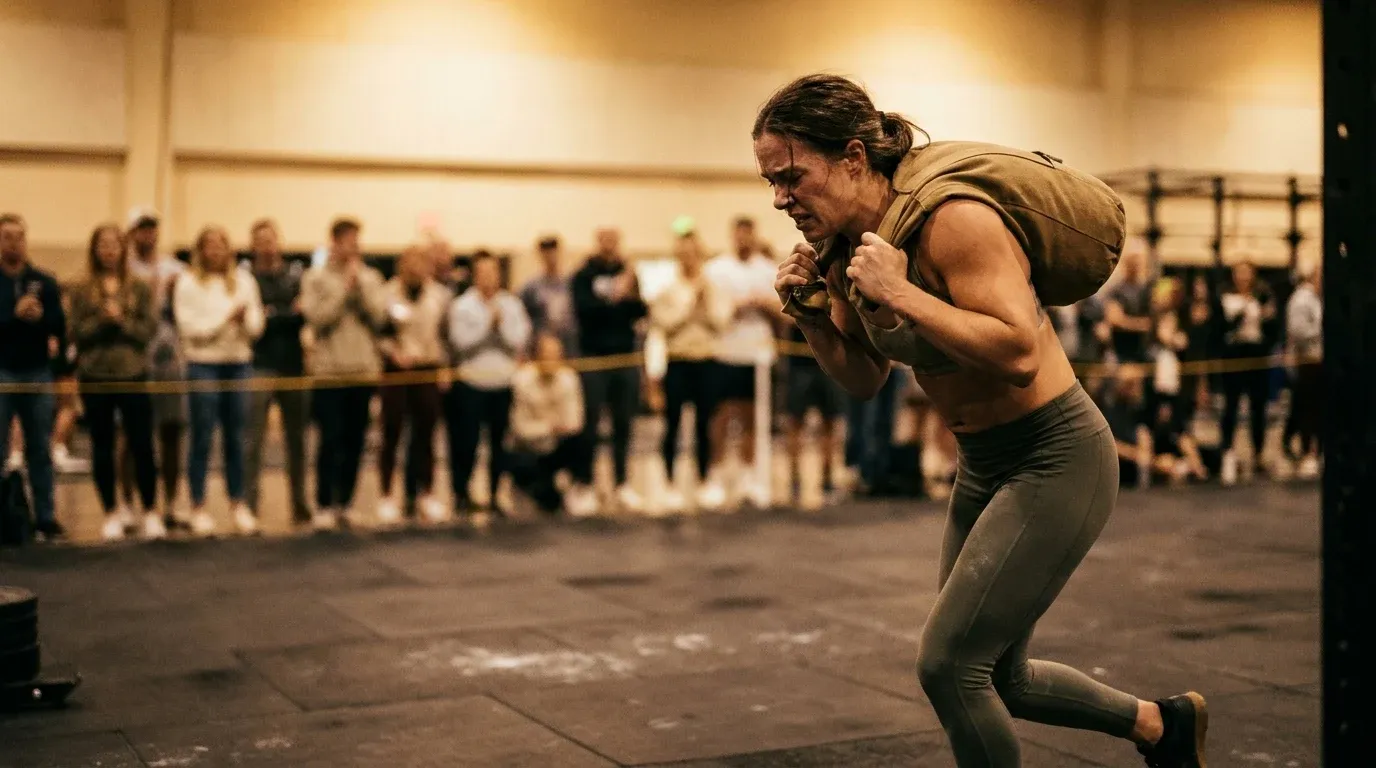
Joanna Wietrzyk crossed the finish line at HYROX Hamburg on November 2, 2026, claiming the opening Elite 15 event of the 2026-27 season ahead of Lauren Weeks. It was a clean, commanding performance. It was also the first time she had raced publicly since Beijing, where she finished a HYROX event while suffering bowel incontinence and ignited one of the most uncomfortable conversations the sport has ever had to have.
Six weeks is not a long time. It's enough time for the internet to move on to something else, but not enough time for the people inside a sport to forget. Wietrzyk showed up in Hamburg anyway, put in the work on the course, and won. How you interpret that depends on what you think competitive sport is actually asking of its athletes.
What Happened in Beijing
The Beijing incident became a flashpoint almost immediately. Wietrzyk, mid-race and visibly unwell, continued to compete rather than withdraw. She finished. The reaction split along predictable lines: some framed it as a display of elite mental toughness, the kind that separates professionals from the field. Others, including athletes and race officials, raised legitimate questions about hygiene, safety, and what it means to keep going when your body is telling you to stop.
The criticism directed at Wietrzyk was widespread and, in some corners, genuinely harsh. Social media amplified the disgust faster than any governing body could respond. Within days, HYROX found itself in an unusual position: drafting new rulebook language in response to a situation the existing rules simply hadn't anticipated. The updated language now addresses athlete health management and on-course contamination risks with language that didn't exist before Beijing.
That rule revision matters. It signals that HYROX treats the Beijing incident not as an aberration to be quietly buried, but as an edge case that exposed a genuine gap in how the sport governs itself. The sport is growing fast. Events draw thousands of participants at the recreational level, and the Elite 15 circuit carries significant media visibility. A clear policy framework around health and contamination isn't a luxury. It's infrastructure.
The Hamburg Result
Against that backdrop, Wietrzyk's Hamburg win carries more weight than a standard season opener. She beat Lauren Weeks to take first place, moving to the top of the early Elite 15 standings. The race itself unfolded across HYROX's signature format: eight 1-kilometer runs separated by eight functional fitness stations, including ski ergs, sled pushes, rowing, and wall balls.
Performance at this level isn't just about cardiovascular capacity. It's about the ability to sustain power output through accumulated fatigue, manage pacing across transitions, and execute under competitive pressure. Wietrzyk's win suggests those capacities are intact. Whether the Hamburg crowd and the broader HYROX community received it warmly is a separate question, and one the sport will keep navigating as the season progresses.
If you want a broader picture of how the Elite 15 weekend unfolded, HYROX Hamburg Saturday's Elite Doubles results offer additional context on how the field performed across disciplines.
Resilience, Image, and What the Sport Owes Its Athletes
The conversation around Wietrzyk quickly became a proxy debate for a larger one: what do we actually expect from elite athletes when things go wrong in public?
There's a version of the Beijing story that reads as admirable. Elite competitors push through pain, nausea, and conditions that would sideline most recreational athletes. Bowel distress during endurance competition is not rare. Studies on long-distance running and functional fitness events consistently show gastrointestinal distress affects a significant percentage of competitors, with some estimates placing the figure above 60% in ultraendurance formats. The decision to continue is one athletes make constantly, often invisibly.
There's another version that raises harder questions. When continuing puts other athletes and course staff in contact with biological contamination, the individual decision becomes a collective concern. The fact that HYROX's rulebook had no language to address this tells you something about how quickly the sport's elite tier has grown and how regulatory frameworks tend to lag behind competition realities.
Public image recovery in sports follows a pattern that's well documented: the athlete performs, the performance becomes the story, and the controversy recedes unless it's repeated or escalated. Wietrzyk's Hamburg win fits that pattern. The more interesting question is whether governing bodies learn faster than public attention fades. HYROX's rule update suggests they're trying to.
The Physical Demands Behind the Comeback
A six-week turnaround between high-level HYROX performances is tight but manageable for an athlete at Wietrzyk's training level. Elite HYROX athletes maintain year-round conditioning blocks that combine strength work with sustained aerobic capacity. Recovery protocols at this level are precise and individualized.
Nutrition plays a significant role in that recovery and in pre-race preparation, particularly when gastrointestinal vulnerability is already a concern. Athletes competing at this intensity pay close attention to gut health, hydration strategies, and supplementation timing. If you're working through similar questions at your own training level, the evidence breakdown in Magnesium, Biotics, Shatavari: Sorting Hype from Evidence is worth your time, particularly around the biotics research and gut function under physical stress.
Protein intake is equally central to maintaining lean mass and supporting the connective tissue demands of repeated sled pushes, wall balls, and high-volume running. Recent review findings on pea protein and muscle growth are relevant here, particularly for athletes managing dietary restrictions while trying to sustain output across a full competitive season.
The strength component of Elite 15 preparation also demands deliberate periodization. If you're planning your own winter training block alongside watching the Elite 15 season unfold, a structured approach to winter strength planning can help you build the functional capacity that separates athletes who fade in the final stations from those who don't.
How Governing Bodies Respond to Edge Cases
HYROX's response to Beijing is a useful case study in how young sports organizations handle incidents that fall outside existing frameworks. The instinct in many governing bodies is to manage these situations quietly, issue a vague statement, and avoid setting precedent. HYROX took a different path by updating its rulebook directly.
That approach has practical advantages. It gives officials a clear framework for future situations. It gives athletes explicit guidance about what decisions are permitted and which create rule violations. And it removes the ambiguity that allowed the Beijing situation to become a prolonged controversy rather than a resolved one.
It also carries a risk. Writing rules in response to a specific, high-profile incident can produce language that's too narrow to address the next edge case, which will inevitably look different. Sports governance at its best anticipates categories of problems rather than just replicating the last one in policy form. Whether HYROX's updated language is broad enough to hold up through a full season remains to be seen.
The parallel with other endurance sports is instructive. Marathon governing bodies have faced similar questions around medical withdrawal protocols, with debate about when race officials can or should intervene when an athlete is visibly compromised but refuses to stop. The tension between athlete autonomy and duty of care isn't unique to HYROX. It runs through every sport that pushes humans to their physical edges in public.
What Comes Next for Wietrzyk and the Elite 15
One win doesn't resolve everything, but it resets the competitive narrative. Wietrzyk is now the athlete who won the season opener, not just the athlete from the Beijing incident. Lauren Weeks, who finished second in Hamburg, will be a consistent threat across the remaining Elite 15 calendar. The points race across fifteen events means no single result defines the season.
For you as a follower of the sport, the 2026-27 Elite 15 season is worth tracking closely. It's the first season being contested under updated health and contamination rules. It features a defending champion with significant public attention on her, a competitive women's field, and a governing body that has signaled it's willing to adapt its frameworks when they fall short.
That combination of competitive intensity and institutional evolution is what makes elite HYROX genuinely interesting right now. Wietrzyk's Hamburg win is the opening chapter. The rest of the season will show whether the sport has moved on or simply moved forward.