

If you drink two or three cups of coffee every morning without thinking twice about it, new research suggests your brain is quietly thanking you. A landmark study published in JAMA in February 2026 tracked 130,000 participants over 43 years and found that regular caffeinated coffee drinkers had an 18% lower risk of developing dementia compared to those who drank little or none. That's not a minor statistical blip. That's one of the strongest associations ever documented between a dietary habit and long-term cognitive health.
But the findings come with important nuance. Not all coffee counts. Not all caffeine sources work equally. And for athletes already using caffeine as a performance tool, the study adds a critical layer of context to what daily use actually does to your brain over decades.
The Study: Scale and Design
This wasn't a short-term randomized trial with a few hundred volunteers. The JAMA 2026 study drew from two of the most rigorous long-term cohort datasets in existence: the Nurses' Health Study and the Health Professionals Follow-up Study. Combined, they tracked 130,000 participants across 43 years, making this one of the largest and longest prospective cohort studies ever conducted on caffeine and cognitive outcomes.
Participants reported dietary habits at multiple intervals over the study period. Researchers adjusted for a comprehensive set of confounders including age, physical activity, smoking, alcohol use, BMI, sleep quality, and cardiovascular health. Cognitive outcomes were assessed through both objective neuropsychological testing and self-reported cognitive decline.
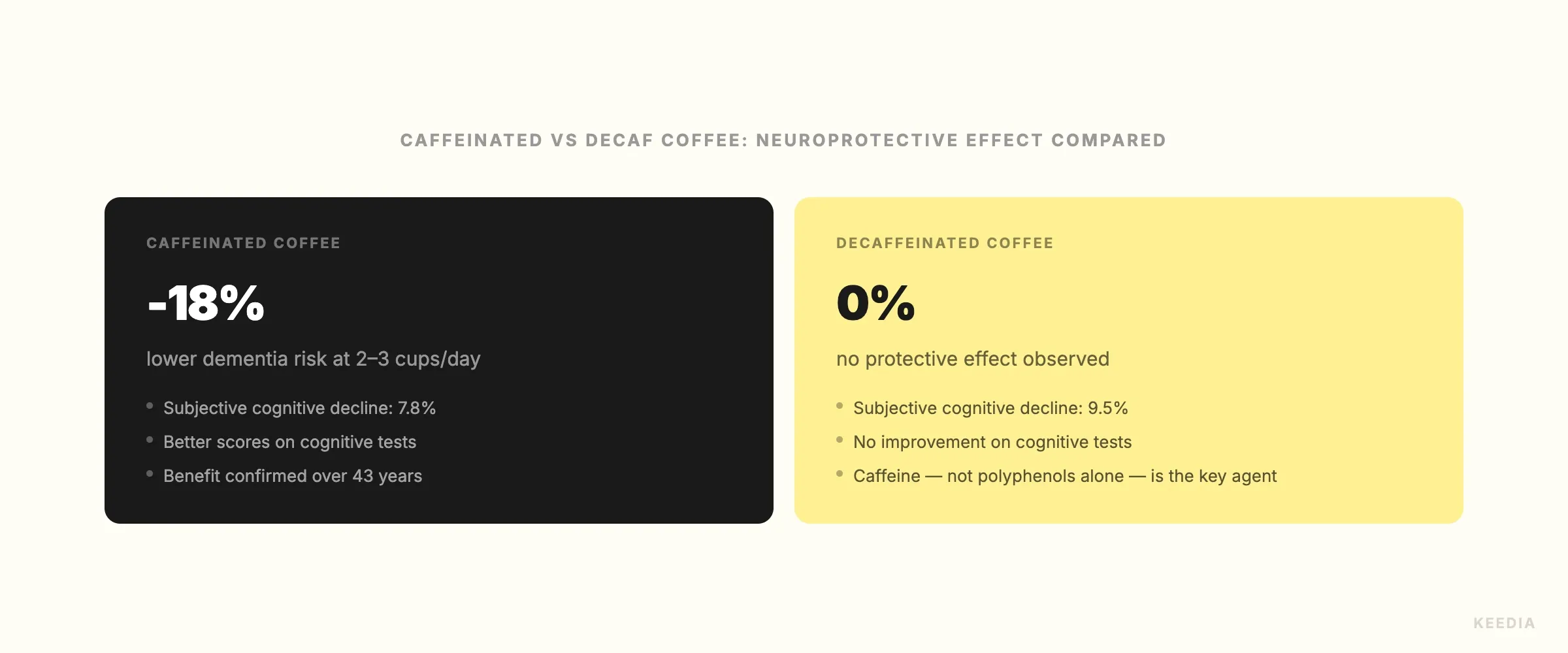
The result: participants drinking 2–3 cups of caffeinated coffee daily showed an 18% reduction in dementia risk. Those same drinkers also performed better on objective cognitive tests and reported subjective cognitive decline at a rate of 7.8%, compared to 9.5% in low or non-coffee drinkers. That 1.7 percentage point difference may sound small in isolation, but across a population of millions, it represents an enormous number of people maintaining sharper cognition into older age.

Why Decaf Doesn't Deliver the Same Benefit
Here's where the data gets interesting. Decaffeinated coffee showed no statistically significant protective effect on dementia risk. That single finding changes the entire conversation about what's driving the benefit.
For years, researchers speculated that coffee's neuroprotective effects were largely due to its polyphenol content, particularly chlorogenic acids, which have demonstrated anti-inflammatory and antioxidant properties in vitro. Decaf retains most of those polyphenols. But if decaf drinkers see no measurable cognitive protection, the polyphenols alone can't be carrying the load.
Caffeine itself appears to be doing significant work. The most plausible mechanisms involve caffeine's role as an adenosine receptor antagonist. By blocking adenosine receptors in the brain, caffeine reduces neuroinflammation and may slow the accumulation of amyloid-beta plaques, one of the primary pathological markers of Alzheimer's disease. Animal studies have shown that regular caffeine exposure reduces both amyloid and tau pathology. This JAMA study provides large-scale human data consistent with that mechanism.
It also raises a practical question worth considering. If you've been relying on decaf to get the ritual without the stimulation, you may be opting out of the primary neuroprotective agent. Understanding how your caffeine sensitivity and receptor dynamics work over time matters. If tolerance has become an issue, strategies around caffeine tolerance reset and restoring adenosine receptor sensitivity may help you maintain both the performance and long-term health benefits.
What Tea Drinkers Can Take From This
Tea drinkers weren't left out of the good news. The study found that 1–2 cups of caffeinated tea daily produced comparable risk reductions in dementia, even at lower caffeine doses than the coffee-drinking group. Researchers attribute this partly to caffeine and partly to tea's distinct polyphenol profile, particularly EGCG (epigallocatechin gallate), a catechin found in high concentrations in green tea that has demonstrated neuroprotective effects in preclinical models.
The combined action of caffeine and EGCG may produce a synergistic effect that allows tea to deliver similar cognitive protection at a lower absolute caffeine dose. This matters for people who are sensitive to higher caffeine intake or who prefer lighter stimulation. It also suggests the neuroprotective equation isn't purely about caffeine quantity. It's about the full bioactive package of what you're drinking.
The Optimal Dose Window
The 2–3 cup range wasn't arbitrary. The data showed a clear dose-response curve, but the benefits plateaued and began to attenuate above 4 cups per day. High consumers (5 or more cups daily) did not show the same protective effect, and the study authors noted that very high intake may introduce confounders related to sleep disruption, cortisol elevation, and cardiovascular strain that can offset cognitive benefits.
This is consistent with what the broader research landscape suggests. Caffeine's benefits, whether cognitive, cardiovascular, or metabolic, tend to operate within a moderate dose window. The JAMA data puts that window, specifically for dementia risk reduction, at 2–3 cups of standard caffeinated coffee per day, roughly 200–300mg of caffeine depending on brew strength and preparation method.
If you're already supporting your health through multiple evidence-based habits, it's worth noting how caffeine fits alongside other interventions. For example, research on sauna and cardiovascular health points to overlapping mechanisms involving inflammation reduction and vascular protection that may compound the benefits of regular coffee consumption.
What This Means for Athletes
Athletes and high-performance individuals have used caffeine as a performance tool for decades, and the evidence base for its ergogenic effects is among the strongest in sports nutrition. It improves time-to-exhaustion, peak power output, reaction time, and perceived effort. Many athletes are already consuming caffeine daily, often in the 200–400mg range, through pre-workout supplements, coffee, or both.
A common concern has been whether chronic daily caffeine use, especially at higher performance-oriented doses, might carry long-term neurological costs. This study directly addresses that concern. For individuals staying within the 2–3 cup range, daily moderate caffeine use does not appear to harm brain health over the long term. In fact, the data suggests it actively supports cognitive longevity.
That's a meaningful finding. If your caffeine use is structured, consistent, and within the moderate dose window, you're not trading long-term brain health for short-term performance. You're potentially supporting both simultaneously.
It's also worth thinking about how caffeine fits into your broader recovery and cognitive load stack. Sleep quality is one of the most important variables for brain health, and for athletes using caffeine regularly, timing matters. If caffeine is affecting your sleep architecture, you're likely negating some of its protective benefits. Research on magnesium and sleep for athletes shows that certain forms can meaningfully improve sleep quality without interfering with caffeine's daytime effects.
For athletes focused on optimizing training adaptations, cognitive sharpness between sessions is part of the performance picture too. Pairing structured training approaches with evidence-based nutritional support has a compounding effect. If you're exploring how to build both aerobic capacity and long-term health markers, the protocols behind improving VO2max integrate well with a moderate caffeine strategy that supports both training quality and cognitive function.
What the Study Doesn't Tell You
No single observational cohort study, regardless of scale, establishes causation. The JAMA 2026 study is prospective and carefully controlled, but it can't fully eliminate the possibility of residual confounding. Healthy user bias is always a consideration: people who drink moderate amounts of coffee may also tend to have other health-supportive habits that contribute to lower dementia risk.
The study also doesn't specify preparation method, bean origin, or roast level, all of which affect polyphenol concentration and caffeine content. A double espresso and a large filter coffee can contain very different amounts of the relevant compounds even if both count as "one cup" in self-reported data.
And individual variation matters. Caffeine metabolism varies significantly based on CYP1A2 genotype. Slow metabolizers may experience more prolonged effects from the same dose, which could shift the optimal intake range for any given person.
The Practical Bottom Line
The JAMA 2026 study doesn't require you to change your habits if you're already drinking 2–3 cups of caffeinated coffee daily. It gives you strong, long-term evidence that you're doing something your brain appears to benefit from. If you're a tea drinker, 1–2 cups delivers comparable protection, particularly with green tea's EGCG content working alongside caffeine.
If you're an athlete already using caffeine strategically, staying within the moderate dose window supports both performance and cognitive longevity. The brain health case for caffeine just got considerably stronger. And that's a finding worth understanding clearly, not overhyping. For anyone looking to complement this with a well-rounded recovery strategy, cold water immersion and contrast therapy research offers additional insights into how various recovery modalities interact with overall health markers.
Drink your coffee. Keep it to two or three cups. Pay attention to your sleep. The data, at this scale and duration, is about as clear as nutritional epidemiology gets.