
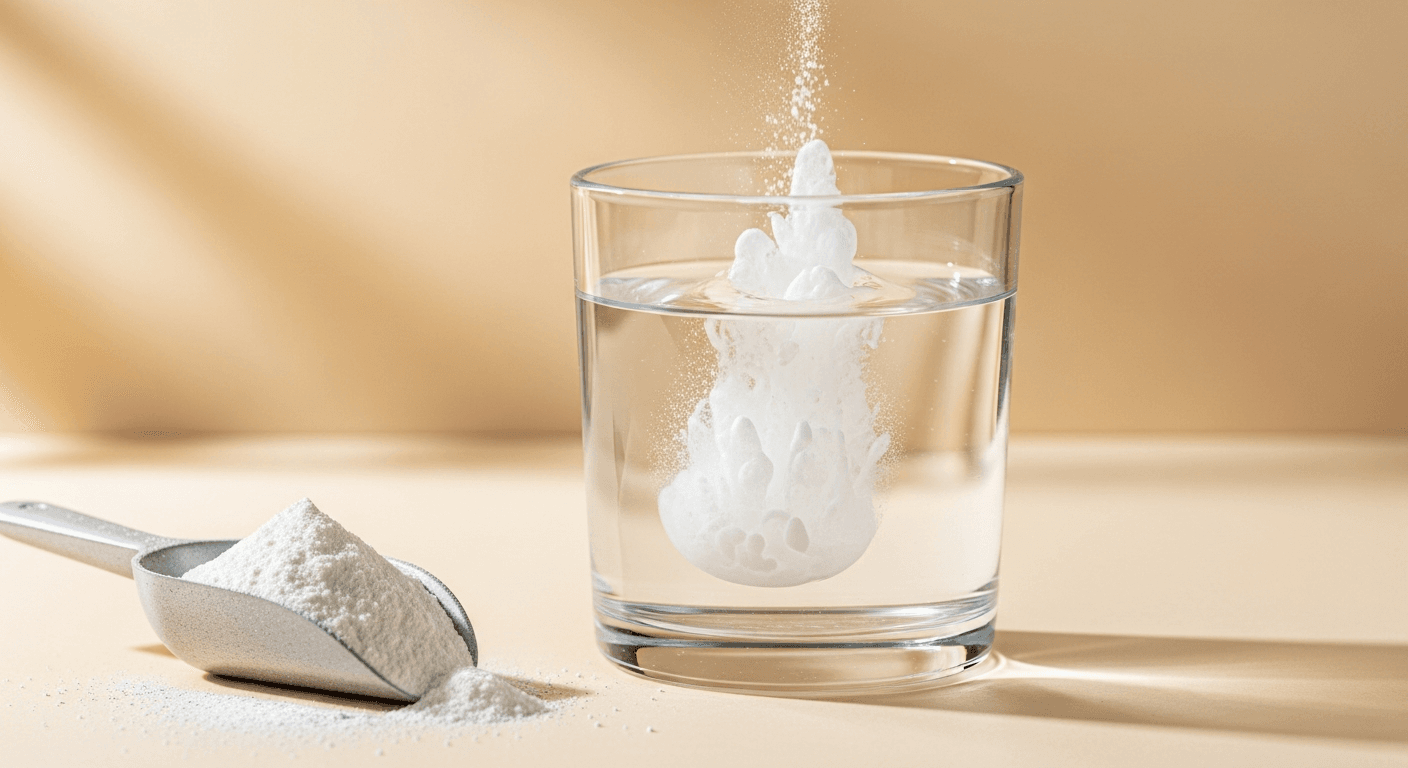
Creatine is the most studied sports supplement ever made. Hundreds of randomized controlled trials, decades of real-world use. And the myths still won't die. Here's what the research confirms, what it's starting to discover, and what you can safely ignore.
How it works in the muscle
In muscle tissue, creatine binds with a phosphate group to form phosphocreatine — a rapid-release energy reserve that regenerates ATP (adenosine triphosphate), the fuel behind every muscle contraction.
In practice: heavy sets, sprints, any high-intensity burst under about 30 seconds draws on your phosphocreatine stores first. The more saturated those stores are, the longer you can sustain peak output before dropping off. Over time: more reps at the same weight, more total volume, more muscle growth.
Research also shows creatine reduces myostatin levels — the protein that naturally limits muscle growth. That's not a marginal effect.
What the science confirms without ambiguity
Across dozens of meta-analyses, the consensus is clear:
- Muscle mass: significant lean mass increases, particularly in adults doing resistance training
- Strength: measurable improvements in maximal strength on compound movements
- Power output: real gains on explosive 1 to 30-second efforts
- Recovery: reduced muscle damage markers post-training, faster recovery between sessions
The 2026 research: creatine and the brain
The muscle benefits are established. The new frontier in 2026 is the muscle-brain axis. A study published in May 2026 via ScienceDaily identified potential neuroprotective mechanisms for creatine supplementation. Parallel research is investigating creatine's role in cerebral energy metabolism — the brain is a massively energy-intensive organ, and creatine may support it similarly to how it supports muscle.
The evidence-based claim right now: creatine appears to improve memory, cognitive processing speed, and mood — especially in people with lower baseline levels (vegetarians, older adults, vegans). The evidence isn't as strong as the muscle literature yet. But it's building fast.
The exact dosing protocol
The simplest method, backed by all the major meta-analyses: 3 to 5 grams per day, every day — training days and rest days both.
Loading (20g/day for 5-7 days) saturates your muscles faster — roughly one week vs. 3 to 4 weeks without loading. Both protocols reach the same endpoint. If you want to feel effects sooner, load. If you're patient, 5g/day is enough to deliver meaningful strength gains.
Timing: taking creatine with a meal — any meal — slightly optimizes absorption via the post-meal insulin response. Not a make-or-break factor. But worth doing.
Myths to stop repeating
"Creatine damages kidneys": studies up to 5 years of continuous use show no adverse effects on kidney function in healthy adults. The myth comes from confusing creatine with creatinine — a kidney marker that creatine supplementation raises slightly in raw value, without indicating clinical damage.
"Creatine causes water retention": partially true, and not a problem. Creatine draws water into muscle cells (intracellular) — not subcutaneous bloat. The water goes into the muscle, contributing to cell volume and anabolic signaling.
"You need to cycle creatine": no evidence that on/off cycling produces any advantage. Continuous supplementation is simpler and just as effective.
The 2026 market signal
Create Wellness, a creatine gummy brand, just raised $20 million from Alliance Consumer Growth and Unilever Ventures. The signal: creatine is leaving the bodybuilding aisle and entering the mainstream.
Active parents, seniors, remote workers — the case for daily creatine is increasingly universal. The format doesn't matter much. Monohydrate powder, gummies, capsules — 3 to 5 grams per day, consistently. That's the protocol the science supports, regardless of how it's packaged.