
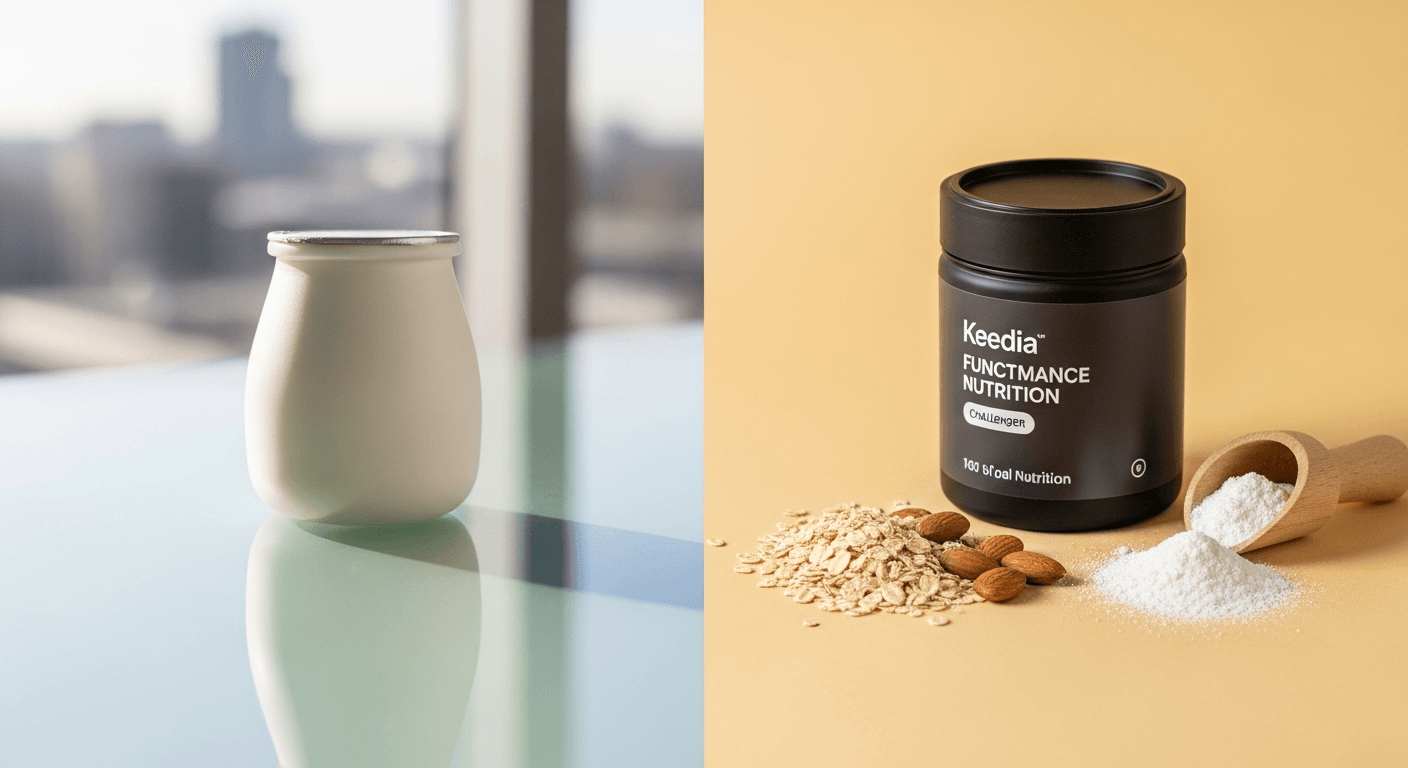
When Danone announced its $1 billion acquisition of Huel in 2025, the headlines focused on the price tag. But the more consequential story isn't the transaction itself. It's what the deal reveals about where the entire food industry is heading, and what that means for anyone who takes their nutrition seriously.
Big Food has made its bet. Functional, complete nutrition products are no longer a niche category for biohackers and elite athletes. They're the next frontier of mainstream eating, and the corporations that have long controlled supermarket shelves are now racing to own that space.
What the Huel Deal Actually Signals
Huel built its reputation on a simple but radical idea: give people every nutrient they need in a convenient, calorie-controlled format, and let performance, not pleasure, be the primary pitch. That message resonated with a specific kind of consumer, typically active adults and everyday athletes who treat food as fuel first and experience second.
For years, that positioning kept Huel in a premium, direct-to-consumer lane. You ordered online, paid a premium, and accepted that your lunch came in a shaker bottle. The brand's cult following was real, but it was also limited by distribution. That changes under Danone.
Danone's global distribution network spans over 120 countries and includes deep relationships with major grocery chains, hospital foodservice providers, and convenience retailers. The institutional confidence behind a $1 billion valuation isn't just about Huel's current revenue. It's about where those products can go when they're sitting next to Greek yogurt and bottled water in every major retailer across the US, UK, Canada, and Australia.
This is the moment complete nutrition moves from specialty supplement to everyday staple. And that shift carries real consequences for how you eat, shop, and think about what's actually in your food.
The End of the Simple Ingredient List
For most of food industry history, the consumer value proposition was straightforward: taste, price, convenience, and brand familiarity. Ingredient lists were a secondary concern, something health-conscious consumers checked but most shoppers ignored.
That model is breaking down. A growing body of market research shows that consumers, particularly those aged 25 to 45, are increasingly making purchase decisions based on functional claims. Protein content, micronutrient completeness, glycemic impact, and gut health credentials are now front-of-package priorities rather than footnotes.
Huel was an early architect of this shift. Its marketing has always led with macros, micronutrients, and scientific formulation rather than taste profiles or lifestyle imagery. That approach, once considered cold and clinical, now looks prescient. Danone recognized it and paid $1 billion to own it.
What you're seeing across the wider industry is a fundamental reframing of what food is supposed to do. The message is no longer "this tastes great." It's "this performs for you." Calories-plus-function has replaced the simple ingredient list as the primary selling point, and that shift is accelerating as more legacy brands follow Danone's lead.
Why Active Adults Should Pay Attention
If you're someone who works out consistently, tracks your protein intake, or thinks seriously about how nutrition supports your performance and recovery, this transition affects you directly. Here's why.
Wider retail availability is the obvious upside. Having access to nutritionally complete products in a local grocery store rather than through a subscription delivery model lowers the barrier significantly. For people managing busy schedules, that convenience has genuine value.
But convenience and quality don't always travel together when a brand scales under corporate ownership. The history of Big Food acquisitions offers plenty of cautionary examples. When a company built on nutritional integrity gets absorbed into a conglomerate optimizing for margin, shelf life, and mass appeal, formulations often change quietly. Ingredients get swapped, processing methods shift, and the product that originally earned consumer trust starts to drift.
This isn't speculation about Danone specifically. It's a pattern worth understanding. Research on food reformulation following major acquisitions consistently shows pressure to reduce costs, extend shelf stability, and broaden palatability for mainstream consumers. Each of those pressures can work against the nutritional density that made the original product worth buying.
The practical implication for you is straightforward: if you currently use Huel or similar products as a meaningful part of your nutrition strategy, build a habit now of reading the nutrition panel carefully after any reformulation, not just the marketing language on the front of the package.
The Bigger Pivot in Big Food
Huel isn't an isolated case. It's part of a broader acquisition wave that includes protein-focused brands, greens powders, gut health products, and fortified meal replacements. Legacy companies across the food and beverage sector have collectively spent billions in recent years buying brands that lead with function rather than flavor.
The strategic logic is clear. The global functional food and beverage market was valued at over $300 billion in 2024, with compound annual growth projections consistently above 7 percent. In the US alone, functional nutrition products are among the fastest-growing categories in both grocery and foodservice. That's not a trend Big Food can afford to watch from the outside.
What's shifting is not just what these companies sell, but how they define eating well. For decades, wellness messaging from food corporations focused on restriction: low fat, low sugar, low calorie. The new playbook is additive. The pitch is that food should actively contribute to your health outcomes, your athletic performance, your cognitive function, and your energy levels. Eating well isn't about avoiding the wrong things anymore. It's about consuming the right things in the right combinations.
That reframing has real merit. If you're already thinking about how mixing up your workouts adds years to your life, pairing that physical effort with genuinely functional nutrition is a logical next step. The science on the interaction between diet quality and exercise outcomes is robust. Better fuel supports better adaptation.
But it also creates new marketing vulnerabilities. When function becomes the selling point, function claims become the primary tool of persuasion. The risk is that "functional" becomes as meaningless as "natural" did a decade ago: a word that sounds rigorous but gets applied to anything a marketing team wants it to cover.
What to Actually Look For in Functional Nutrition Products
Whether you're evaluating Huel post-acquisition or any other product in this rapidly expanding category, a few principles keep your choices grounded in what actually matters.
- Third-party testing matters more than front-of-package claims. Look for products certified by NSF International, Informed Sport, or USP. These certifications verify that what's on the label is actually in the product, and nothing else is.
- Complete nutrition requires micronutrient breadth, not just macros. A product can hit your protein and carbohydrate targets while being meaningfully deficient in vitamins, minerals, or essential fatty acids. Check the full nutrition panel, not just the macronutrient summary.
- Ingredient quality shifts under cost pressure. Watch for changes in protein sources (whole food versus isolated), fiber types (soluble versus insoluble balance), and fat sources (the ratio of omega-3 to omega-6 matters). These aren't marketing details. They have measurable physiological effects.
- Reformulations often happen quietly. Companies aren't required to announce formula changes. If a product you rely on starts tasting different or affecting you differently, check the current label against the version you originally started using.
If you're working with a trainer or coach to structure your nutrition around specific performance goals, this is also a good moment to have that conversation. A qualified professional can help you evaluate whether any given product actually fits your needs rather than just your convenience. If you're still building that support structure, understanding how to choose a personal trainer as a fitness beginner is a practical starting point.
The Industry Is Moving Fast. Your Standards Don't Have To.
Danone's acquisition of Huel is a clear signal that functional nutrition is entering its mainstream phase. That's genuinely good news in some ways. More people having access to nutritionally complete, convenient food options is a net positive for public health.
But mainstream adoption driven by corporate scale also brings pressure on the very qualities that made these products worth trusting. When distribution expands, formulation integrity sometimes contracts. When marketing budgets grow, claims often outpace evidence.
Your best response isn't cynicism about the category. It's rigor about your own choices. The same curiosity that leads you to track how your cardio fitness in your 20s predicts future disease risk is the right lens for evaluating what you eat. Long-term health outcomes depend on the cumulative quality of thousands of small decisions, and what you put in your body every day is among the most consequential of them.
The food industry is redefining what eating well means. That doesn't mean you have to accept their definition. Read the labels, verify the claims, and let outcomes, not marketing, be your benchmark.