
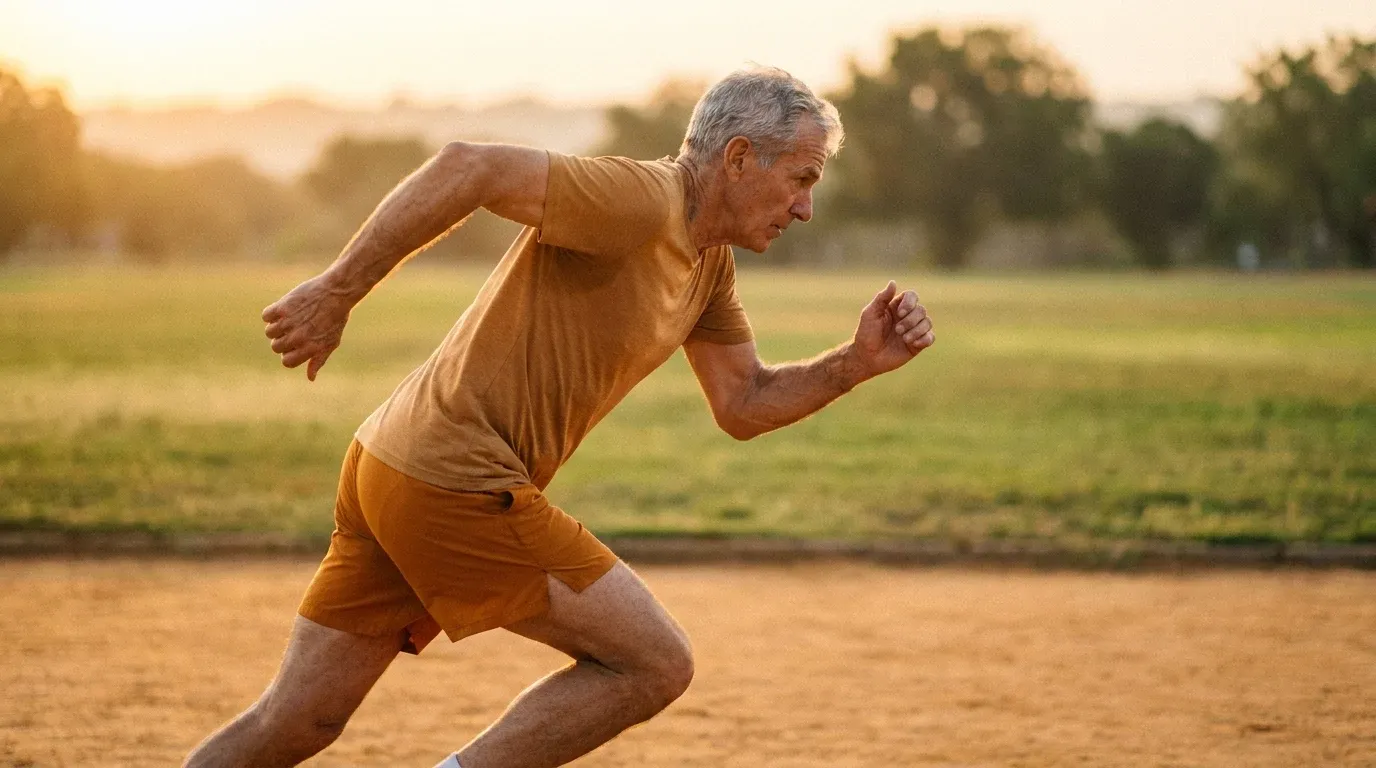
If you're over 50 and trying to lose body fat without watching your muscle disappear with it, the type of training you choose matters far more than most people realize. A six-month randomized controlled trial has confirmed what many sports scientists suspected: high-intensity interval training is the only exercise modality that consistently allows older adults to reduce fat mass while preserving lean muscle. That finding has real, practical implications, especially around what you eat and when you eat it.
What the Study Actually Found
The trial ran for six months and compared three groups of older adults: one doing HIIT, one doing moderate-intensity continuous training (MICT), and a control group with no structured exercise. At the end of the study period, the HIIT group had lost significant body fat while maintaining their lean muscle mass. The moderate-intensity group did lose some fat, but they also experienced a measurable decline in lean tissue. The sedentary control group, predictably, fared worst on both counts.
That gap between HIIT and moderate-intensity training is the critical detail here. It tells you that working harder, in structured intervals, sends a different signal to aging muscle than steady, moderate effort does. The physiological explanation centers on the acute hormonal and mechanical stress that high-intensity work generates. Short, repeated bursts of near-maximal effort stimulate muscle protein synthesis in a way that lower-intensity sustained work simply doesn't match.
For older adults specifically, this matters because sarcopenia, the age-related loss of skeletal muscle, accelerates after 50. Any intervention that can simultaneously reduce fat and protect lean tissue represents a meaningful clinical advantage, not just an aesthetic one. Muscle mass correlates directly with metabolic health, insulin sensitivity, fall prevention, and long-term independence.
Why Moderate Training Falls Short on Its Own
The slight lean mass loss observed in the moderate-intensity group shouldn't be dismissed as a rounding error. It reflects a real metabolic trade-off that happens when you're in a caloric deficit or even at maintenance calories while doing sustained, aerobic-dominant work. Your body, particularly an aging body, can begin breaking down muscle protein for fuel when the intensity signal isn't strong enough to override that process.
This doesn't mean moderate-intensity exercise is without value. It supports cardiovascular health, mood, recovery, and joint mobility. Research also consistently shows that more movement slows Parkinson's progression, reinforcing the broad case for staying active in any form. The point isn't to abandon moderate training. It's to understand that if body composition is your primary goal after 50, pairing it with HIIT and a carefully structured nutrition strategy is non-negotiable.
The practical takeaway for moderate-intensity exercisers is this: your nutrition plan has to work harder to compensate for what the training stimulus alone won't preserve. That means protein intake, meal timing, and caloric structure all need to be deliberate rather than approximate.
The Nutrition Variables That Change When You Add HIIT
HIIT doesn't just change how you train. It changes how your body handles nutrients in the hours after each session. That post-exercise window is when protein synthesis peaks, and if you're not fueling it properly, you're leaving the primary benefit of the training on the table.
Here's what the evidence supports for older adults combining HIIT with a fat-loss goal:
- Total daily protein intake: Research consistently places the target for older adults in an active fat-loss phase at 1.6 to 2.2 grams of protein per kilogram of body weight per day. Older muscle is less sensitive to leucine, the key amino acid that triggers muscle protein synthesis, which means you need more total protein to generate the same anabolic signal a younger person gets from less.
- Post-HIIT protein timing: Consuming 30 to 40 grams of high-quality protein within 30 to 60 minutes of finishing a HIIT session directly supports the elevated muscle protein synthesis window. Whey protein is frequently cited in this context due to its leucine content and fast absorption rate, but a high-quality whole food source works comparably if the protein threshold is met.
- Protein distribution across meals: Spreading protein evenly across three to four meals rather than front-loading or back-loading your intake produces better muscle protein synthesis outcomes. Older adults who consume one or two very high-protein meals while underconsuming at others don't get the same cumulative anabolic effect as those who hit a meaningful dose, roughly 30 to 40 grams, at each sitting.
- Caloric deficit depth: A moderate deficit of 300 to 500 calories per day is more compatible with muscle preservation during HIIT than aggressive restriction. Cutting too deep while performing high-intensity work depletes glycogen faster and forces the body to pull from lean tissue to sustain energy output.
Structuring HIIT for Older Adults Without Burning Out
The study used structured HIIT protocols, not random bouts of hard effort. That distinction matters. Effective HIIT for fat loss and muscle preservation in older adults typically involves two to three sessions per week, with adequate recovery built in between each one. More is not better here. Overdoing high-intensity work without recovery increases cortisol, suppresses protein synthesis, and raises injury risk.
A standard format that works well is four to six intervals of high effort lasting 30 to 60 seconds, followed by recovery periods of 90 seconds to two minutes. The work intervals should feel genuinely hard, around an eight or nine out of ten on perceived exertion. If you're completing them comfortably, they're not HIIT in any meaningful sense.
Rest management between intervals also shapes outcomes. The science on rest periods between sets applies here: too short, and output drops so significantly that each interval stops being high-intensity. Too long, and you lose the cardiovascular and metabolic stress that makes the protocol effective. For most older adults, 90 seconds of active recovery, light movement rather than sitting still, produces better results than either extreme.
On non-HIIT days, lower-intensity resistance training or walking supports recovery without adding excessive stress. Seven strength sessions can begin shrinking fat cells, according to recent research, and pairing them with your HIIT days across the week creates a complementary stimulus that addresses both fat metabolism and structural muscle maintenance.
What This Means If You're Currently Doing Cardio Only
A lot of adults over 50 default to walking, cycling, or swimming as their primary form of exercise. These are excellent choices for cardiovascular health, stress management, and longevity. But if you're also trying to reduce body fat and you haven't incorporated any high-intensity work, this study gives you a direct signal to reconsider your approach.
The data doesn't suggest you should swap your moderate activity for HIIT. It suggests you should add it. Two HIIT sessions per week alongside your existing routine, combined with a structured protein intake strategy, can shift the body composition outcome meaningfully compared to moderate cardio alone.
If you've been stuck at a plateau despite consistent effort, the problem may be the training signal rather than the volume. Breaking through a training plateau often requires diagnosing the specific variable that's stalling progress, and for many older adults doing cardio-dominant programs, that variable is intensity.
Putting the Nutrition and Training Together
The framework isn't complicated, but it requires consistency across both the exercise and the eating side simultaneously. You can't optimize one and neglect the other and expect the fat-loss-without-muscle-loss outcome this study observed in the HIIT group.
A practical weekly structure for an adult over 50 targeting body composition might look like this:
- Two to three HIIT sessions per week, each lasting 20 to 30 minutes including warm-up
- Two strength or resistance training sessions targeting major muscle groups
- Daily protein intake of 1.6 to 2.0 grams per kilogram of body weight, distributed across three to four meals
- A caloric deficit no deeper than 400 to 500 calories per day to protect lean tissue
- 30 to 40 grams of protein consumed within an hour of each HIIT session
- Adequate sleep, since growth hormone, which supports muscle protein synthesis, is primarily released during deep sleep stages
The study's findings reinforce a principle that's easy to overlook: at older ages, the quality of the training stimulus determines whether fat loss comes at the cost of muscle. HIIT, done with appropriate structure and paired with a protein-forward nutrition strategy, is currently the strongest evidence-based approach available for adults who want to lose fat without losing what keeps them strong.
That's not a minor distinction. It's the difference between getting leaner and getting frail.