
The men's vitality supplement market is on pace to exceed $8 billion globally in 2026, and the shelves, both physical and digital, are overflowing. Products with names like SpartaMax, AlphaCore, and VirilForce stack six, eight, sometimes twelve ingredients onto a label, cite individual studies in their marketing copy, and charge $60 to $90 per bottle for the privilege. The problem isn't that these ingredients are fake. The problem is that the research behind them is far more conditional than the packaging suggests.
This piece breaks down the actual clinical evidence behind the most common vitality ingredients, explains why the gap between individual research and finished-formula data matters, and gives you a framework to evaluate any product yourself before spending a dollar.
The Finished Formula Problem Nobody Talks About
Here's the marketing logic most brands rely on: Ingredient A has a study showing benefit X. Ingredient B has a study showing benefit Y. Therefore, a product containing both A and B delivers X plus Y. It sounds reasonable. It isn't science.
Take a brand like SpartaMax as a representative example. Its formula includes Tongkat Ali, Ashwagandha, Maca Root, Zinc, Vitamin D, and L-Arginine, all ingredients with some level of individual research. But no published randomized controlled trial exists on that specific combination at those specific doses. That's not an accusation. It's the standard reality for virtually every men's vitality product on the market.
Ingredient interactions matter. Absorption rates change when compounds are combined. Dosing thresholds proven in isolation may not hold in a multi-ingredient blend. This is the same challenge covered in depth when examining why ingredient testing doesn't predict your joint supplement's results. The mechanism applies equally here. You're buying evidence for the parts, not the whole.
When you evaluate any supplement, your first question should be: does a clinical trial exist on this finished formula? If the answer is no, everything else is extrapolation.
Tongkat Ali: The Strongest Case in the Category
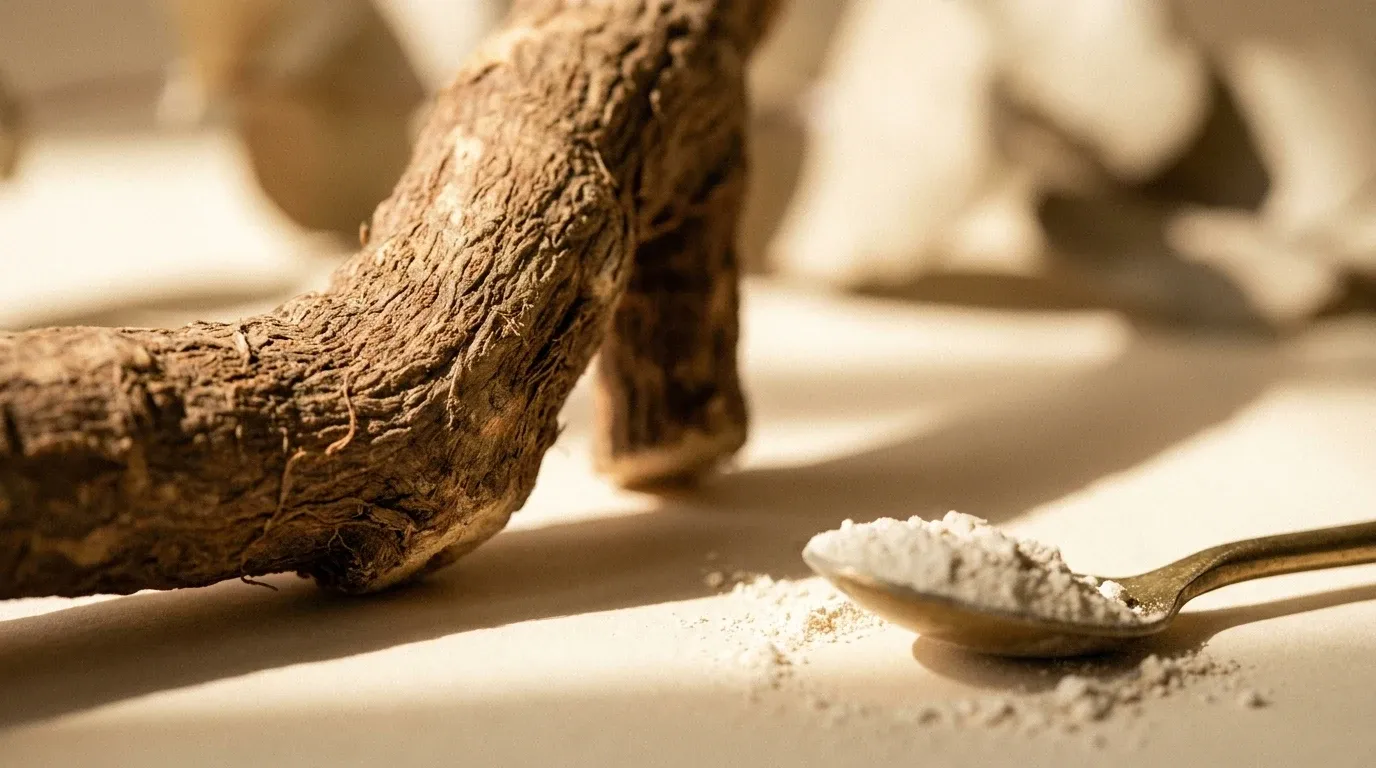
Tongkat Ali, derived from the root of Eurycoma longifolia, has accumulated the most credible human trial data of any ingredient in the men's vitality space. Multiple double-blind, placebo-controlled studies conducted on physically active men have shown statistically significant increases in free testosterone and reductions in cortisol at daily doses of 200 to 400mg of a standardized extract.
The key word is standardized. The research that generated positive results used extracts standardized to specific glycosaponin and eurypeptide concentrations, typically 22% and 0.8% respectively. Generic "Tongkat Ali root powder" listed on a label without a standardization disclosure is not the same product used in those trials. You can't assume equivalence.
One well-cited human study found that 200mg of a standardized water-soluble extract taken daily for four weeks produced a 37% reduction in cortisol and a 15% increase in testosterone in moderately stressed adults. The stress-hormone modulation effect is, arguably, better supported than the direct testosterone effect, and both are clinically relevant. If you're dealing with high training loads or chronic work stress, cortisol reduction has direct implications for recovery and body composition. It connects to the same physiological pathways explored when looking at how treating insomnia affects daytime function and hormonal outcomes.
Tongkat Ali is one ingredient where the evidence justifies interest, provided the product discloses a standardized extract and delivers 200mg or more per daily serving.
Ashwagandha: Formulation Matters More Than You Think
Ashwagandha is the other ingredient in this category with genuine RCT support, and the research is meaningful. Studies on KSM-66 and Sensoril, both patented, standardized root extracts, have demonstrated statistically significant reductions in serum cortisol, improvements in perceived stress scores, and modest but real gains in muscle strength and recovery when combined with resistance training.
KSM-66 is a full-spectrum root extract standardized to a minimum of 5% withanolides. Sensoril uses a root and leaf blend and is standardized differently, typically to 10% withanolides. Both have multiple RCTs behind them. A 2019 study found that 600mg of KSM-66 daily over 8 weeks produced significant improvements in testosterone levels alongside strength outcomes in resistance-trained men. Another study using Sensoril at 250mg twice daily showed meaningful cortisol reduction over 60 days.
Here's the critical distinction: generic ashwagandha root powder at unspecified standardization, which is what most budget blends use, is not equivalent to KSM-66 or Sensoril. The withanolide concentration may be a fraction of what the trials used. When a product simply lists "Ashwagandha Root Extract 300mg" with no further detail, you have no way of knowing whether it bears any resemblance to the studied form.
Check the label for the patented name. If it's not there, treat it as an unknown.
L-Arginine: A Filler That Research Has Largely Moved Past
L-Arginine remains one of the most common ingredients in men's vitality and circulation formulas. It's also one of the clearest examples of a marketing ingredient that science has substantially moved on from.
The rationale for arginine is that it's a precursor to nitric oxide, which supports vascular dilation and circulation. That mechanism is real. The problem is bioavailability. Orally ingested L-Arginine is heavily metabolized in the gut and liver before it reaches systemic circulation, meaning large portions of the dose are broken down before they can influence nitric oxide synthesis.
L-Citrulline, by contrast, converts to arginine in the kidneys and reaches systemic circulation far more efficiently. Multiple trials have shown that 6 to 8 grams of citrulline malate outperforms equivalent or higher arginine doses on blood flow and exercise performance markers. Yet arginine remains ubiquitous in vitality blends because it's substantially cheaper.
If a product lists L-Arginine at 500mg to 1,000mg as a circulation support ingredient, understand what you're actually buying. It's not fraudulent. It's a cheaper input that the research literature has largely superseded. If circulation support is a priority for you, look for products specifying L-Citrulline at clinically relevant doses, typically 3 grams or more.
Maca Root: Wellness Positioning vs. Clinical Evidence
Maca Root is the ingredient category veterans call a "wellness positioner." It appears on labels, it has a history of traditional use in Andean culture, and some small studies have suggested effects on libido and mood. However, the clinical trial quality is substantially lower than what exists for Tongkat Ali or standardized Ashwagandha.
Most maca studies involve small sample sizes, short durations, and inconsistent standardization of the root material. Effects on testosterone levels specifically are not well-supported in the current literature. What the better-quality evidence suggests is a modest, self-reported improvement in sexual desire in some populations, which is not the same as a hormonal or physiological mechanism.
Maca is not harmful. It's not the point of the formula. It's the ingredient that lets a brand include something with a compelling story and a traditional use claim without committing to a specific, testable mechanism. Recognize it for what it is.
How to Evaluate Any Vitality Supplement Yourself
You don't need a biochemistry degree to do a credible ingredient audit. Here's a practical framework:
- Demand finished-formula trial data first. Ask whether the brand has conducted or sponsored a clinical trial on the complete product. Most haven't. That doesn't mean automatic rejection, but it sets expectations correctly.
- Check for standardized extract designations. For Ashwagandha, look for KSM-66 or Sensoril. For Tongkat Ali, look for a glycosaponin and eurypeptide standardization or a patented extract name. Generic root powder is not a substitute.
- Look up the actual dose. Compare the dose on the label to the dose used in the trial cited in the marketing copy. Many products list an ingredient at 100mg when the study used 400mg. That's a meaningful difference.
- Identify fillers by their position on the label. Ingredients listed last in a proprietary blend often appear at doses too small to produce effects. L-Arginine at 250mg is not a circulation treatment. It's a label entry.
- Separate what the ingredient actually studied from what the product claims. A study on cortisol reduction does not automatically translate to a testosterone claim. These are related but distinct outcomes.
The same critical thinking applies across the supplement landscape. If you're already doing the work in the gym, which research continues to validate as a direct lever for hormonal health and cognitive function, as explored in the evidence on how lifting weights affects brain health, a supplement stack shouldn't be your primary strategy. It should be, at best, a marginal optimization on top of sound fundamentals.
What Credible Looks Like
A men's vitality product that earns serious consideration would include: Tongkat Ali as a standardized extract at 200mg or more, KSM-66 or Sensoril Ashwagandha at 300 to 600mg, L-Citrulline rather than L-Arginine for circulation support, transparent labeling with no proprietary blends obscuring individual doses, and ideally a third-party testing certification such as NSF Certified for Sport or Informed Sport.
That combination doesn't guarantee results. Individual response to any supplement varies. But it represents the difference between buying evidence and buying marketing. Most products on the market are the latter. A few are starting to take the former more seriously.
The category is growing fast enough that better-quality products are beginning to emerge. Your job as a consumer is to know the difference. That starts with reading past the front of the label and asking the question most buyers skip: where's the proof that this specific formula, at these specific doses, does what you're claiming?
If the answer isn't on the page, it doesn't exist yet. And that's worth knowing before you spend $75 a month finding out the hard way.