

Omega-3, Vitamin D, and Exercise: The Combo That Slows Biological Aging
Most supplement research asks a simple question: does this thing do something useful? The DO-HEALTH trial asked a harder one. What happens when you combine three low-cost interventions, hold them for three years, and measure the result not on symptoms or biomarkers, but on the biological age of your DNA itself?
The answer, published in Nature Aging, is that the combination of 1g/day of omega-3, 2000 IU/day of vitamin D, and 30 minutes of exercise three times per week slowed biological aging by 2.9 to 3.8 months over three years compared to placebo. That number sounds modest. It isn't, once you understand what's actually being measured.
What epigenetic clocks actually measure
Your chronological age is the number of years since you were born. Your biological age is something different. It reflects how your cells have been functioning, how efficiently your body repairs itself, and how much cumulative stress your systems have absorbed over time.
Epigenetic clocks measure biological age by analyzing DNA methylation patterns. Methylation is a chemical process where small molecular tags attach to specific sites on your DNA, influencing which genes get expressed and which stay silent. These patterns shift in predictable ways as you age, and researchers have developed algorithms that use thousands of these methylation sites to calculate a biological age estimate with remarkable precision.
What makes epigenetic clocks meaningful is their predictive power. Several validated versions, including PhenoAge, GrimAge, and DunedinPACE, have been shown in large population studies to predict risk of cancer, cardiovascular disease, cognitive decline, and all-cause mortality. They don't just measure age. They measure how fast you're aging right now.
DunedinPACE, one of the clocks used in the DO-HEALTH trial, is particularly relevant because it measures the pace of aging rather than a static age estimate. A score of 1.0 means you're aging at the average rate. A score above 1.0 means you're aging faster. The trial measured whether the interventions could shift that number.
What the DO-HEALTH trial found
The trial enrolled over 2,000 adults aged 70 and older across five European countries. Participants were randomized into groups receiving omega-3 alone, vitamin D alone, a simple home exercise program alone, combinations of two, or all three together. A placebo group received none of the interventions. Biological age was assessed at baseline and again at three years using multiple epigenetic clocks.
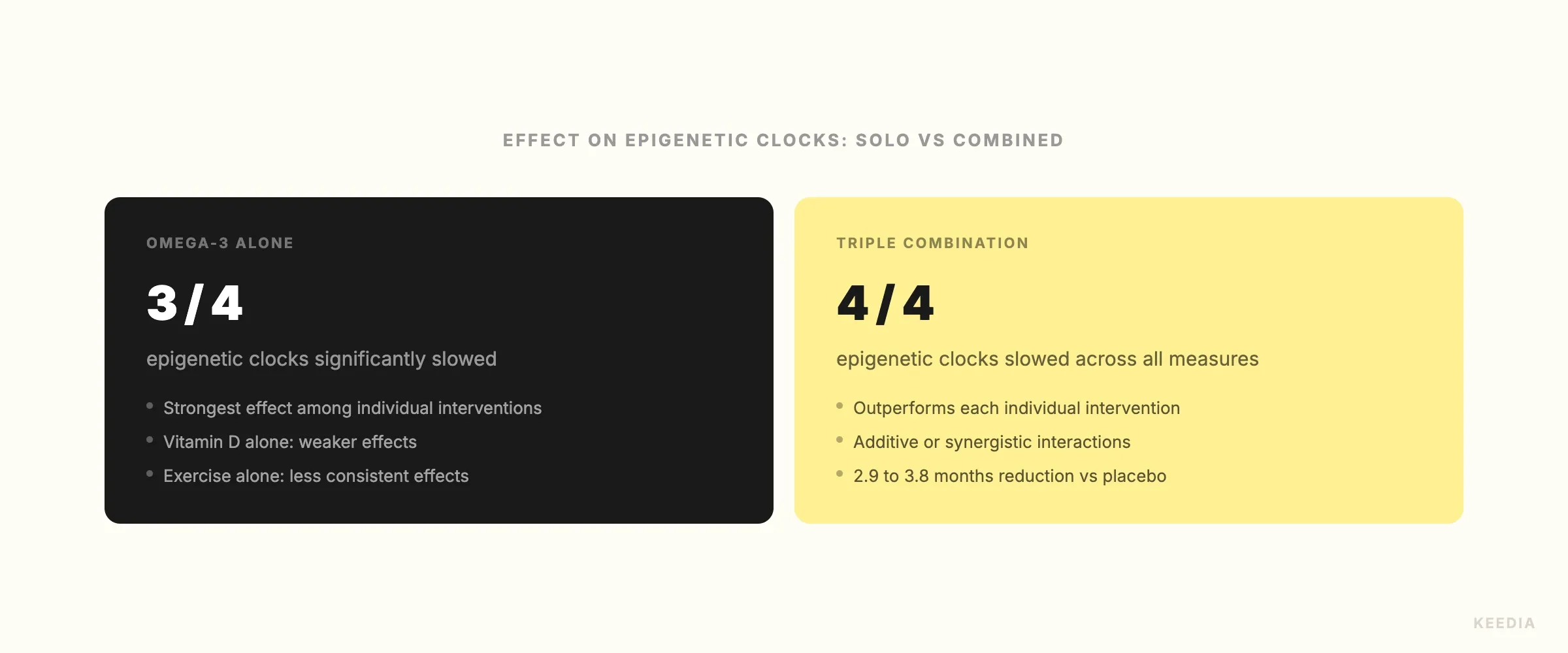
The triple combination produced the strongest effect across all clocks tested. Participants receiving omega-3 plus vitamin D plus exercise showed biological aging that was 2.9 to 3.8 months slower than placebo over the three-year window, depending on which clock was used.
That's a meaningful number. In epigenetic clock research, slowing biological aging by even one month over a multi-year period is considered a clinically relevant finding. Three to four months over three years represents a real shift in trajectory, not statistical noise.
Crucially, no single intervention matched the triple combination. Omega-3 alone reduced aging on three of the epigenetic clocks tested, making it the strongest individual performer. Vitamin D alone and exercise alone showed weaker individual effects. But when all three were combined, the results exceeded any of them individually, suggesting that the interventions work through partially independent mechanisms that add up, or possibly amplify each other.

Why omega-3 stands out individually
The fact that omega-3 independently affected three of the epigenetic clocks is significant. Several mechanisms have been proposed. Omega-3 fatty acids, particularly EPA and DHA, reduce systemic inflammation, which is one of the primary drivers of accelerated epigenetic aging. They also appear to influence telomere maintenance and may directly affect methylation patterns at certain genomic loci.
The dose used in the trial was 1g/day of algae-derived omega-3, not fish oil. Algae-derived omega-3 is the upstream source that fish themselves eat to accumulate EPA and DHA. It delivers the same fatty acids without the contaminant concerns associated with some fish oil products and is suitable for people who don't consume fish. At that dose, you're looking at roughly two standard fish oil capsules per day in equivalent terms. It's a realistic, affordable daily habit, not a clinical intervention that requires medical supervision.
If you're already paying attention to nutrient timing, foundational supplements like omega-3 fit naturally alongside other evidence-backed protocols. Research on compounds like magnesium and sleep for athletes follows the same pattern: modest doses, consistent use, measurable effects on processes that compound over time.
What 3.8 months actually means in practice
The honest answer is that we don't know exactly what 3.8 months of slower biological aging translates to in terms of lived experience or disease risk. Epigenetic clocks are predictive tools built on population data, not individual forecasts. Shifting your biological age by a few months doesn't mean you'll live a few months longer. It means your biological systems are operating more like those of a person who is chronologically younger than you.
What we do know is that people with lower biological age scores on validated clocks have measurably lower rates of chronic disease and mortality in longitudinal studies. They also tend to have better physical function, cognitive performance, and resilience to acute illness. Moving your trajectory in that direction is meaningful, even if the exact downstream benefit is hard to quantify for a single person.
The framing that matters most is not "I gained 3.8 months." It's "I'm aging at a measurably slower rate than I was before." Over a decade, that compounds.
The exercise component: what kind and how much
The exercise protocol in the DO-HEALTH trial was deliberately simple: 30 minutes of structured physical activity, three times per week, performed at home. It included strength, balance, and flexibility work, designed to be accessible to adults over 70 without gym access or prior training experience.
For younger or more trained individuals, this represents a fairly low volume. The trial doesn't tell us whether higher training loads produce greater epigenetic benefits, whether a different exercise modality would outperform this protocol, or whether the effects would be larger in a 40-year-old than in a 75-year-old. These are open questions.
What the trial does confirm is that even modest, consistent physical activity contributes to the epigenetic signal, and that it interacts with the nutritional interventions rather than operating in isolation. If you're already training regularly, the exercise component is likely covered. The question is whether your nutrition stack is doing the same work. Research on improving VO2max through research-backed protocols consistently shows that training adaptations depend heavily on systemic inflammation and recovery capacity. Omega-3 and vitamin D influence both.
Limitations you should actually know about
The DO-HEALTH trial is rigorous and the findings are significant, but there are real constraints on how broadly the results apply.
- Age range: The population was adults aged 70 and older. Whether the same protocol produces the same epigenetic effects in adults in their 30s, 40s, or 50s is unknown. Epigenetic aging rates differ across the lifespan, and it's plausible that earlier intervention produces stronger or weaker effects.
- Three-year window: The trial measured outcomes over three years. It's not known whether the effects persist, accelerate, or plateau beyond that point. Epigenetic aging is not linear, and long-term trajectories are harder to predict.
- Supplement quality and bioavailability: The trial used a standardized, controlled supplement dose. Commercial omega-3 and vitamin D products vary significantly in quality, purity, and bioavailability. Not all 1g omega-3 capsules are equivalent.
- Combination synergy: The trial found that the triple combination outperformed individual interventions, but it wasn't designed to fully disentangle the mechanisms. Whether the interaction is truly synergistic at a biochemical level or simply additive requires further investigation.
These limitations don't undermine the finding. They frame it correctly. This is strong evidence for a specific protocol in a specific population, and it's directionally meaningful for everyone else.
How to apply this practically
The protocol is simple enough that it doesn't require significant lifestyle restructuring. You're looking at three components:
- Omega-3: 1g/day of EPA and DHA combined, from algae-derived or high-quality fish oil sources. This is a low dose and well within safe long-term use guidelines.
- Vitamin D: 2000 IU/day. Most adults in northern latitudes are deficient or insufficient, particularly in winter months. This dose is safe for the general population without requiring blood testing, though checking your baseline 25(OH)D level is a reasonable first step if you haven't done so.
- Exercise: At minimum, 30 minutes of structured movement three times per week. If you're already training more than this, you're likely exceeding the minimum threshold.
The research on complementary wellness protocols points in a consistent direction: multiple low-cost, low-risk interventions, maintained consistently, tend to produce effects that exceed any single intervention on its own. The same principle applies to findings around sauna use and cardiovascular health, where frequency and consistency matter more than any single session.
There's also a broader pattern worth naming. The interventions with the best long-term evidence are almost always the least dramatic ones. Omega-3 and vitamin D are not new or expensive. A 30-minute home workout three times a week isn't a sophisticated training plan. The DO-HEALTH findings matter precisely because they show that simple, sustainable habits, maintained over years, produce measurable changes at the level of your DNA.
That's not a minor finding. It's a reason to actually do the boring things consistently, rather than cycling through whatever protocol is generating interest this month. Your epigenome is keeping score either way.