
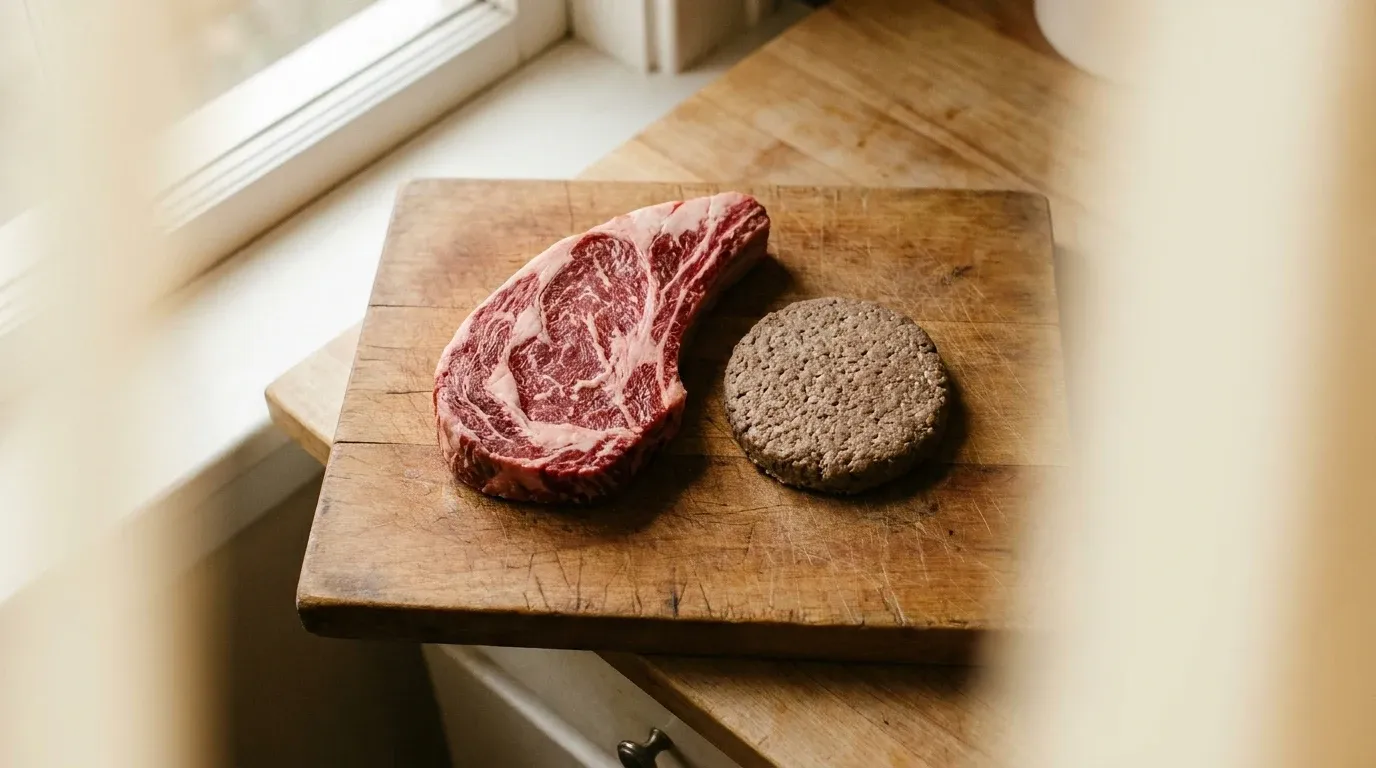
The protein aisle has never been more crowded, and the marketing on both sides has never been louder. Pasture-raised beef brands tout omega-3s and regenerative farming. Plant-based burger companies promise heart health and sustainability. A 2026 head-to-head study finally puts some of those claims to the test, and the results don't cleanly favor either camp.
If you're training consistently and trying to build or preserve muscle, the category label on the package matters far less than what's actually inside it.
What the 2026 Research Actually Found
Published in early 2026, a large comparative study directly measured nutritional profiles and selected health markers in adults consuming pasture-raised red meat versus commercially available plant-based meat alternatives over a 16-week period. It's one of the most rigorous direct comparisons to date, controlling for total caloric intake, training habits, and baseline diet quality.
The findings were nuanced. Pasture-raised red meat showed meaningfully higher concentrations of omega-3 fatty acids, conjugated linoleic acid (CLA), zinc, and heme iron compared to both conventional beef and plant-based alternatives. Plant-based alternatives, on the other hand, showed wide variability. Some performed reasonably well on fiber and certain micronutrients. Others were indistinguishable from ultra-processed food by every measurable standard.
Neither group produced uniformly better health outcomes. The determining factors were processing level, total dietary context, and consistency of consumption, not the protein source category itself.
The Ultra-Processing Problem Nobody's Talking About Loudly Enough
Here's where the plant-based health halo starts to crack. Many of the most popular plant-based meat products on the market are classified as ultra-processed foods under the NOVA classification system. That means they're engineered with combinations of protein isolates, refined starches, industrial seed oils, flavor compounds, and significant amounts of sodium.
The 2026 study found that several plant-based alternatives contained between 350 and 600 milligrams of sodium per 100 grams. That's not a rounding error. For someone eating two servings a day as a protein source, sodium intake from that single food category alone could approach or exceed 1,200 milligrams before anything else hits the plate.
High sodium doesn't automatically make a food harmful, but it's worth flagging when that same food is being marketed as a health-forward choice. If you're already using pre-workout supplements, protein powders, and sports drinks, your total daily sodium load deserves attention. The stimulant-free pre-workout landscape is evolving, but sodium content in your whole food choices still drives the baseline.
Pasture-raised red meat isn't without its own complexity. The premium price point, typically $18 to $28 per pound for quality cuts in the US market, makes it inaccessible as a daily staple for many people. And while its nutritional profile outperforms conventional grain-fed beef, the comparison to plant-based products is more context-dependent than most headlines suggest.
Protein Quality: Animal Sources Still Lead, but the Gap Is Closing
For athletes and serious fitness enthusiasts, protein quality matters more than protein quantity alone. The key metrics are amino acid completeness and bioavailability. Animal proteins, including pasture-raised beef, score high on both. They contain all essential amino acids in proportions that closely match human muscle protein synthesis requirements, and the bioavailability of those amino acids is consistently high.
Plant-based alternatives are catching up, particularly through blending strategies. Products that combine pea protein with rice protein, for example, produce a more complete amino acid profile than either source alone. The 2026 study confirmed that the best-formulated plant blends achieved leucine concentrations closer to animal protein benchmarks than older single-source products did.
Still, the gap hasn't fully closed. Leucine, the amino acid most directly linked to activating muscle protein synthesis, remains higher per gram of protein in animal sources. This matters especially if you're working against age-related muscle loss. Research consistently shows that leucine thresholds for triggering anabolic signaling become more important as you get older. Understanding how your aging muscles defend against wasting helps explain why protein source selection becomes more consequential over time, not less.
If you rely primarily on plant-based alternatives for protein, the practical solution isn't to abandon them. It's to ensure you're either choosing blended products with verified leucine content or supplementing strategically. Casein protein offers one approach for those who include dairy, providing a slow-digesting protein source that supports overnight muscle synthesis alongside plant-heavy daytime eating.
Neither Category Wins Automatically. Here's Why That Matters
The framing of this debate as "meat vs. plants" is the wrong lens for a fitness-focused reader. The real distinction is between minimally processed, nutrient-dense foods and highly processed products, regardless of which kingdom they came from.
A pasture-raised ribeye and a plant-based burger patty made with 30 ingredients are not equivalent foods in either direction. Neither are a lentil bowl and a fast-food beef patty. Processing level, ingredient quality, and dietary context determine the actual health signal, not the headline protein source.
The 2026 study made this explicit. When researchers isolated comparisons to minimally processed plant foods versus pasture-raised meat, the gap in inflammatory markers and lipid profiles narrowed substantially. The biggest negative outcomes in the plant-based group were concentrated among the ultra-processed products, not whole or minimally processed plant proteins.
For training purposes, your goals also shape the equation. If you're in a caloric surplus building muscle, hitting leucine thresholds efficiently from fewer grams of food may favor animal protein. If you're in a caloric deficit and need volume and fiber to manage satiety, higher fiber intake from plant sources carries real functional advantages beyond just digestive health, including effects on strength and joint comfort that recent research has documented.
How to Read a Label Like a Professional
The most actionable takeaway from the 2026 research isn't a verdict on which category wins. It's that you need to evaluate the actual product, not the product's category.
When you're looking at any protein source, plant-based or animal, here's what to check:
- Protein per serving vs. total calories: A product with 15 grams of protein and 280 calories is not as efficient as one with 20 grams and 180 calories, regardless of the source.
- Sodium content: Anything above 400 milligrams per serving deserves scrutiny if you're consuming it multiple times per day.
- Ingredient list length and recognizability: A five-ingredient product behaves nutritionally differently from a 25-ingredient one, even if the macros look similar.
- Fat composition: Pasture-raised beef has a more favorable omega-6 to omega-3 ratio than conventional beef. Some plant-based products are high in refined seed oils that shift that ratio unfavorably.
- Fortification vs. naturally occurring nutrients: Iron added as a fortification is not absorbed at the same rate as heme iron from animal sources. The label may show comparable numbers, but the functional delivery differs.
This kind of label literacy is the same discipline you'd apply to any supplement decision. The category name is marketing. The ingredient panel is data.
Practical Guidance for Fitness-Focused Eaters
If you eat animal proteins and you're prioritizing nutritional density, pasture-raised or grass-finished options genuinely offer a better profile than conventional grain-fed beef. The omega-3 and CLA differences are real and documented. Whether those differences are worth the price premium depends on your budget and how central red meat is to your overall protein intake.
If you prefer plant-based eating or use plant-based products to complement your diet, the quality range is wide. Whole food plant proteins like lentils, edamame, black beans, and tofu perform consistently well. Many packaged plant-based meat alternatives do not. Read every label as if the marketing on the front of the package doesn't exist.
For most people training at moderate to high intensity, the evidence points toward a practical middle ground: prioritize protein quality and total intake, minimize ultra-processed products from either category, and adjust based on your individual response and goals. A diverse protein strategy, one that doesn't rely exclusively on any single source or product type, remains the most defensible approach the 2026 data supports.
Your breakfast choices also shape more than you might expect. Research on morning meal composition and cortisol response suggests that what you eat early in the day influences metabolic and stress signaling throughout it. If you're building a nutrition protocol around training, understanding how your breakfast affects your stress levels adds another layer to the protein timing conversation.
The bottom line is that neither pasture-raised meat nor plant-based alternatives hold a universal advantage. The 2026 research confirms what careful nutritional analysis has suggested for years: processing level and product quality matter more than the protein kingdom. Evaluate what's in your food, not just what category it's sold under.