
You finish a winter run, barely sweating, and assume your hydration is fine. You didn't overheat, you didn't feel thirsty, and you're not dizzy. So you skip the water bottle and move on. That assumption is costing you performance, recovery, and potentially your health.
Cold-weather dehydration is one of the most underestimated problems in recreational and competitive sport. It's not dramatic. It doesn't announce itself the way heat exhaustion does. But the physiological mechanisms driving it are well-established, and the consequences are real.
Cold Suppresses Your Thirst by Up to 40%
Your thirst response isn't a neutral alarm system. It's influenced by temperature, and in cold environments, it gets significantly blunted. Research has consistently shown that cold exposure reduces the sensation of thirst by approximately 40% compared to exercising in warm conditions, even when fluid losses are similar.
The mechanism comes down to blood redistribution. When temperatures drop, your body shunts blood toward your core to protect vital organs. This peripheral vasoconstriction maintains central blood volume, which tricks your brain into registering that fluid levels are adequate. The result: you're losing fluid, but you don't feel it.
This isn't a minor inconvenience. A 2% drop in body water is enough to measurably impair endurance performance. A 3% drop affects cognitive function, decision-making, and reaction time. Winter athletes routinely hit these thresholds without ever feeling thirsty enough to act on it.
The practical implication is that you cannot rely on thirst as a hydration cue during cold-weather training. Scheduled drinking, not reactive drinking, has to become the default strategy.
Breathing Costs You More Water Than You Think
There's a hydration drain in winter that almost nobody accounts for: respiratory water loss. Every time you exhale in cold, dry air, you're losing moisture. Your lungs must humidify and warm incoming air before it reaches your airways, and that process pulls water from your respiratory tract on every single breath.
During high-intensity winter exercise, respiratory water loss can reach 1 to 1.5 liters per hour, depending on the temperature, humidity, and your breathing rate. That's a significant fluid deficit that has nothing to do with sweat and everything to do with the simple act of breathing hard in cold air.
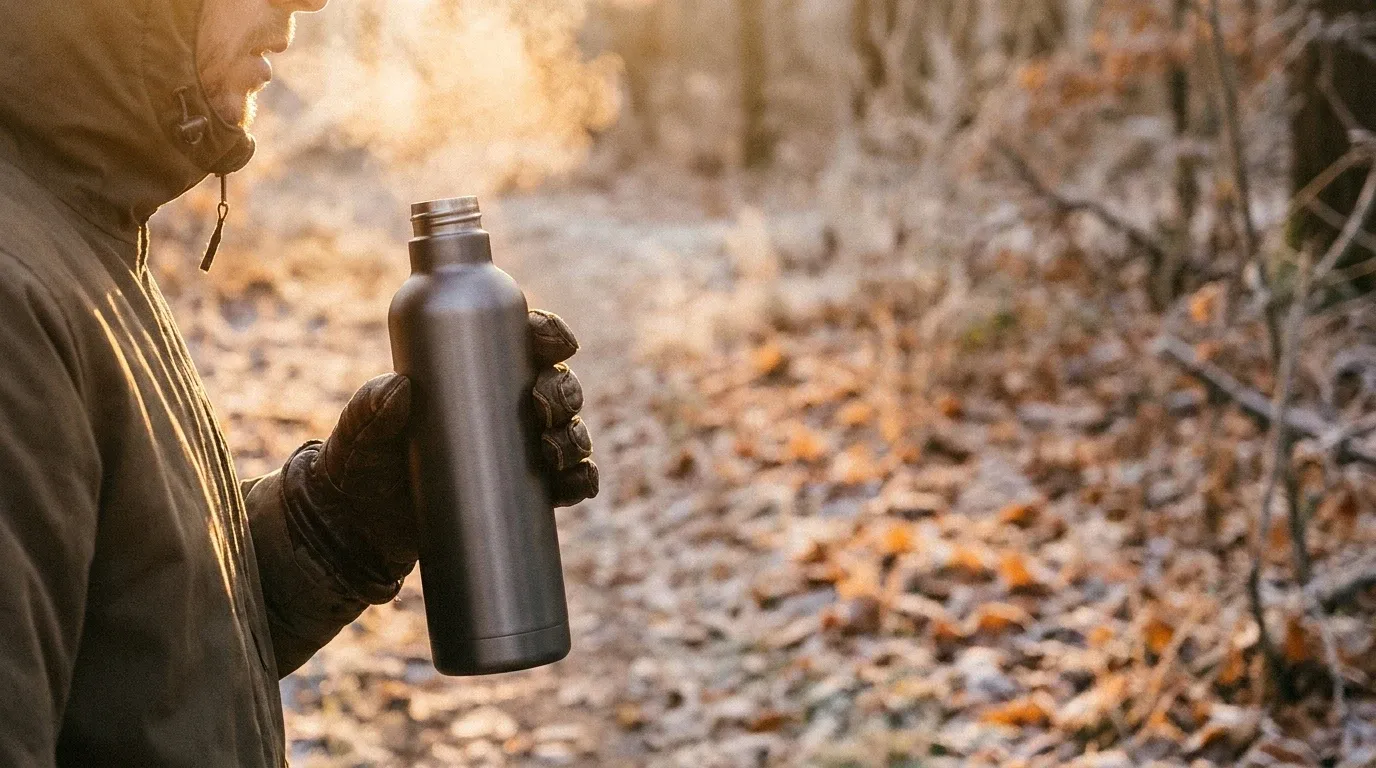
You can actually see this happening. That visible cloud when you exhale in freezing temperatures is water vapor leaving your body. At altitude, where air is even drier, the losses are greater still. Skiers, snowshoers, and high-altitude trail runners are particularly exposed to this effect.
Standard summer hydration plans don't account for respiratory losses because they're built around sweat rate estimation. If you're carrying those plans into winter training without adjustment, you're starting every session with an incomplete strategy. A useful correction: add roughly 300 to 500 ml of fluid to your target intake on cold days to offset baseline respiratory losses, more if you're working at high intensity or elevation.
Electrolyte Balance Shifts in Cold Weather
Hydration isn't just about water volume. It's about what's dissolved in that water, and winter changes the equation on that front too.
In warm conditions, you lose significant sodium through sweat, which is why electrolyte drinks and salt supplementation are emphasized in summer training. In cold conditions, sweat rate drops, so sodium losses through perspiration fall as well. But the picture is more complicated than simply needing less sodium.
Cold exposure triggers a hormonal shift in how your kidneys handle sodium. Specifically, it increases levels of atrial natriuretic peptide (ANP), a hormone released when blood volume increases due to vasoconstriction. ANP signals the kidneys to excrete more sodium, which drags water with it. The result is increased urine output, sometimes called cold diuresis, which accelerates fluid loss through a route that has nothing to do with sweating.
Cold diuresis is particularly pronounced in the first 30 to 60 minutes of cold exposure. Athletes who are bundled up, warm indoors, and then step outside for a session will often feel the urge to urinate fairly quickly. That's fluid leaving the body in a way that a standard hydration plan doesn't anticipate.
The electrolyte takeaway for winter isn't to load up on sodium as you might in a summer marathon. It's to maintain a moderate, consistent electrolyte intake that supports fluid retention without overcorrecting. Hyponatremia, the dangerous condition where sodium drops too low from drinking too much plain water, is actually more common in cold-weather endurance events than many athletes realize, because the baseline sodium context is already altered.
Practical Strategies That Actually Work in Winter
Understanding the mechanisms is useful, but it doesn't do anything for you on a cold morning run unless you have concrete behaviors to fall back on. Here's what the evidence supports.
- Drink on a schedule, not on demand. Set a timer or use distance markers as drinking cues. In cold conditions, your thirst mechanism is not a reliable guide. Aim for 150 to 200 ml every 15 to 20 minutes during activity lasting longer than 45 minutes.
- Use warm fluids to increase compliance. Cold athletes don't want cold drinks. Warm water, warm diluted sports drinks, or herbal teas are not just more comfortable. They're more likely to actually get consumed. Insulated bottles or flasks are worth the investment for outdoor winter sessions.
- Pre-hydrate deliberately. Because cold diuresis is front-loaded, arriving at your session already well-hydrated reduces the early deficit. Drink 400 to 600 ml of fluid with a small amount of sodium in the 60 to 90 minutes before cold-weather training.
- Monitor urine color consistently. Pale straw yellow is still the most practical real-world marker of adequate hydration. Dark yellow or amber is a clear sign you're behind, regardless of whether you felt thirsty.
- Adjust for altitude and wind. Both increase respiratory water loss substantially. If you're skiing, mountaineering, or running in exposed conditions, your fluid targets need to be higher than indoor or low-elevation equivalents.
- Account for layering. Heavy clothing creates a microclimate that can significantly increase sweat rate even in cold conditions. Intense indoor gym sessions in winter gear, cross-country skiing, or heavy-pack hiking can produce sweat losses closer to summer training. Don't assume low temperature equals low sweat.
How Coaches Should Be Thinking About This
If you work with athletes or general fitness clients, winter hydration is a gap worth addressing directly in your programming. Most clients apply summer habits year-round because nobody has told them to do otherwise, and because cold-weather dehydration doesn't trigger the obvious signals that summer dehydration does.
Adding a hydration check-in to your intake process can surface this blind spot early. The same applies to reviewing how your clients perform in winter blocks compared to summer. Unexplained drops in endurance, focus, or recovery quality during cold months may have a hydration component that's easy to miss if you're not looking for it.
This connects to a broader point about how well athletes understand what's actually happening in their bodies. Just as there's often a significant gap between perceived and actual physiology when it comes to supplements (as explored in Longevity Supplements: The Gap Between Hype and Evidence), the assumption that "cold means less hydration needed" is a persistent myth that circulates because it feels intuitively true.
Understanding what training actually does to your body across all conditions, including what training actually does to your heart over time, requires going beyond the obvious signals and building awareness of the mechanisms that aren't immediately visible.
The Winter Hydration Baseline
There's no single formula that applies to every athlete in every cold environment, but there are starting points that are more accurate than the summer defaults most people are using.
A reasonable winter hydration target for a 70 kg (154 lb) athlete engaged in moderate-to-high intensity training is 2.5 to 3.5 liters of fluid per day, with session-specific additions of at least 500 ml per hour of activity in cold conditions. Electrolyte intake should be consistent but moderate: not aggressively salted as in heat, but not plain water throughout, either.
Beyond volume, timing matters. Spreading fluid intake throughout the day rather than drinking large amounts in one go supports better absorption and reduces the urinary losses that come from rapid fluid loading. Pair fluids with small amounts of complex carbohydrates or natural sodium sources (broth, lightly salted foods) around sessions to support fluid retention without over-supplementing.
Winter training is demanding enough without running a hidden hydration deficit. The cold makes it easy to forget this basic requirement, but your performance, cognition, and recovery don't forget. Build the habit before the deficit builds on you.