
A January 2026 GlobeNewswire report projects the global activewear market at $241.8 billion by 2032. That top-line number gets cited in pitch decks and investor memos constantly. But if you're building or funding a fitness apparel brand right now, the headline figure is the least useful part of the report. The real intelligence is in the segmentation.
Where is the growth actually concentrated? Which product categories are pulling ahead? And what does the structural shift in this market mean for independent brands with limited runway? Here's what the data tells you.
The Three Forces Driving Growth
The $241.8B projection rests on three converging drivers: rising global health consciousness, the full normalization of athleisure as a dress code, and accelerating technical innovation in performance fabrics.
Health consciousness is a structural trend, not a cycle. Post-pandemic behavior shifts have proven durable across the US, UK, Canada, and Australia. Gym membership growth, the explosion of home training, and sustained interest in preventive wellness have all expanded the addressable consumer base for activewear well beyond traditional athletic demographics.
Athleisure normalization means the market is no longer constrained by sport participation rates. You don't need to run a marathon to buy $140 running shorts. The consumer buying activewear today is as likely to be wearing it to a coffee meeting as a track session. That behavioral reality has fundamentally reshaped what "the activewear market" actually is.
Technical innovation is the third pillar, and it's where the most interesting competitive dynamics are forming. More on that below.

The Fastest-Growing Segments You Need to Track
The report identifies three high-growth categories that are outpacing the broader market. If you're making product investment decisions, these are the segments worth building toward.
- Smart moisture management and temperature regulation fabrics. Active moisture-wicking technology has matured, but temperature-regulating textiles, fabrics that respond dynamically to body heat and external conditions, are moving from premium niche to mainstream expectation. Brands that are still leading with basic moisture-wicking as a differentiator are already behind.
- Sustainable and recycled performance materials. This is no longer a brand values story. It's a product performance and supply chain story. Recycled nylon and polyester blends have closed most of the performance gap with virgin materials, and consumer willingness to pay a premium for sustainable construction is measurable and growing, particularly in the $80-$200 price tier where most challenger brands compete.
- Gender-inclusive sizing and design architecture. Extended size ranges and genuinely inclusive fits (not just scaled-up standard cuts) are driving meaningful conversion gains for brands that execute them properly. This is an underserved segment with high loyalty potential and relatively low competitive intensity at the premium tier.
The Athleisure Blur Is Now the Product Brief
The performance-to-everyday transition isn't a trend anymore. It's the dominant use case for a large and growing share of activewear buyers. Brands like Rhone, Set Active, and Bandit Running are explicitly designing for this: the product brief isn't "gym only," it's office-to-gym-to-weekend without a wardrobe change.
Rhone's dress pants that double as technical training trousers. Set Active's studio-to-street collections built around color cohesion and clean silhouettes. Bandit Running's positioning around the run commuter and the casual runner who also lives in cities. These aren't compromises. They're deliberate decisions to capture the consumer's entire day, not just the workout hour.
For brands still designing exclusively around peak athletic performance metrics, this represents a positioning gap. The consumer has moved. The question is whether your product roadmap has followed.
This shift also connects to a broader pattern in how fitness integrates into daily life. The same consumer who wants technical apparel that transitions through their day is rethinking training structure, recovery, and nutrition as part of a continuous lifestyle, not a discrete gym session. Understanding this consumer holistically, including how they think about the evolving relationship between fitness coaching and everyday behavior change, gives product teams better briefs than demographic data alone.
Lululemon vs. Vuori: The Market Is Not Monolithic
If you needed one data point to prove that market size doesn't predict brand outcomes, look at the Lululemon-Vuori divergence.
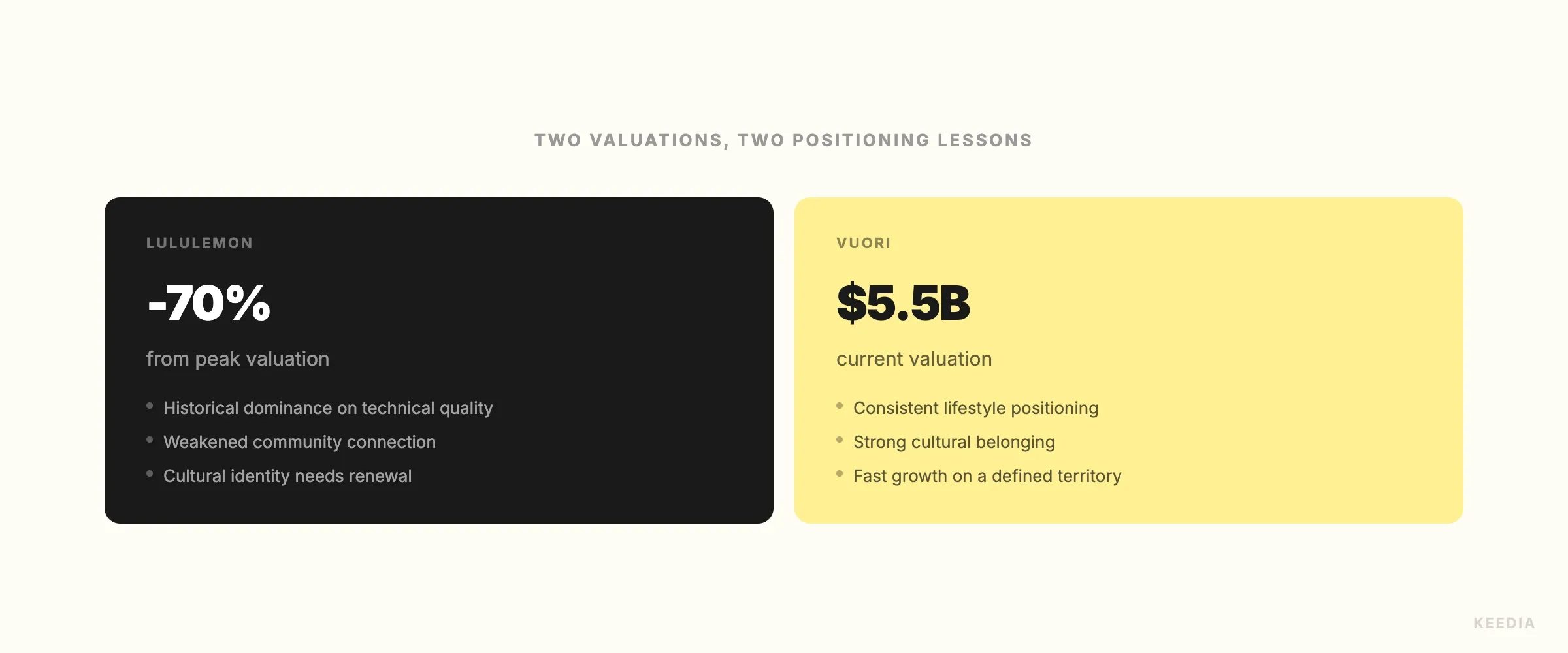
Lululemon is down roughly 70% from its peak valuation. Vuori is valued at $5.5 billion and still growing. Both operate in the same premium activewear market. Both sell leggings and shorts at similar price points. The product quality difference between them is not large enough to explain that valuation gap.
What explains it is positioning, community, and narrative coherence. Lululemon's brand story became diluted as it scaled. Category extension into footwear, accessories, and men's wear created execution drag. Vuori maintained a tighter identity: California-influenced, masculine-leaning without being exclusionary, with a community-first retail strategy that built genuine loyalty.
The lesson for founders and investors is direct: a rising market lifts category awareness, not individual brands. You can operate in the fastest-growing segment of a $241B market and still lose if your positioning isn't differentiated and your community isn't real. This pattern tracks closely to what's happening in adjacent wellness categories. The Q1 2026 consolidation activity in sports supplements shows the same dynamic: large markets, but winner concentration among brands with strong identity, not just distribution.
Wearable Tech Integration Is the Next Decade's Differentiator
The most significant structural shift in the activewear market over the next five to ten years isn't fabric or sustainability. It's the integration of wearable technology directly into apparel.
Fitness trackers embedded in garments. Biometric sensors in waistbands and compression sleeves. AI-powered fabrics that adapt to physiological data in real time. These aren't speculative. Products in early commercial stages already exist, and the development pipeline from both dedicated startups and major athletic brands is substantial.
The companies building this category now will own a defensible position that's extraordinarily difficult to replicate later. Hardware and software integration at the garment level requires material science expertise, manufacturing relationships, data infrastructure, and regulatory navigation. That's a multi-year moat, not a product feature you can add in the next collection cycle.
The consumer appetite is real. A fitness enthusiast who already tracks sleep, HRV, and recovery metrics through a wearable device is a natural buyer for apparel that expands that data picture. The 2025 meta-analysis showing poor sleep cuts strength output by 12% is exactly the kind of finding that makes biometric-integrated apparel a practical tool, not a novelty, for serious training consumers.
The 12-24 Month Window for Independent Brands
Here's the structural reality that should be shaping strategy for every independent activewear brand right now: Nike and Adidas are increasing their investment in smart fabric and wearable tech at scale. Their R&D budgets dwarf anything a challenger brand can deploy. When they arrive in force in the smart apparel category, the differentiation gap closes quickly.
The window is approximately 12 to 24 months. Independent and challenger brands that move now on technical fabric differentiation, particularly in temperature regulation and biometric integration, can establish product credibility, retail presence, and community loyalty before the giants commoditize the category.
This isn't a new pattern. It's the same dynamic that played out in plant-based nutrition, premium recovery tools, and connected fitness equipment. Early movers who built genuine product credibility and community before category saturation created durable positions. Late movers got squeezed. The Les Mills and Life Fitness connected equipment partnership is a useful parallel: large players moving into integrated fitness tech create both competitive pressure and market validation that independent brands can leverage.
The strategic priorities for independent brands with 12 to 24 months of runway on this window:
- Identify one technical category to own. Temperature regulation, biometric sensing, sustainable performance fabrics. Pick the lane where you can build genuine IP or supplier relationships, not just marketing claims.
- Build community before you need it. Vuori's valuation is partly a community asset. That takes time to build and can't be bought. The brands that survive category commoditization are the ones whose customers are advocates, not just buyers.
- Price for the premium tier intentionally. The $80-$200 segment is where technical differentiation commands margin. Racing to compete on price in the mass market puts you directly in Nike and Adidas' strongest position.
- Watch adjacent markets for signals. The adaptogen market's 2026 trajectory shows how wellness-adjacent categories scale when consumer awareness and clinical credibility converge. Apparel brands that can tell a credible performance science story, not just a lifestyle story, will have structural advantages.
What the $241B Number Actually Means for Your Brand
A $241.8 billion market projection is an opportunity statement, not a guarantee. Markets that large attract capital, incumbents, and competition in equal measure. The brands that capture disproportionate share of that growth won't be the ones who cited the projection in their pitch decks. They'll be the ones who read the segmentation data, identified where the structural growth lives, and built product and community strategy around specific defensible positions.
The technical fabric segment is moving fast. The athleisure blur is already the mainstream use case. Wearable tech integration is the next moat. And the window for independent brands to establish credibility before the market consolidates is real, but it's not indefinitely open.
The $241B number tells you the category is worth building in. The segmentation tells you exactly where to build.