
Nike just handed the industry a roadmap. Whether competing brands treat it as a warning or a checklist will determine who holds shelf space in 2027 and who's scrambling to catch up.
The announcements coming out of Nike's pipeline reveal aren't about individual products. They're about a structural reset in how Nike designs, manufactures, and extends its core intellectual property across categories. For every brand competing in performance footwear or athleisure apparel, the strategic implications are immediate.
Tuned Air Is Not a Product. It's a Process Weapon.
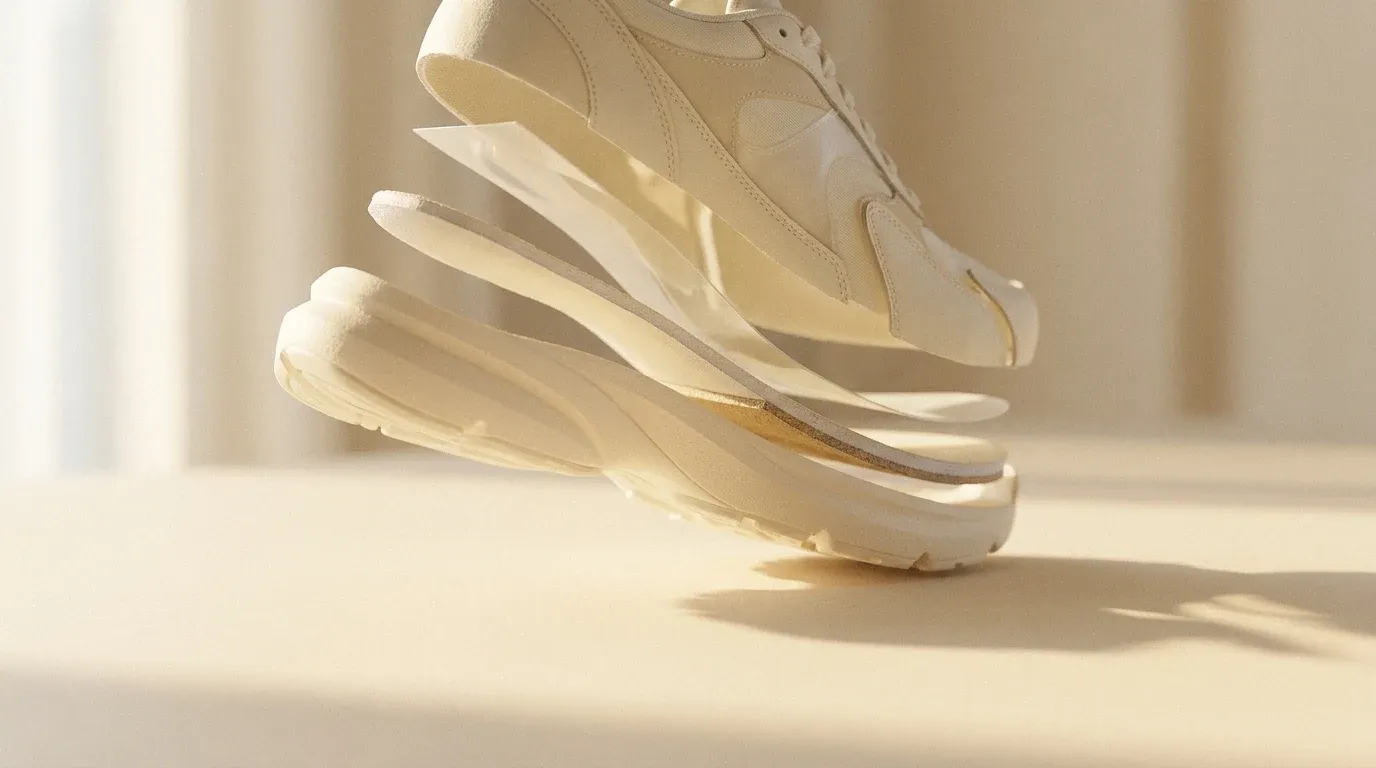
The headline figure from Nike's pipeline is the one that should make competing brand executives uncomfortable: a 70% reduction in development time through Tuned Air, a new manufacturing method that uses digital print and lamination to enable more precise cushion construction within the Air franchise.
To understand why that number matters, consider how challenger brands have competed against Nike over the past two years. On Running, New Balance, and Adidas didn't simply outdesign Nike. They outpaced it. They moved faster from concept to shelf, iterated in response to consumer behavior, and filled the cultural and retail gaps that opened up when Nike's product cycle slowed during its period of organizational restructuring.
Tuned Air closes that window. If Nike can compress its Air platform iteration cycle by 70%, the competitive advantage that speed-to-market challengers have exploited starts to erode. This isn't a single product innovation that can be countered with a competing launch. It's a manufacturing capability that compounds over time.
For mid-tier performance footwear brands, the strategic question isn't whether Tuned Air produces better shoes. It's whether your own development pipeline can keep pace with a Nike that's operating at a fundamentally different speed.
Project Ride and Nike Morpho X: Reclaiming Lost Ground in Sportswear
Nike's pipeline also includes two new footwear platforms, Project Ride and Nike Morpho X, both aimed squarely at the sportswear segment. That's not a coincidence. It's an admission.
Over the past two years, Nike has ceded meaningful ground in lifestyle and casual performance footwear. New Balance's 990 and 1906 families, Adidas's Samba and Gazelle resurgence, and On Running's expanding crossover appeal have collectively pulled consumers, particularly in the 18-35 demographic, away from Nike's heritage silhouettes.
Project Ride and Morpho X appear designed to re-enter that conversation with platforms built on updated materials and construction, rather than relying on retro reissues or archive silhouettes. The distinction matters. Retro product cycles are inherently finite. New platforms, if they land, can sustain commercial momentum for three to five years.
For Adidas, New Balance, and On in particular, the response isn't to panic. It's to deepen. The cultural equity those brands have built in sportswear over the past 24 months isn't erased by a Nike announcement. But it does require active maintenance through community investment, storytelling, and product consistency that a larger competitor can't easily replicate at scale.
Therma-FIT Air: When Footwear IP Becomes an Apparel Platform
The move that may carry the longest strategic tail isn't in footwear at all. Nike's commercial launch of the Therma-FIT Air jacket extends the Air platform from cushioning technology into insulated apparel, using trapped-air technology to deliver lightweight warmth.
This is a category expansion play built on established brand IP, and it's a structurally different kind of threat. Nike isn't entering a new apparel category cold. It's entering with a platform consumer already associate with performance credibility and 40 years of marketing investment behind a single word: Air.
For apparel-first brands competing in the insulated performance outerwear space, including Arc'teryx at the premium end, Patagonia in the values-led segment, and Columbia in the mid-market, the competitive pressure isn't necessarily about product specs. It's about narrative. When a consumer stands in front of a wall of insulated jackets and one of them carries the Air name, the brand recognition asymmetry is real.
The broader signal here is that Nike is moving toward a multi-category defense of its core IP. Brands that compete with Nike in one category now need to monitor how that IP migrates into adjacent ones. As the fitness equipment market approaches $19.5B by 2030, cross-category brand expansion is becoming a defining strategic axis for the largest players, and Nike's Therma-FIT Air move is a clear example of how that works in practice.
The Turnaround Fatigue Problem Nike Still Has to Solve
None of this lands cleanly without acknowledging the credibility gap Nike is still carrying. The company has cycled through multiple leadership and strategy pivots in a compressed window. That's created what analysts and retail partners have started calling turnaround fatigue: a market skepticism that separates innovation claims from actual execution.
The pipeline announcements are real. The manufacturing capabilities appear substantive. But in an industry where sell-through data speaks louder than press cycles, Nike's 2027-28 pipeline will ultimately be judged by whether these platforms move product at full price in competitive retail environments, not by what gets announced on a stage.
For competing brands, that gap is itself a strategic opportunity. The window between Nike's announcement and its execution is where positioning work happens. Retailers, buyers, and consumers are still forming their impressions of what Nike's next chapter actually looks like. Brands that show up with consistent sell-through, tight storytelling, and reliable product cycles during this window are building credibility that persists even after Nike's pipeline fully deploys.
This dynamic mirrors patterns playing out across the broader fitness industry. Just as Noom's pivot to enterprise and hardware created a credibility test that the market will evaluate through retention data rather than launch momentum, Nike's turnaround will be measured in quarterly sell-through, not quarterly announcements.
The 70% Figure: Why It's the Number That Changes Strategy
Return to the development time reduction, because it deserves more than a headline mention. A 70% compression in development cycle time, if consistently realized across Nike's Air platform portfolio, produces compounding effects that are easy to underestimate at the announcement stage.
Consider what a standard footwear development cycle looks like for a mid-size performance brand. From concept to commercialization, 18 to 24 months is common. For Nike, the same cycle on Air-based products may now run closer to six to eight months. That means Nike can respond to a competitor's market success, observe consumer behavior, adjust its platform, and have a counter-product in retail within a window that most brands can't even complete an internal brief in.
The practical implication is this: if you're a brand that has gained shelf space because Nike was slow, that protection is diminishing. The product-cycle window that challengers have used to earn retail placement and consumer attention gets meaningfully smaller when Nike is operating at this tempo.
The strategic response for competing brands falls into two paths. The first is to accelerate your own proprietary material platform development. This is capital-intensive and takes time, but it's the only structural answer to a structural threat. Brands that are still relying on third-party cushioning systems or commodity materials don't have a defensible position when Nike is iterating its own IP at speed.
The second path is differentiation where manufacturing scale doesn't apply. Community infrastructure, coaching ecosystems, hyper-local retail experiences, and brand values that require genuine cultural investment rather than budget. These are areas where a brand with $500M in revenue can compete with one that has $50B, because the asset isn't production capacity. It's trust and specificity. The same principle applies across the fitness industry: as we've covered in the fitness trends shaping 2026, consumer loyalty increasingly flows toward brands that demonstrate consistent presence in a person's actual life, not just in their marketing feed.
What Competing Brands Should Be Auditing Right Now
Nike's pipeline announcements give every competing brand a concrete reason to run a development cycle audit in the next 90 days. Here's what that audit should examine:
- Development cycle benchmarks: Where does your brand sit relative to a 6-to-8-month concept-to-shelf timeline? If the honest answer is 20 months, that's a structural vulnerability, not a process quirk.
- Proprietary material IP: Does your brand own or exclusively license a materials platform that Nike cannot quickly replicate or position against? If not, what's the investment roadmap to get there?
- Retail relationship depth: Are your key retail partners carrying your product because of genuine sell-through performance, or because Nike left a gap? The latter is a temporary position.
- Category adjacency exposure: If Nike extends Air further into performance apparel, training gear, or recovery products, which of your revenue lines are directly in that path?
- Community differentiation: What does your brand own culturally that Nike's budget cannot simply purchase? This is worth identifying explicitly, because it's your most defensible asset in a manufacturing-speed competition.
The brands that treat Nike's 2027-28 pipeline as a distant concern are the ones most likely to find themselves reactive in 2026. The brands that treat it as an immediate strategic signal and use the next 12 months to consolidate their differentiation have a real opportunity to hold and extend their position, even as Nike accelerates.
As the competitive dynamics across fitness and wellness continue to consolidate around a smaller number of dominant platforms, the strategic calculus for mid-tier brands is increasingly clear. Scale with intention, differentiate where budget cannot follow, and move faster than your current process allows. Nike just made the last point non-negotiable. For more on where brand strategy is heading across adjacent verticals, the analysis on Planet Fitness's $360M revenue expansion playbook illustrates how structured operational discipline converts market size into durable competitive position.